The consumption of localized media in Scotland requires an understanding of how distinct territorial boundaries, historical industrial changes, and modern digital consolidation shape the flow of regional information. The East End of Glasgow represents a specific demographic and geographical entity with distinct communication channels, independent media outlets, and hyper-local reporting structures. Individuals tracking news developments within this specific sector must navigate a complex ecosystem of traditional print journalism, digital regional hubs, and independent civic publications.
- What is the Geographic and Demographic Scope of East End News in Glasgow?
- Which Media Outlets Publish East End News in Glasgow?
- How Did Industrial Deindustrialization Shape the History of East End Media?
- What Types of Stories Dominate East End News Coverage?
- How Can Residents Access Public Notices and Planning Applications?
- What Role Do Housing Associations Play in Disseminating Local News?
- How Are Digital Platforms and Social Media Altering News Delivery?
- What Impact Does the People Make Glasgow Communities Scheme Have?
- How Reliable Are Local News Sources in the East End of Glasgow?
- What Are the Key Communication Channels for Emergency News?
- How Does the East End News Landscape Influence Property and Business Decisions?
What is the Geographic and Demographic Scope of East End News in Glasgow?
The East End of Glasgow encompasses specific electoral wards, residential communities, and regeneration zones located east of the city centre, housing a population of over 150,000 residents who rely on targeted local news distribution network systems.
Understanding this localized media sector requires an explicit definition of the geographic boundaries that dictate news coverage. The East End is bounded by the north bank of the River Clyde to the south, the city boundary with North and South Lanarkshire to the east, and the M8 motorway corridor to the north. Hyper-local news reporting covers prominent neighborhoods, which include Dennistoun, Bridgeton, Calton, Gallowgate, Shettleston, Parkhead, Tollcross, and Easterhouse.
Demographically, these territories are defined within the frameworks of the Scottish Index of Multiple Deprivation (SIMD), published by the Scottish Government. The data records significant pockets of historic socioeconomic deprivation alongside rapidly gentrifying urban zones, such as the continuous residential developments across the Clyde Gateway regeneration zone. Local news reporting reflects this duality, balancing reporting on structural poverty, public health initiatives, and community-led infrastructure projects with coverage of real estate changes and commercial developments.
Which Media Outlets Publish East End News in Glasgow?
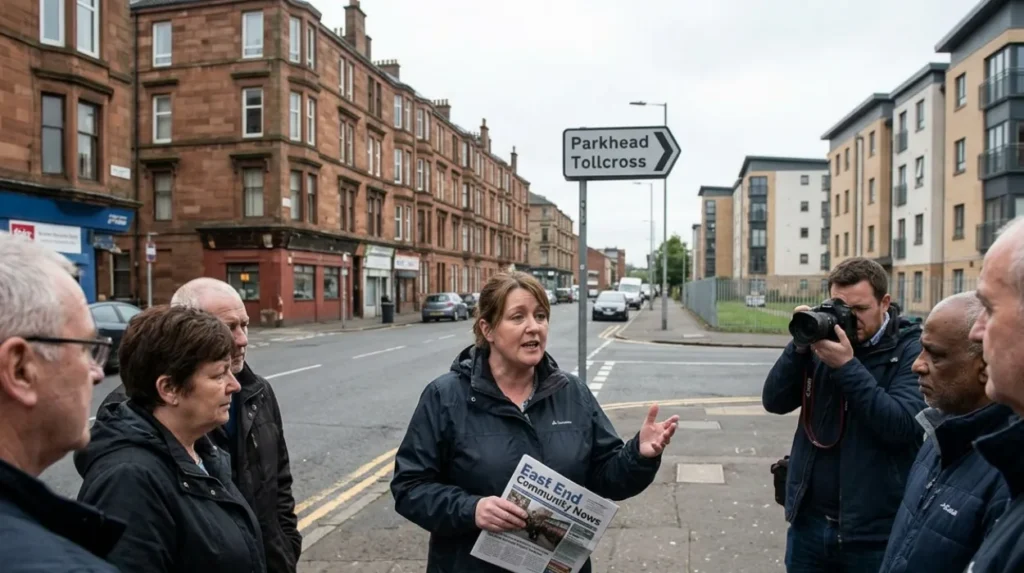
Local news covering the East End of Glasgow is published by a combination of major regional daily titles, digital news portals, and independent community media operations that actively monitor hyper-local council decisions, criminal courts, and civic activities.
The media landscape of Glasgow is structurally tiered, ensuring that East End news is distributed across several competing platforms. The primary publication dedicating specific resources to this geographical zone is the Glasgow Times, a daily newspaper owned by Newsquest Media Group. The publication maintains a dedicated digital section specifically categorized for East End news, covering localized police incidents, planning applications submitted to Glasgow City Council, and community interest stories.
In addition to major daily publications, alternative print and digital operations provide extensive coverage. Glasgow Live, a digital-only publication owned by Reach plc, utilizes hyper-local targeting to deliver real-time traffic updates, public safety warnings, and business opening announcements relevant to East End residents. Independent community journalism also plays a critical role through publications such as The Glasgow Bell and targeted neighborhood newsletters managed by local housing associations, such as the Milnbank Housing Association in Dennistoun and the Parkhead Housing Association. These organizations document localized planning disputes, community asset transfers, and third-sector charitable initiatives.
How Did Industrial Deindustrialization Shape the History of East End Media?
The history of East End media mirrors the broader economic transformation of the region from a global heavy engineering hub to a post-industrial services economy, shifting news focus from labor movements to urban regeneration.
During the nineteenth and early twentieth centuries, the East End of Glasgow served as the industrial engine of the city, driven by manufacturing, textile production, and heavy engineering firms, such as the Parkhead Forge steelworks owned by William Beardmore and Company. Media coverage during this historical epoch was heavily dominated by labor politics, trade union organization announcements, and industrial safety reports. Local printing presses and radical political pamphlets frequently circulated throughout Bridgeton and Calton, documenting the activities of the Independent Labour Party and early socialist movements in Scotland.
The comprehensive deindustrialization of the region during the latter half of the twentieth century led to the closure of major employer hubs, causing sharp population declines and systemic economic challenges. Consequently, the structural focus of local journalism shifted significantly. Media coverage from the 1980s onward transitioned from documenting industrial output and labor strikes to reporting on state-sponsored urban regeneration initiatives, housing stock transfers, and public health investigations. Modern news reporting continually references this industrial heritage when analyzing contemporary land-use decisions, such as the transformation of contaminated former industrial sites into modern residential complexes.
What Types of Stories Dominate East End News Coverage?
News coverage within the East End of Glasgow focuses systematically on five primary thematic categories, which include public safety incidents, infrastructure regeneration projects, municipal planning, local football updates, and third-sector community initiatives.
Public safety and emergency services reporting constitute a significant percentage of daily digital news traffic. Outlets systematically monitor statements from Police Scotland regarding localized crimes, traffic accidents, and judicial proceedings at the Glasgow Sheriff Court. For example, recent prosecutions handled by the Crown Office and Procurator Fiscal Service (COPFS) regarding large-scale illicit distribution hubs operating out of warehouses in the East End feature prominently in regional crime reporting.
Urban regeneration and municipal planning represent another major thematic pillar. News platforms track the multi-million-pound investments channeled through Clyde Gateway, a urban regeneration company established in 2008 by the Scottish Government, Glasgow City Council, and South Lanarkshire Council. Journalism in this sector focuses on large-scale housing developments, such as the approved masterplans for hundreds of homes in Shawfield and Bridgeton, alongside tracking the commercial expansion of high-growth sectors including clean energy and advanced manufacturing.
A third dominant category is sporting and cultural news tied directly to local identity. The East End houses Celtic Park, the stadium of Celtic Football Club, located in the Parkhead district. News media frequently report on the logistical, infrastructural, and public safety implications of major sporting events, including municipal traffic closures, large-scale public fan gatherings in areas like the Trongate and Gallowgate, and the economic impact of match-day crowds on local retail and hospitality businesses.
How Can Residents Access Public Notices and Planning Applications?
Individuals seeking official public notices, licensing changes, and statutory planning updates for the East End must utilize the automated planning portals maintained directly by Glasgow City Council.
Statutory news and legal notifications regarding changes to the built environment are published through formal administrative channels rather than standard commercial news feeds. Glasgow City Council operates an online Planning and Building Standards portal where all applications for physical development, demolition, and tree preservation orders within East End wards must be registered for public consultation. This system categorizes applications by specific geographic wards, such as the Dennistoun ward and the Calton ward.
Public notices regarding road closures, temporary traffic regulation orders (TTROs), and alcohol licensing applications are published weekly in the public notices sections of local printed media, primarily the Glasgow Times, in accordance with statutory requirements set out in the Town and Country Planning (Scotland) Act 1997. These notices provide precise geographical data, operational timelines, and formal mechanisms for residents to submit expressions of support or formal objections to the local authority.
Explore More Area Guide
Historic Shawfield Stadium Demolished For 450 New Homes, Rutherglen 2026
Celtic FC in Glasgow: History, Stadium, Success, and Local Identity
What Role Do Housing Associations Play in Disseminating Local News?
Housing associations operating across the East End act as critical hyper-local media nodes, publishing specialized newsletters, performance reports, and community interest stories that directly reach thousands of tenants.
Due to the unique historical development of social housing in Glasgow following the mass demolition of traditional tenements in the mid-twentieth century, community-controlled housing associations manage significant portions of the residential property market in the East End. Notable institutions include the West of Scotland Housing Association, Thenue Housing Association, and Tollcross Housing Association. These organizations function as highly localized information distributors within their specific operational boundaries.
The information disseminated by these associations focuses on critical tenant matters, including rent structure consultations, property maintenance schedules, energy efficiency upgrading programs, and localized welfare rights advice. By distributing printed quarterlies and maintaining localized digital noticeboards, housing associations fill the information gap left by the consolidation of commercial regional newspapers, ensuring that low-income households and elderly demographics retain access to critical community news.
How Are Digital Platforms and Social Media Altering News Delivery?
Digital delivery models, hyper-local Facebook groups, and independent digital publishers have decentralized the distribution of East End news, reducing reliance on traditional daily print newspapers.
The structural consolidation of regional journalism under major media conglomerates has accelerated the transition toward digital-first and digital-only information ecosystems. Neighborhood-specific digital forums, such as localized community council pages and independent resident groups on social media platforms, frequently break hyper-local news regarding utility outages, road traffic collisions, and micro-level criminal activities before traditional newsrooms can verify and publish the data.
This digital shift has also enabled the rise of specialized independent digital media platforms. Outlets such as The Glasgow Bell focus on long-form investigatory journalism, tracking complex municipal issues such as tax avoidance schemes, commercial property fires in the city centre, and the structural preservation of historic local landmarks like the Glasgow Necropolis. These digital platforms rely on subscription models, reader donations, and targeted local advertising, presenting an alternative to the high-density advertising and algorithmic click-bait models often found on large corporate news sites.
What Impact Does the People Make Glasgow Communities Scheme Have?
The People Make Glasgow Communities scheme alters the local news landscape by facilitating the transfer of public assets to community groups, generating significant civic news coverage regarding local governance.
The People Make Glasgow Communities (PMGC) program was launched by Glasgow City Council to allow local community organizations, charities, and third-sector groups to take over the operational management or ownership of municipal venues, sports facilities, and community centers. News reporting within the East End regularly tracks the progress, approvals, and operational outcomes of these asset transfers, highlighting shifts in local civic governance.
A prime example of this mechanism in action is the approved 25-year lease of the Bluevale Neighbourhood Centre in Dennistoun to the Bluevale Community Club, a local charity providing holistic support, sports provisions, and addiction recovery services across the East End. News outlets extensively document these regulatory transitions, detailing the financial structures, lease costs, and community feedback associated with transferring assets from arms-length external organizations, such as Glasgow Life, to localized grassroots operators.
How Reliable Are Local News Sources in the East End of Glasgow?
The reliability of news information concerning the East End depends on the regulatory compliance of the publishing outlet with established journalistic standards bodies and official public record repositories.
Commercial print publications and their associated digital properties, including the titles managed by Newsquest Media Group and Reach plc, are legally regulated by the Independent Press Standards Organisation (IPSO). These newsrooms operate under the strict guidance of the Editors’ Code of Practice, which mandates factual accuracy, the opportunity for reply, and distinct boundaries between speculative reporting and verified fact. Readers can verify corporate compliance and view official corrections logs directly via the IPSO regulatory portal.
For historical data, statistical trends, and legal records, primary source verification remains the most reliable mechanism. Crime statistics are systematically logged and published by Police Scotland via quarterly performance reports broken down by local area commands. Similarly, demographic trends, life expectancy metrics, and economic data are maintained by National Records of Scotland (NRS) and the Glasgow Centre for Population Health (GCPH). Utilizing these primary institutional resources allows researchers, residents, and strategists to bypass sensationalized commercial framing and access objective data.
What Are the Key Communication Channels for Emergency News?
Emergency news regarding severe weather, major traffic accidents, and active public safety incidents in the East End is channeled through real-time digital notification networks operated by statutory public services.
During critical public safety incidents, traditional print media and daily news sites do not provide the real-time velocity required for immediate civic coordination. Statutory emergency communication is led directly by the corporate communications divisions of public utility providers and emergency services. Police Scotland utilizes its official regional digital communication feeds to issue immediate public safety instructions, missing person appeals, and localized traffic diversions during ongoing incidents.
| Organization | Information Domain | Primary Communication Channel |
| Police Scotland | Public safety alerts, criminal incidents, missing persons | Verified social media channels, official press portal |
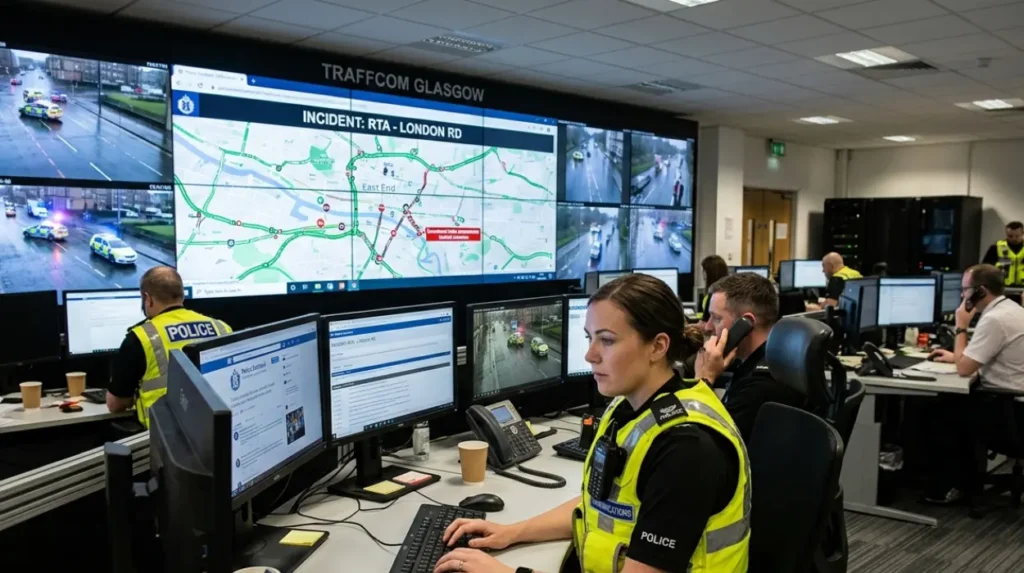
| Glasgow City Council | Emergency road closures, school closures, waste disruptions | TRAFFCOM alerts, corporate digital newsroom |
| Scottish Water | Water main bursts, supply outages, localized flooding | Automated postcode tracker, digital service updates |
| SP Energy Networks | Electrical grid failures, power outages, substation maintenance | Live power outage map, SMS text notification alerts |
Municipal infrastructure emergencies, such as severe localized flooding or structural damage to major transportation routes, are managed via Glasgow City Council’s TRAFFCOM system. This traffic management network feeds real-time updates directly to regional transport operators, satellite navigation systems, and dedicated digital traffic news desks. For localized utility emergencies, such as water main bursts affecting dense residential zones in Parkhead or Shettleston, Scottish Water maintains an online automated postcode tracking system that provides hourly resolution updates regarding repair timelines and mitigation measures.
How Does the East End News Landscape Influence Property and Business Decisions?
Monitoring local media feeds provides commercial investors and property buyers with critical predictive data regarding infrastructure investments, zoning changes, and localized economic trends.
The continuous stream of news documenting the East End provides crucial market intelligence for stakeholders assessing the regional political economy. Investors monitor local news to track the progression of strategic development frameworks (SDFs) enacted by the local authority. For instance, news regarding council initiatives to increase “drug litter patrols” near safe consumption facilities or targeted funding to save local libraries provides direct insight into the civic health and operational priorities of specific neighborhoods.
Furthermore, corporate closures and commercial relocations reported in local business sections serve as leading indicators of macroeconomic shifts within specific sub-markets. News regarding the administration and liquidation of major manufacturing firms, retail giants, or independent hospitality institutions directly impacts employment statistics and local commercial property vacancy rates. By synthesizing coverage from real estate announcements, planning approvals, and third-sector asset transfers, businesses and prospective residents can construct accurate risk profiles prior to deploying capital within the Glasgow market.
What area does “East End of Glasgow” cover?
The East End includes areas such as Dennistoun, Bridgeton, Calton, Gallowgate, Parkhead, Shettleston, Tollcross, and Easterhouse. It lies east of Glasgow city centre and is part of major regeneration zones like Clyde Gateway.