Key Points
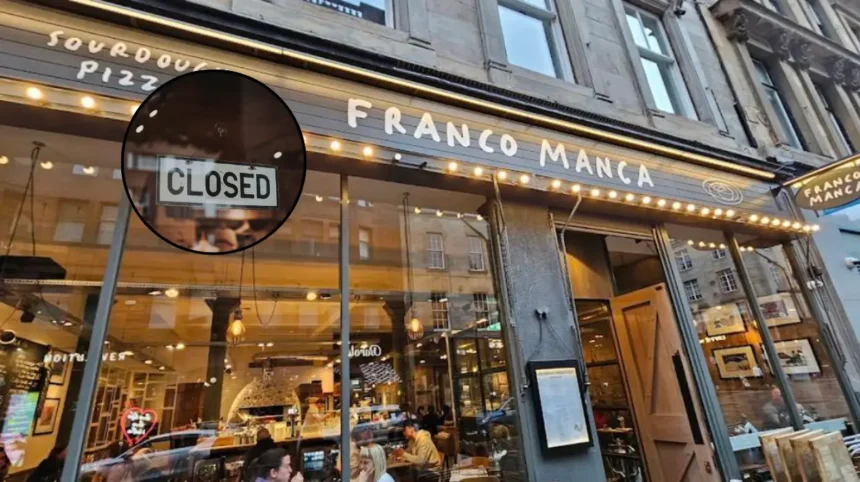
- Branch Closure Confirmed: The Franco Manca Neapolitan pizza branch located on Mitchell Street in Glasgow city centre has confirmed its final day of operation will be Sunday, May 24, 2026.
- National Downsizing: Parent company The Fulham Shore is shutting down 16 of its roughly 70 UK locations after securing necessary creditor approval.
- Mass Redundancies: The financial restructuring strategy will impact approximately 225 jobs across the United Kingdom.
- Company Voluntary Arrangement (CVA): The business entered into a CVA mechanism to restructure its debt and operational footprint under advice from financial restructuring specialists.
- Severe Economic Pressures: Corporate executives directly blamed disproportionately high UK VAT rates, minimum wage hikes, increased national insurance contributions, and an absence of targeted high-street business rates relief.
- Creditor Backing: The survival plan received a decisive endorsement, with more than 90 per cent of voting creditors backing the CVA proposal.
Glasgow (Glasgow Express) May 19, 2026 – The high street hospitality sector has suffered another contraction as the management behind the Glasgow city centre branch of sourdough pizza chain Franco Manca officially confirmed it will cease trading permanently at the end of the current week. The Mitchell Street site has been designated as one of 16 underperforming branches to be shuttered across the United Kingdom after its parent firm, The Fulham Shore, finalised a Company Voluntary Arrangement (CVA) corporate restructuring process aimed at stabilizing the wider brand.
- Key Points
- What Message Did Franco Manca Management Share With Its Scottish Customers?
- How Did Systemic Economic Pressures Force A Leading Pizza Brand Into Financial Restructuring?
- What Did The Chief Executive Say About UK Tax Burdens And Labour Overhead Hikes?
- Which Other Franco Manca Branches Face Closure Across The UK Retail Landscape?
- What Do the Financial Administrators and Corporate Advisers Say About the Survival Plan?
- Was the Restructuring Process Deemed a Success by Financial Advisers?
- Background of the Restructuring and the Hospitality Tax Crisis
- Prediction: How This Development Can Affect Consumers and the Hospitality Sector
- How Will This Affect the Hospitality Workforce?
- How Will This Affect High Streets and Commercial Landlords?
As reported by Caroline Baldwin of The Caterer, the 16 selected locations represent a minority portion of Franco Manca’s nationwide estate of approximately 70 venues. The formal restructuring vote, which concluded earlier this month, received over 90 per cent backing from voting creditors, granting the business the explicit legal mandate to proceed with the closures. However, the operational downsizing means that roughly 225 workers are facing redundancy across the country as the brand scales back its physical footprint.
What Message Did Franco Manca Management Share With Its Scottish Customers?
The local team operating the Mitchell Street site reached out directly to their customer base via a digital announcement to confirm the exact timeline of the departure. In an official email correspondence dispatched to regional subscribers, the Glasgow staff stated:
“We’ve got some sad news – our Franco Manca in Glasgow is closing this Sunday (May 24). It’s been a joy serving you, and we’re genuinely grateful for every visit, every slice, and every bit of support you’ve shown us over the years. We’d love to see you for one last slice this week.”
The communication confirmed that the closure marks the end of the brand’s immediate physical presence in the heart of Glasgow, leaving fans of the Neapolitan sourdough specialist with only a few days to visit the city centre location.
How Did Systemic Economic Pressures Force A Leading Pizza Brand Into Financial Restructuring?
The corporate decision to dismantle a portion of the restaurant portfolio comes amidst vocal criticism from company directors regarding the legislative and fiscal environment governing British hospitality.
As reported by Felix Armstrong, Retail Reporter for City AM, the leadership team at The Fulham Shore pointed squarely at compounding overheads, specifically noting that even well-regarded brands are experiencing critical financial stress due to external fiscal factors.
What Did The Chief Executive Say About UK Tax Burdens And Labour Overhead Hikes?
As reported by Kieran Howells of Grocery Gazette, Marcel Khan, the Chief Executive Officer of The Fulham Shore, clarified that the targeted closures were an unavoidable commercial reality forced by a combination of statutory cost increases and uncompetitive tax policies. Khan stated:
“Even restaurant businesses that are doing all the right things from a customer and operational perspective are not immune to widely publicised pressures impacting the hospitality industry. This includes significant increases in national insurance and the national living wage in recent history, as well as a lack of business rates relief for the restaurant sector and disproportionately high VAT in the UK compared with Europe.”
As further detailed by Robert Rowlands, Deputy Editor for Money and Lifestyle at Aberdeen Live, the executive management team argued that the legislative cost increases enacted during the spring fiscal adjustments added an unsustainable financial burden onto physical high street establishments. Khan added:
“As a result of these external cost pressures, we have to make sure that we are putting our business on a sustainable footing for long-term growth and development. This is why we have taken the difficult decision to undertake a CVA for Franco Manca, which will see a minority proportion of our restaurants closing where they are no longer sustainable in this cost environment. We are deeply saddened by the closures of a minority proportion of our restaurants, and will support our affected team members throughout this process in every way that we can.”
Which Other Franco Manca Branches Face Closure Across The UK Retail Landscape?
While the loss of the Mitchell Street site directly impacts the Scottish high street, the restructuring process is heavily concentrated across England, particularly hitting the capital.
As reported by Charlotte Smith of the Daily Express, industry analysts noted that roughly half of the 16 targeted pizzerias are situated within Greater London, including the brand’s historically significant “home” venue where its commercial journey began.
According to data verified by The Caterer, the legally approved list of closing Franco Manca branches spans across the following 16 locations:
- Scotland: Glasgow (Mitchell Street)
- London Region: Battersea, Brixton (Atlantic Road), Broadway Market, Chiswick, Kilburn, New Oxford Street, Stoke Newington, and Tottenham Court Road.
- English Regions: Bishops Stortford, Bromley, Cheltenham, Didsbury, Hove, Lincoln, and Plymouth.
The inclusion of the Brixton site raised notable attention within the food sector. Franco Manca originally launched its concept in Brixton Market in 2008 before relocating to a nearby site on Atlantic Road in 2024. The closure of this specific area represents a total withdrawal from the location that birthed the brand’s Neapolitan sourdough concept.
Explore More City Centre News
The Raven sports bar makeover in Glasgow ahead of Scotland World Cup 2026
Ruby Hotels Plan for West Nile St, Glasgow City Centre 2026
What Do the Financial Administrators and Corporate Advisers Say About the Survival Plan?
The execution of the structural overhaul was orchestrated by corporate restructuring specialists from the multinational professional services firm Alvarez & Marsal, who were originally brought in by the board in February to review strategic paths, including a potential sale.
Was the Restructuring Process Deemed a Success by Financial Advisers?
As reported by Caroline Baldwin of The Caterer, Paul Berkovi, Managing Director of Alvarez & Marsal, expressed confidence that the high turnout and positive vote from the firm’s creditors would provide the remaining estate with a stable foundation. Berkovi stated:
“Today’s vote saw a significant majority of the company’s creditors support the CVA, reflecting constructive engagement across stakeholders. Against a challenging backdrop for the sector, this is an important step for Franco Manca, enabling the business to complete its financial restructuring and secure the platform for its operational transformation.”
Corporate ownership noted that by legally severing the underperforming lease agreements through the CVA mechanism, the remaining 54 restaurants can receive higher capital investment to protect long-term market market share.
Background of the Restructuring and the Hospitality Tax Crisis
The financial difficulties materialising at Franco Manca follow a significant shift in corporate ownership and a rapidly deteriorating macroeconomic climate for casual dining operators across Britain.
In 2023, The Fulham Shore—which also owns and operates the 28-strong Mediterranean casual dining chain, The Real Greek—was acquired in a private take-private transaction valued at £93.4 million.
The acquisition was executed by the prominent Japanese foodservice conglomerate Toridoll Holdings, with corporate backing from the specialised hospitality investment vehicle Capdesia.
Despite substantial international backing and operational improvements over the past 24 months—including recorded increases in customer loyalty metrics, visit frequencies, and workforce productivity—the group could not escape the compounding fiscal pressures on the high street.
Restaurant owners have frequently lobbied the UK Treasury for structural reforms, pointing out that UK hospitality businesses face a 20 per cent VAT rate on hot food, which is substantially higher than the reduced rates applied to restaurants in various European Union jurisdictions.
Furthermore, the industry has expressed frustration over targeted government interventions. Chancellor Rachel Reeves previously introduced an emergency mitigation package worth approximately £300 million intended to shield independent pub operators from escalating business rates. However, this relief explicitly excluded high street restaurants and hotel operators.
Franco Manca’s issues mirror broader industry trends. Recently, John Vincent, the co-founder of the healthy fast-food brand Leon, reassumed control of his firm and instantly announced the closure of 20 sites.
As reported by Felix Armstrong of City AM, Vincent publicly warned that state-imposed fiscal measures were severely damaging the high street ecosystem, stating:
“The high street is dead… This is not the market that’s doing this. This is the government. It’s not the consumer that doesn’t want to eat in restaurants.”
Prediction: How This Development Can Affect Consumers and the Hospitality Sector
The operational retrenchment of Franco Manca is highly likely to trigger a multi-layered ripple effect across distinct segments of the public, specifically local consumers, the regional workforce, and the broader commercial property landscape in Glasgow.
For city centre consumers in Glasgow, the departure of the Mitchell Street branch diminishes the variety of affordable, mid-tier casual dining options within the urban core.
As major corporate chains retrench, consumers will likely face reduced physical accessibility to established brands, potentially leading to a higher concentration of independent, localized operations or, conversely, empty retail units that lower footfall in shopping districts.
How Will This Affect the Hospitality Workforce?
For the hospitality workforce, the immediate impact is a heightened state of job insecurity and increased competition within the regional labour market. With 225 redundancies occurring simultaneously across the country, displaced kitchen staff, front-of-house workers, and site managers will flood local job markets at a time when competing restaurant groups are similarly freezing recruitment or downscaling operations to cope with increased National Insurance contributions and minimum wage mandates.
How Will This Affect High Streets and Commercial Landlords?
For commercial landlords and urban planners, this development signals a prolonged softening of retail property values. The rejection of existing leases via CVAs leaves major landlords with vacant, specialized restaurant units that are expensive to reconfigure. This will likely force property owners to offer significant rent concessions or longer rent-free periods to attract new tenants, ultimately altering the economic viability of high-street commercial developments across the UK.