Key Points
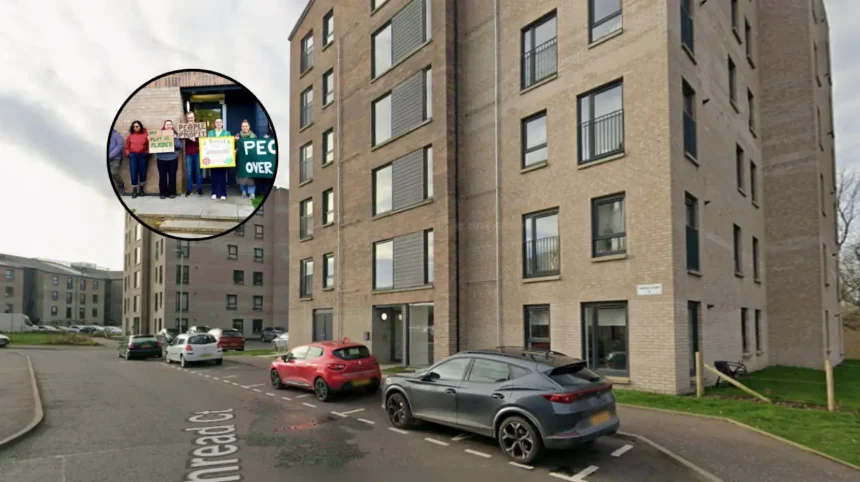
- Residents at Thread Court in Bridgeton say disabled tenants have been left unable to leave their flats because the building lift has been out of action since a flood on February 10 caused by a burst pipe.
- Tenants met landlord Touchstone, a subsidiary of housing association Places for People, on Thursday, May 14, over concerns about the broken lift and rent hikes.
- Residents and Living Rent members allege that attempts to contact the landlord about ongoing building problems have been ignored.
- Touchstone has apologised for poor communication and says the lift is due to be working again on Friday, May 16.
- The landlord says compensation and support for tenants with additional needs are being considered on a case-by-case basis.
- One disabled tenant, Keira Thorburn-Scott, said she had recently been unable to leave her flat for seven days because of pain and the lack of lift access.
Glasgow (Glasgow Express) May 16, 2026 – Residents in Glasgow’s east end say disabled tenants at Thread Court in Bridgeton have been left effectively trapped in their homes after a lift broke following a flood caused by a burst pipe, with the landlord now apologising and saying repairs are due to be completed today.
What happened at Thread Court?
As reported by Glasgow Live, residents at Thread Court met with landlord Touchstone on Thursday, May 14, to raise concerns about the lift, which has been out of service since February 10 after a flood linked to a burst pipe.
The meeting also covered complaints about rent increases and what residents described as wider difficulties in getting problems addressed.
The report said tenants and Living Rent members at the building claimed they had tried to contact the landlord repeatedly about the situation, but their concerns had not been answered. The allegations centre on communication failures as well as the length of time taken to restore the lift.
For disabled tenants and others living on upper floors, the outage has created a practical barrier to daily life. According to the report, some residents say they have been unable to leave their homes without significant difficulty because they cannot safely use the stairs.
Who is speaking out about the impact?
One of the residents quoted in the report is Keira Thorburn-Scott, a disabled tenant on the fourth floor. She said she had found it increasingly difficult to leave her home because she could not walk up and down the stairs while the lift was out of order.
Keira Thorburn-Scott also said:
“I feel trapped – I recently wasn’t able to leave the flat for seven days due to my pain and not being able to navigate the stairs.”
That account illustrates the day-to-day effect the fault has had on at least some tenants with mobility issues.
The residents’ complaint is not only about inconvenience but about access, dignity and safety. In practical terms, a lift failure in a multi-storey block can leave disabled tenants dependent on others for routine movement in and out of the building.
What has the landlord said?
Glasgow Live reported that Touchstone apologised for its lack of communication with tenants after concerns were raised. The landlord also said the lift is expected to be back in operation on Friday, May 16.
Touchstone said it was considering compensation, including for people with additional support needs, on a case-by-case basis.
That suggests the landlord is treating some residents’ circumstances as more urgent or more complex than others, rather than applying a single remedy across the block.
The apology is significant because residents had alleged their calls and messages were ignored. Even if repairs are now close to completion, the dispute also appears to have become a question of how the landlord handled the fault over the previous months.
Explore More Local Glasgow News
Chopstix Opens New Glasgow Restaurant at 203 Argyle Street, 2026
Oceania Para athletes target Glasgow 2026 as GAPS camps start in Darwin
Why has the dispute become about more than repairs?
The issue has widened beyond the lift itself because residents also raised rent hikes during their meeting with the landlord.
That means the building’s condition, the cost of living in it and the standard of landlord communication are all now under scrutiny at the same time.
In housing disputes, long repair delays can intensify existing tensions, particularly when residents feel they are paying more without seeing improvements in services. In this case, the loss of lift access appears to have become the clearest symbol of those wider frustrations.
The report also points to collective pressure from residents and campaigners. Living Rent members were present at the Thread Court meeting, indicating that the dispute is being organised not just as an individual complaint but as a shared housing issue affecting multiple tenants.
What are the residents claiming?
Residents say they have been left with unanswered concerns about the building and with limited confidence that their reports were taken seriously.
The allegation that attempts to contact the landlord were ignored is central to their complaint because it suggests the delay was not only technical but administrative.
For disabled tenants, the impact of the outage is more severe than a routine maintenance problem. If someone cannot use stairs safely and the lift is unavailable, then access to the outside world, medical appointments, shopping and social contact can all be restricted.
The report’s description of residents being “trapped in their homes” is therefore not simply dramatic language.
It reflects the lived experience of a building where one essential piece of equipment failed and remained unavailable for a prolonged period.
What is the wider housing context?
Repairs, compensation and communication are recurring issues in social housing disputes, particularly in larger buildings where a single fault can affect many residents at once. When a lift breaks, the consequences can be immediate for people with mobility needs, but the frustration often grows when the repair timetable is unclear.
The presence of a housing association subsidiary in the complaint also matters because residents may expect a higher level of accountability from a social landlord than from a private property manager. In situations like this, tenants typically look for clear updates, realistic repair dates and recognition of the harm caused by delays.
The Thread Court case fits a broader pattern in which tenants are increasingly public about repair failures, rent pressure and access problems. That often places pressure on landlords to respond not only by fixing the fault, but by addressing the trust gap created while the fault remained unresolved.
Background of the development
Thread Court tenants say the issue began after a flood on February 10, caused by a burst pipe, took the building’s lift out of service. Over the following months, residents say the lift remained broken, while complaints about communication and maintenance continued.
On Thursday, May 14, tenants met Touchstone to press the case over the lift and rent rises. According to the report, the landlord apologised for its communication problems and said it was working towards getting the lift running again on May 16.
The report also identified Touchstone as a subsidiary of housing association Places for People. Residents have said they want compensation, especially where additional support needs have been affected by the loss of lift access.
What could this mean for tenants?
If the lift is restored as promised, the immediate pressure on disabled tenants and residents on higher floors should ease, particularly for those who have been unable to leave home easily. That would not, however, automatically resolve concerns about the length of the delay or the handling of complaints.
If compensation is offered, it could set a precedent for how the landlord responds to prolonged service failures affecting vulnerable tenants. For affected residents, that may help with the practical costs and disruption caused by the outage, but it may also be seen as a test of whether the landlord accepts responsibility.
For tenants generally, the development may strengthen calls for faster repairs and better communication in future disputes. In a building where access depends on a lift, even a single outage can affect health, independence and confidence in the landlord’s response.