
Key Points
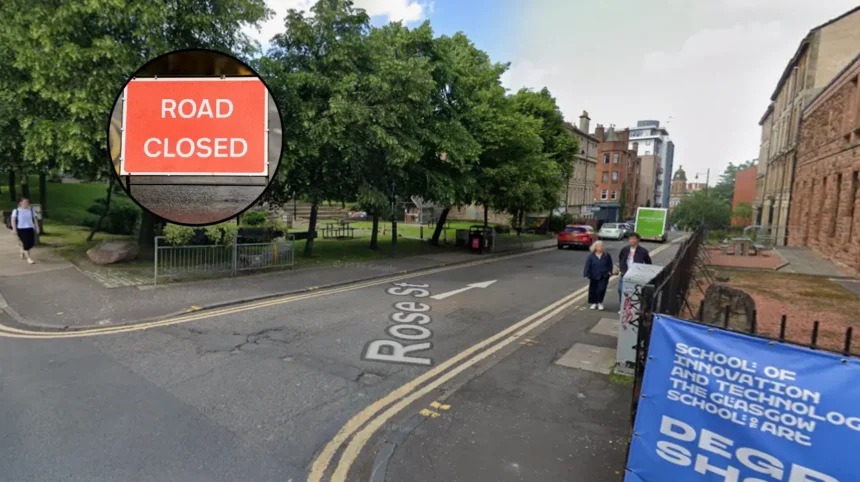
- Rose Street in Glasgow city centre, between Sauchiehall Street and Renfrew Street, has been closed to traffic by Glasgow City Council.
- The closure is for emergency ironworks repairs.
- Drivers are warned to expect delays and consider alternative routes.
- A Glasgow City Council spokesperson confirmed the details of the closure and advised road users accordingly.
Glasgow (Glasgow Express) May 11, 2026 –
- Key Points
- Why Has Rose Street in Glasgow Been Closed?
- What Impact Will the Rose Street Closure Have on Drivers?
- Who Is Responsible for the Emergency Ironworks Repairs on Rose Street?
- When Did Glasgow City Council Announce the Rose Street Closure?
- How Can Drivers Avoid Delays from the Rose Street Closure?
- What Are the Boundaries of the Rose Street Closure in Glasgow?
- Has Glasgow City Council Provided Updates on Similar Past Closures?
- Background of the Development
- Predictions: How This Can Affect Glasgow City Centre Road Users
Rose Street, a busy thoroughfare in Glasgow’s city centre between Sauchiehall Street and Renfrew Street, has been shut by Glasgow City Council to facilitate emergency ironworks repairs. The council has issued an avoid area warning, urging drivers to anticipate delays and seek alternative routes. A spokesperson for Glasgow City Council stated: “Rose Street between Sauchiehall Street and Renfrew Street is currently closed to traffic for emergency ironworks repairs. Road users are advised to expect delays and consider alternative routes.”
Why Has Rose Street in Glasgow Been Closed?
The closure targets urgent repairs to ironworks beneath the street, a measure deemed necessary by Glasgow City Council to address immediate infrastructure concerns.
As reported in initial coverage from local sources, the decision prioritises safety on this key city centre route. No specific timeline for reopening has been detailed in the council’s statement, though the emphasis remains on minimising disruption through advance warnings to motorists.
Glasgow’s city centre streets like Rose Street handle significant daily traffic, connecting major areas such as Sauchiehall Street, known for its commercial and cultural hubs, to Renfrew Street.
The council’s prompt action reflects standard procedure for emergency works, where immediate closure prevents potential hazards from deteriorating further.
Road users have been directed to follow signage for diversions, with the advisory issued via official channels including the council’s website and social media.
What Impact Will the Rose Street Closure Have on Drivers?
Motorists are advised to expect delays due to the full closure of Rose Street between the specified junctions. Glasgow City Council has explicitly warned of congestion and recommended alternative routes to bypass the affected area. The spokesperson’s statement underscores this:
“Road users are advised to expect delays and consider alternative routes.”
This stretch of Rose Street serves as a vital link for vehicles navigating Glasgow’s dense city centre, particularly those travelling from Sauchiehall Street northward.
With no mention of partial access or timed restrictions, the closure implies a complete shutdown to all traffic, prompting drivers to plan ahead. Public transport users may also face indirect effects if services rely on nearby routes, though no specific bus or service diversions were noted in the council’s update.
Who Is Responsible for the Emergency Ironworks Repairs on Rose Street?
Glasgow City Council has taken direct responsibility for the closure and the ensuing repairs. The authority, accessible via its official website at glasgow.gov.uk, announced the measures to ensure public safety. Their Facebook page, GlasgowCC, echoed the advisory for wider reach.
As the local governing body, the council oversees maintenance of public roads, including ironworks such as manhole covers, gratings, and underground supports prone to wear in high-traffic zones.
The term “ironworks repairs” typically encompasses cast iron components integral to urban infrastructure, which require specialised intervention when faults emerge. No contractor details were provided in the statement, placing oversight squarely with the council.
When Did Glasgow City Council Announce the Rose Street Closure?
The announcement aligns with current operations as of May 11, 2026, with the street “currently closed” per the spokesperson’s remarks.
Coverage from sources tracking local disruptions first highlighted the issue around this date, indicating a rapid response to the emergency need.
MyGov.scot, the portal for Scottish public services, lists Glasgow City Council among organisations handling such matters.
Immediate implementation of the closure suggests the ironworks issue was identified promptly, avoiding escalation.
While exact start times for repairs were not specified, the council’s phrasing implies works are underway, with ongoing monitoring to manage traffic flow.
This follows patterns seen in prior Glasgow incidents, such as temporary Sauchiehall Street restrictions for unrelated events.
How Can Drivers Avoid Delays from the Rose Street Closure?
The primary guidance from Glasgow City Council is to “consider alternative routes,” with expectations of delays for those near the site. Signed diversions are presumed in place, standard for council-managed closures in the city centre.
Links to mapping for key points—Rose Street, Sauchiehall Street, and Renfrew Street—aid in visualising options.
Planning tools like real-time traffic apps are advisable, given the area’s congestion. Past closures nearby, such as on Sauchiehall Street for filming or events, have similarly directed traffic via parallel roads like Bath Street or Hope Street. Pedestrians and cyclists may retain access, though this was not explicitly confirmed.
What Are the Boundaries of the Rose Street Closure in Glasgow?
The affected section is precisely defined as Rose Street between Sauchiehall Street and Renfrew Street. This confines the works to a short but critical city centre segment, minimising broader network impacts. The council’s spokesperson reiterated:
“Rose Street between Sauchiehall Street and Renfrew Street.”
Geographically, Sauchiehall Street marks the southern limit, a major east-west artery, while Renfrew Street forms the northern boundary, linking to the Theatre Royal area.
Ironworks in this zone likely support drainage or utility access points, common in Glasgow’s Victorian-era layout. No extensions beyond these junctions were mentioned.
Has Glasgow City Council Provided Updates on Similar Past Closures?
While this incident is isolated, Glasgow City Council has managed comparable emergency works previously. For instance, nearby Sauchiehall Street saw closures for non-emergency reasons like filming, with services resuming post-event.
Broader context includes ongoing infrastructure strains in the city centre, as seen with sewer repairs on Cathedral Street reported elsewhere, though unrelated here.
The council maintains transparency via platforms like mygov.scot, where public advisories are posted. No prior Rose Street-specific emergencies were directly referenced, but the response mirrors standard protocol: closure, warning, and diversion advice.
This closure underscores routine maintenance challenges in a bustling urban environment, where ageing infrastructure necessitates swift intervention.
Background of the Development
Rose Street forms part of Glasgow’s interconnected city centre grid, originally laid during the city’s 19th-century expansion as an industrial hub. Ironworks, often cast iron covers and frames from that era, support essential services like sewers and cabling beneath.
Glasgow City Council, established under local government reforms, handles such repairs through its roads and infrastructure teams, funded by council tax and Scottish Government grants.
The area between Sauchiehall and Renfrew Streets sees heavy footfall from shoppers, theatre-goers, and commuters, amplifying the need for rapid fixes. Historical records note similar works on adjacent streets, reflecting ongoing preservation of Glasgow’s foundational layout.
Predictions: How This Can Affect Glasgow City Centre Road Users
This development can lead to increased travel times for drivers navigating the city centre, particularly those dependent on north-south links near Sauchiehall Street. Commuters and delivery services may face rerouting costs and delays, potentially straining parallel roads like Renfrew Street extensions or Douglas Street. Public transport, including buses on nearby routes, could experience knock-on congestion if volumes shift. Pedestrians remain largely unaffected, but local businesses might see minor dips in passing trade during peak hours. Prolonged repairs, if required, could compound these effects, though the council’s diversion strategy aims to distribute pressure across the network. Overall, impacts stay localised, with alternatives mitigating widespread disruption for the area’s daily road users.