Key Points
- Glasgow City Council implemented the Low Emission Zone (LEZ) scheme, aimed at reducing vehicle emissions in the city centre.
- Proliferation of “Just Eat VIP lanes” has contributed to increased traffic congestion and disruption.
- City centre described as a “war zone” due to combined effects of LEZ enforcement and dedicated delivery lanes.
- LEZ has generated significant revenue through fines, with over £1 million collected in its first 10 months.
- Air quality improvements noted in some areas, including reductions in NO2 levels, alongside changes in traffic flow.
- Ongoing debates about the balance between environmental goals and urban accessibility for residents and businesses.
Glasgow (Glasgow Express) April 24, 2026 – Glasgow city centre has been likened to a “war zone” following the full enforcement of the Low Emission Zone (LEZ) and the expansion of dedicated delivery lanes for services like Just Eat, as reported across multiple outlets.
- Key Points
- What Has Turned Glasgow City Centre into a ‘War Zone’?
- How Is the Low Emission Zone Affecting Traffic and Air Quality?
- What Role Are Just Eat VIP Lanes Playing in the Chaos?
- Why Are Glasgow’s Streets Particularly Vulnerable?
- Background of the Development
- Prediction: How This Development Can Affect Glasgow Residents and Businesses
What Has Turned Glasgow City Centre into a ‘War Zone’?
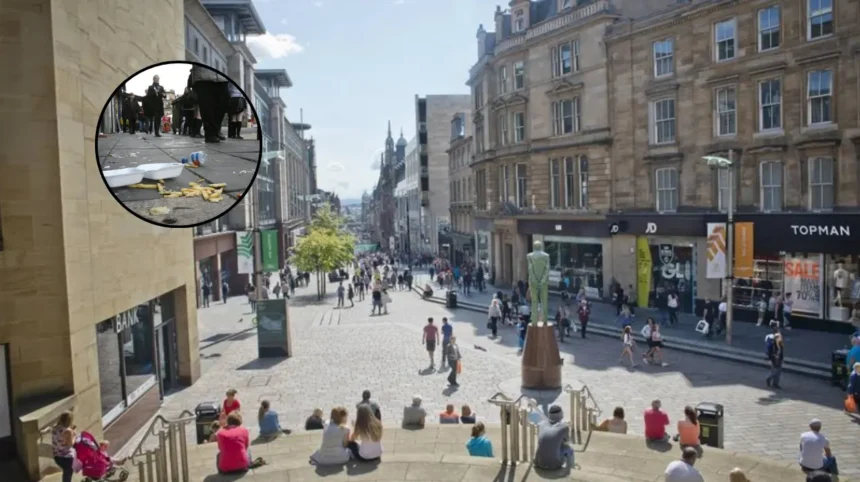
The description of Glasgow’s city centre as a “war zone” stems directly from commentary by Mark Smith, columnist for The Herald, in his piece titled “Welcome to the war zone – it’s Glasgow city centre.” Published on the Herald Scotland website, Smith attributes the chaotic conditions to the “money spinning” LEZ scheme introduced by Glasgow City Council and the “proliferation of Just Eat VIP lanes.” He writes: “Congratulations Glasgow City Council, you have finally done it,” highlighting the cumulative impact on daily traffic and pedestrian movement.
As reported by Mark Smith of The Herald, these measures have prioritised environmental targets and delivery efficiency over smooth urban flow, leading to gridlock in key thoroughfares. The LEZ, enforced since June 2023, restricts non-compliant vehicles—primarily diesel cars registered before September 2015 and petrol vehicles before 2006—from entering the zone, resulting in approximately 33,000 fines and over £1,010,585 in penalty charges by April 2024, according to figures released by Glasgow City Council and covered by the BBC.
How Is the Low Emission Zone Affecting Traffic and Air Quality?
Research from the Urban Big Data Centre (UBDC) at the University of Glasgow examines the LEZ’s initial impacts. The study found a statistically significant reduction in traffic on High Street, leading to notable decreases in normalised NO2 levels of 25-27% on weekdays and a 35% drop on weekends, though weekend traffic flow showed no significant change. On Hope Street, traffic patterns remained stable, yet NO2 levels fell by 9-13% on weekdays, indicating that the LEZ discourages high-emission vehicles from the city centre.
Glasgow City Council announced in August 2025 that air pollution had dropped by a third within the LEZ area, with 2024 data showing a 34% reduction in nitrogen dioxide compared to 2022, the last full year before enforcement. Diffusion tube monitoring outside the zone recorded a 21% drop in harmful pollutants. These findings align with the council’s stated objective to decrease emissions, though traffic flow has remained largely unchanged overall.
The BBC reported that the council generated over £1 million from LEZ fines in just over 10 months, with revenue earmarked for an evaluation process to fund projects after covering operational costs.
What Role Are Just Eat VIP Lanes Playing in the Chaos?
Dedicated “VIP lanes” for delivery services like Just Eat have exacerbated congestion, as noted by Mark Smith of The Herald. These lanes, intended to speed up food deliveries, have proliferated across Glasgow’s city centre, contributing to bottlenecks on narrow streets originally developed in the pre-car era.
Footage shared with Glasgow Live prompted Just Eat to launch an investigation, as posted on their Facebook page on 21 April 2026, amid concerns over delivery operations disrupting public roads. Broader scrutiny of Just Eat emerged in March 2026, when the UK’s Competition and Markets Authority (CMA) placed the company under investigation alongside firms like Dignity, Autotrader, Pasta Evangelists, and Feefo for potential fake or misleading online reviews. The CMA probe focuses on whether Just Eat’s ratings system inflates restaurant and grocer star ratings, giving consumers a misleading picture of quality.
A related Dailymotion video from 30 March 2026 covered the CMA investigation, noting Just Eat’s cooperation and the regulator’s stance that no conclusions have been reached. It also mentioned Pasta Evangelists’ alleged undisclosed discounts for five-star reviews on delivery apps.
Why Are Glasgow’s Streets Particularly Vulnerable?
Glasgow’s city centre features a grid-iron street pattern with many junctions, narrow roads from its rapid pre-car development, and historic bottlenecks at bridges like those over the Clyde. Measures such as the M74 motorway extension reduced city centre traffic by nearly 21,000 vehicles per day, while the Clyde Arc (Squinty Bridge) and pedestrianisation efforts have aimed to alleviate pressure.
Ongoing challenges include on-street parking on narrow streets and traffic build-up at junctions. Park-and-ride schemes and bus lanes represent additional council interventions, but the LEZ and delivery lanes have added new layers of complexity.
Background of the Development
The Low Emission Zone in Glasgow city centre was first announced as part of broader Scottish Government efforts to combat air pollution, with enforcement beginning on 1 June 2023 after a grace period. Glasgow City Council positioned the LEZ within a polygonal boundary encompassing key commercial and cultural districts, using automatic number plate recognition (ANPR) cameras to enforce compliance. Non-compliant vehicles face a £60 fine, reduced to £30 if paid within 14 days.
Just Eat’s expansion of dedicated lanes ties into the surge in food delivery demand post-pandemic, with councils granting permissions to prioritise logistics amid rising e-commerce. Historical traffic management in Glasgow dates back to motorway completions like the M8 and M74, which diverted through-traffic, and initiatives such as the Clyde Tunnel and media alerts for congestion hotspots. The UBDC research provides early empirical data, while council announcements track fiscal and environmental outcomes. These elements converge in 2026 commentary, framing the current “war zone” narrative.
Prediction: How This Development Can Affect Glasgow Residents and Businesses
The combined LEZ enforcement and delivery lane proliferation may lead to sustained traffic disruptions for Glasgow residents, potentially increasing commute times on routes like High Street and Hope Street where flow reductions have occurred alongside air quality gains. Businesses in the city centre could face reduced footfall if congestion deters shoppers, though revenue from fines—exceeding £1 million—might fund infrastructure improvements benefiting long-term accessibility.
Residents with non-compliant vehicles risk ongoing fines, prompting vehicle upgrades or route avoidance, which could strain lower-income households. Delivery-dependent eateries may see operational efficiencies from VIP lanes, but investigations into Just Eat’s practices could erode consumer trust, affecting order volumes. Overall, while NO2 reductions of up to 35% support public health, persistent gridlock descriptions suggest a need for balanced policy adjustments to mitigate economic and convenience impacts on daily life.