Key Points
- A major fire broke out on 8 March 2026 in a B-listed Victorian building at the corner of Union Street and Gordon Street, near Glasgow Central Station, starting in a vape shop and causing partial collapse.
- The Scottish Fire and Rescue Service (SFRS) deployed over 250 firefighters initially, reducing to nine appliances and three high-reach vehicles by 6.30am on 9 March; the site was handed over to Glasgow City Council for demolition.
- Demolition began on 13 March 2026 by specialist contractors Burnfield Demolition; the façade demolition was nearly complete by 20 March, but rubble removal continued.
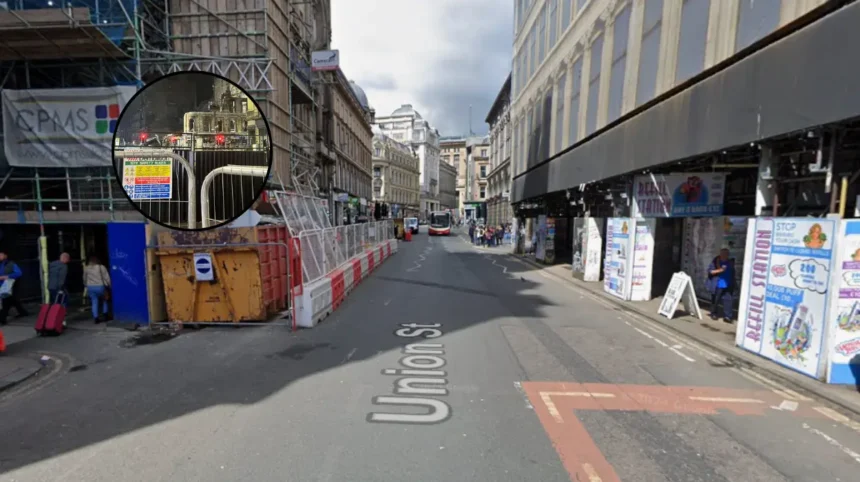
- A safety cordon on Union Street and Gordon Street remains in place until at least July 2026 to ensure a safe environment for contractors and stabilise a wall adjacent to the Central Station Hotel.
- Local businesses report a huge drop in footfall due to the cordon and disruption, with some struggling to survive and others closed indefinitely without reopening dates.
- Glasgow City Council oversees the demolition and has provided updates via its website and social media, emphasising public safety.
Glasgow (Glasgow Express) May 4, 2026 –Nearly two months after a catastrophic fire tore through a historic B-listed Victorian building near Glasgow Central Station, businesses in the surrounding area are grappling with severe financial strain. The blaze, which erupted in a vape shop on Union Street on 8 March 2026, has led to ongoing disruption from a safety cordon that persists until at least July, causing a sharp decline in footfall and forcing several establishments to remain shuttered.
- Key Points
- What Caused the Union Street Fire and Initial Response?
- How Has Demolition Progressed Since the Fire?
- Why Are Businesses Suffering from the Cordon?
- What Is the Current Status Around Central Station?
- Background of the Union Street Fire Development
- Prediction: Impact on Local Businesses and Commuters
What Caused the Union Street Fire and Initial Response?
The fire began shortly before 4pm on Sunday, 8 March 2026, in a commercial building at the corner of Union Street and Gordon Street, a prominent location close to Glasgow Central Station.
As reported by the Scottish Fire and Rescue Service (SFRS) in its media statement, Operations Control mobilised six appliances and specialist resources, with more than 60 firefighters initially working to extinguish the blaze; over 250 firefighters attended the scene in total as the four-storey structure partially collapsed.
A spokesperson for the SFRS stated:
“Firefighters continue to work to extinguish a large building fire on Union Street, Glasgow.”
By 8.30pm on the same day, crews were still active, and an update at 6.30am on Monday, 9 March, noted:
“The response to the commercial building fire on Union Street, Glasgow, has now been reduced, with nine fire appliances and three high-reach vehicles remaining at the scene. Members of the public are still advised to avoid the area where possible, and nearby residents should keep windows closed as a precaution.”
Firefighters used high-reach appliances and ground monitors to dampen hotspots in the fatally compromised structure. Chaos ensued in Glasgow City Centre, with road closures on Union Street and Gordon Street implemented immediately, affecting access to Central Station entrances.
How Has Demolition Progressed Since the Fire?
Glasgow City Council took over the site from the SFRS, declaring the remaining structure “fatally compromised.” As detailed in a council update video on YouTube, demolition by specialist contractors Burnfield Demolition commenced on Friday, 13 March 2026. Councillor Susan Aitken, Council Leader, commented in the video:
“Yesterday afternoon we appointed specialist contractors to demolish what remains of the Union Street building destroyed by fire. The contractors began this work on site this morning (13 March).”
By Friday, 20 March 2026, a LinkedIn post from Glasgow City Council announced:
“Demolition of the remainder of the façade should be complete by the end of today, but in the interests of public safety and access, the cordon will remain in place for the next phase of rubble removal.”
The council emphasised creating a safe working environment for contractors.
In its latest update as of 24 April 2026, reported by BBC News, the council confirmed the cordon on Union Street and Gordon Street would stay until at least July to allow for stabilisation of a wall adjacent to the Central Station Hotel. The barriers enforce safety amid ongoing works.
Why Are Businesses Suffering from the Cordon?
The cordon, erected to protect the public and enable safe demolition, has severely impacted nearby businesses. As covered by BBC News on 30 April 2026, proprietors state the restrictions have led to a “huge drop in footfall,” with some saying the situation “is killing us.” Several establishments in Glasgow Central have struggled to maintain operations, relocating or facing closure.
Glasgow Live reported on 30 April 2026 that businesses near the site, close to Central Station, are “struggling to survive” due to the lack of customers, with works ongoing and no clear reopening timeline for affected premises. The disruption stems directly from the cordon blocking pedestrian and vehicle access.
Councillor Aitken noted in the 13 March council update:
“We’re providing as much support for them [businesses] as we’re able to do. But the only people allowed behind this cordon now are the building control professionals, the construction professionals, and the demolition professionals who know what they are doing. We’re really focused on getting this to be safe as soon as we can and opening it to the public.”
What Is the Current Status Around Central Station?
As of early March 2026, a YouTube update from 12 March showed cordons firmly in place, with High Level station and Gordon Street entrances to Central Station likely closed for an extended period. The transport network adapted, but local access remained limited.
BBC News on 16 March 2026 addressed public queries, noting the council’s decision to demolish was driven by public safety concerns, with further details on next steps available via glasgow.gov.uk/UnionStreetIncident.
The site handover from SFRS to the council occurred shortly after the fire, paving the way for emergency demolition. No injuries were reported from the initial blaze, but the economic ripple effects continue.
Background of the Union Street Fire Development
The Union Street building was a B-listed Victorian structure known as Union Corner, a historic landmark in Glasgow’s bustling city centre. The fire originated in a vape shop, rapidly spreading through the four-storey commercial property, leading to partial collapse and necessitating immediate emergency response.
Glasgow City Council assumed responsibility post-SFRS involvement, prioritising demolition for safety. Updates have been issued regularly through official channels, including the council’s website and social media, detailing progress from initial façade removal to ongoing stabilisation works. The cordon’s extension to July reflects the complexity of securing the adjacent hotel wall.
Prediction: Impact on Local Businesses and Commuters
This development, with the cordon in place until at least July 2026, can affect Glasgow Central area businesses through sustained low footfall, potentially leading to further closures or relocations as revenue drops persist. Commuters using Central Station may face continued restricted access to key entrances, increasing travel times and reliance on alternative routes. Shoppers and visitors to the area could experience reduced options and convenience, shifting patterns to other parts of the city centre.