Paisley, just a short hop from Glasgow, blends rich history, stunning architecture, and modern vibrancy into a destination that captivates visitors year-round. Nestled in Renfrewshire about 7 miles west of Glasgow city center, this town offers an authentic Scottish experience without the crowds.
- Paisley’s Ancient Roots and Founding
- The Majestic Paisley Abbey: A Gothic Masterpiece
- Industrial Revolution: From Weavers to World Fame
- Iconic Landmarks Showcasing Heritage
- Seamless Links to Glasgow
- Vibrant Culture and Festivals
- Modern Economy and Regeneration
- Notable Figures from Paisley
- Sports and Outdoor Pursuits
- Living in Paisley: Community and Future
Paisley’s Ancient Roots and Founding
Paisley’s story begins in the early medieval era, around the 7th century, when Saint Mirin, an Irish monk, is believed to have established a religious community near a waterfall on the White Cart Water. This site evolved into a pilgrimage center, with the town’s name possibly deriving from the Cumbric word “basaleg,” meaning “basilica” or major church, highlighting its early ecclesiastical prominence.
By 1163, Walter fitz Alan, the first High Steward of Scotland, founded a Cluniac priory on his lands, importing monks from Much Wenlock in England. The settlement grew swiftly, earning abbey status in 1245 and influencing regional spirituality and education. Monks from Paisley even established Crossraguel Abbey in Ayrshire, extending the town’s religious reach.
Tragedy marked the abbey’s early years when Edward I of England burned it in 1307, but rebuilding in the 14th century restored its glory. William Wallace, the Scottish hero born nearby in Elderslie, may have received his education here, weaving Paisley into Scotland’s independence narrative.
The Majestic Paisley Abbey: A Gothic Masterpiece
At Paisley’s core stands Paisley Abbey, a Church of Scotland parish church that replaced an 8th-century structure and now exemplifies Gothic architecture from the 14th and 19th centuries. Reconstructed after fires and collapses, its nave features a timber roof added in 1981, while the choir and tower reflect Victorian restorations by architects like Macgregor Chalmers and Robert Lorimer.
The abbey holds royal significance as the burial site for all six High Stewards of Scotland, Marjorie Bruce—daughter of Robert the Bruce and mother of Robert II—and several Stewart kings’ wives. A reconstructed tomb honors Marjorie, who died in 1316 after a riding accident nearby, giving birth via caesarean without anesthesia.
Intriguing features include the 10th-century Celtic Barochan Cross, a Wallace Memorial Window depicting Samson, and stained glass by Edward Burne-Jones and Douglas Strachan. Beneath lies the Paisley Abbey Drain, a 14th-century tunnel designated a Scheduled Ancient Monument, yielding artifacts like polyphonic music slates during excavations.
The abbey’s organ, originally built by Cavaillé-Coll in 1874 and restored in 2009, ranks among Scotland’s finest with 65 stops and a new 32-foot contre bombarde. Today, it hosts Sunday worship and events, drawing history enthusiasts to its angel corbels and carved choir stalls.
Industrial Revolution: From Weavers to World Fame
Paisley’s transformation accelerated in the late 18th century amid the Industrial Revolution, fueled by the White Cart Water for powering mills. What started as cottage weaving exploded into a textile powerhouse, with English owners attracting migrants from Ayrshire and the Highlands.
The Clarks brothers pioneered cotton thread in the 1750s after Napoleon’s blockade cut silk supplies, creating strong 3-ply thread for sewing that birthed J&J Clark. By the 19th century, under Thomas Coats, Paisley dominated global thread production, employing thousands in mills like Anchor and Ferguslie.
Shawls imitating Kashmiri designs, featuring the iconic Paisley pattern—teardrop motifs from East India Company imports—became synonymous with the town after Queen Victoria’s endorsement. At its 1850s peak, 6,000 weavers produced these luxuries, exporting worldwide despite European rivals.
Radicalism simmered among skilled weavers, who protested low pay in the 1816-1820 Radical War and struck for “sma’ shot” thread compensation, commemorated annually. Economic woes hit in the 1840s and during the American Civil War’s cotton shortages, shifting focus to synthetics before overseas competition closed mills by 1993.
Iconic Landmarks Showcasing Heritage
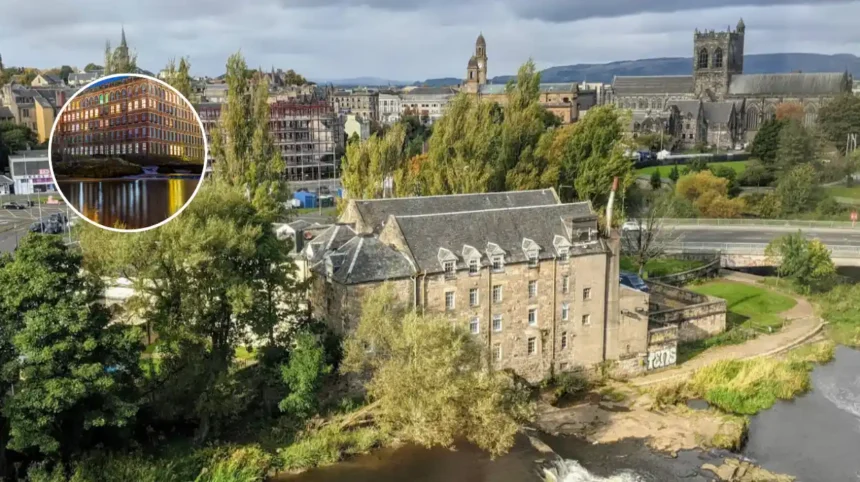
Paisley’s skyline boasts Victorian gems like the Thomas Coats Memorial Church, Europe’s “Baptist Cathedral” with its 60-meter spire, intricate carvings, and Hill Organ. Anchor Mills, a Category A-listed 1886 structure by the Hamills Waterfall, symbolizes textile might and now houses flats.
Coats Observatory, donated by Thomas Coats in 1883, features a Victorian refractor telescope and public stargazing, perched on Oakshaw Hill amid conservation areas. Sma’ Shot Cottages recreate 18th-century weaver homes, offering immersive history.
Paisley Museum and Art Galleries, closed for a £45 million revamp, houses shawls, Egyptian artifacts, and Scottish art by the Glasgow School, set to reopen soon with over 800 paintings. Blackhall Manor, dating to 1160, endures as Paisley’s oldest building.

Seamless Links to Glasgow
Just 7 miles west of Glasgow, Paisley connects effortlessly via ScotRail trains from Glasgow Central to Paisley Gilmour Street—Scotland’s fourth-busiest station—in 9 minutes for £4-13. Buses like First Greater Glasgow run every 5-10 minutes from Percy Street, taking 29 minutes.
The M8 motorway provides Junctions 27-29 access, linking to Glasgow Airport in Paisley’s north, Scotland’s busiest hub operated by AGS Airports. This proximity makes Paisley ideal for day trips from Glasgow, blending urban buzz with suburban charm.
Vibrant Culture and Festivals
Paisley’s creative pulse beats through events like the Spree Festival in October, Scotland’s top arts bash with global music, comedy, and Spiegeltent shows in venues like the Abbey. The Sma’ Shot Day parade in July celebrates weavers with drums, crafts, and markets.
Foodies flock to the April Food and Drink Festival for Scottish producers and street eats, while the Royal National Mòd highlights Gaelic culture with music and poetry. Christmas lights switches draw thousands, capping a year of heritage-infused festivities.
The Paisley pattern endures in modern design, symbolizing resilience on Renfrewshire Council’s logo.
Modern Economy and Regeneration
Post-textile decline, Paisley pivoted to tech, creatives, and services, hosting Renfrewshire Council HQ, University of the West of Scotland’s largest campus, West College Scotland, and Royal Alexandra Hospital. Glasgow Airport and Loganair employ thousands, alongside Chivas Brothers whisky blenders.
Paisley First BID drives town center revival, earning Scotland’s Town of the Year 2025 via investments like £22 million Town Hall refurb (2023), £7 million Central Library, and museum upgrades. Phoenix Retail Park rose from a car factory site, boosting retail and jobs.
This renaissance leverages heritage for tourism, with grants restoring shopfronts and buildings.
Notable Figures from Paisley
Paisley birthed talents like playwright John Byrne (“Slab Boys”), Oscar-nominee Tom Conti, artist Alexander Goudie, and musician Jim Dewar of Robin Trower. Robert Tannahill, the “Weaver Poet,” rivaled Robert Burns, while activists like Willie Gallacher shaped communism.
Modern names include banker Fred Goodwin and TV presenter John Amabile, underscoring diverse legacies.
Sports and Outdoor Pursuits
St Mirren F.C., Paisley’s pro football club, plays at The Paisley 2021 Stadium (capacity 8,029), winning Scottish Cups in 1987 and League Cups in 2013 and 2025. Paisley RFC and Kelburne Hockey Club thrive locally.
Parks like Barshaw and Fountain Gardens offer green escapes, with Gleniffer Braes trails nearby. Hamills Waterfall provides serene photo spots amid urban hikes.
Living in Paisley: Community and Future
Paisley’s suburbs like Castlehead’s Victorian villas and Thornly Park’s Art Deco homes attract families, with post-war areas like Glenburn modernizing. As Renfrewshire’s hub, it balances affordability, schools like Paisley Grammar (1576-founded), and commuter perks.
Ongoing regeneration promises sustained growth, positioning Paisley as a thriving satellite to Glasgow with preserved heritage and forward momentum. Whether exploring abbey crypts or festival streets, Paisley delivers timeless Scottish allure.