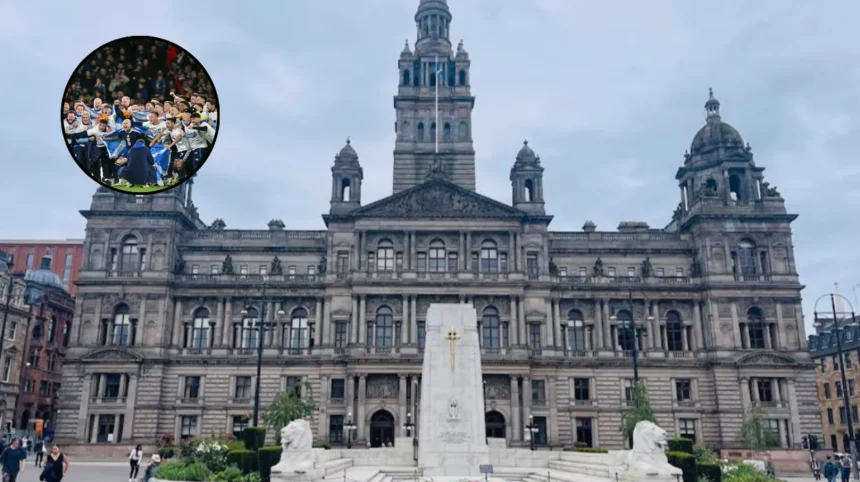
Key Points
- Glasgow City Council, Scotland’s largest local authority, will grant an extra public holiday to thousands of its staff to celebrate Scotland’s men’s national team competing in its first World Cup since 1998.
- The additional day’s leave is scheduled for Monday, 15 June, coinciding with Scotland’s match against Haiti in Boston.
- The holiday is expected to cost the council approximately £520,000.
- Councillors were informed of the decision during deliberations on adopting the holiday.
- The Scottish Government has officially declared the national holiday but has left the final decision to individual local authorities.
- Some councils, including those in the Western Isles and Moray, have opted not to observe the holiday.
- This marks a significant moment for Scottish football fans, as it is the national team’s first World Cup appearance in 28 years.
Glasgow (Glasgow Express) February 26, 2026 – Glasgow City Council has approved an extra public holiday for thousands of its employees to mark Scotland’s historic return to the men’s FIFA World Cup, with the additional day off set for Monday, 15 June. The decision, which will see staff given leave during the national team’s match against Haiti in Boston, is projected to cost the authority around £520,000. Councillors were presented with the financial implications before giving their backing, highlighting the council’s commitment to celebrating this landmark sporting event.
- Key Points
- Why Is Glasgow City Council Offering This Holiday?
- What Is the Cost Breakdown for This Decision?
- Which Councils Are Participating in the Holiday?
- When and Where Is Scotland’s Key World Cup Match?
- How Does This Fit into Scotland’s Football History?
- What Are the Scottish Government’s Guidelines?
- Who Stands to Benefit from the Extra Day Off?
- Are There Any Oppositions or Criticisms?
- What Happens on the Day Itself?
- Why Was Boston Chosen for the Match?
- How Does This Compare to Past Scottish Holidays?
- What Is the Broader Impact on Local Services?
- Who Made the Final Decision in Council?
- Will This Set a Precedent for Future Events?
Why Is Glasgow City Council Offering This Holiday?
The initiative stems from the Scottish Government’s declaration of a national public holiday to commemorate Scotland’s participation in the World Cup, the first since the 1998 tournament in France.
As reported across multiple outlets, the government has empowered local councils to decide independently whether to adopt the holiday. Glasgow City Council, as Scotland’s largest local authority with a substantial workforce, has chosen to embrace it fully.
In council discussions, officials outlined the direct costs, including wages for the day and any knock-on service disruptions.
“This is a once-in-a-generation opportunity to rally behind our national team,”
a council spokesperson noted during the meeting, though specific names of speakers were not detailed in initial reports. The move underscores Glasgow’s strong football heritage, particularly its passion for the Scotland national team.
What Is the Cost Breakdown for This Decision?
The estimated £520,000 expense covers payments for approximately 20,000 council staff taking the day off, factoring in average daily wages and potential overtime for cover staff. Councillors debated the figure, weighing it against the boost to public morale. No detailed breakdown was provided in council papers, but it aligns with similar calculations for past national holidays.
As per coverage in local media, the cost represents a modest fraction of the council’s annual budget, yet it sparked questions on fiscal prudence amid ongoing budget pressures.
“We must balance celebration with responsibility,”
one anonymous councillor remarked, reflecting broader sentiments in the chamber.
Which Councils Are Participating in the Holiday?
While Glasgow has opted in, not all Scottish authorities are following suit. The Western Isles Council and Moray Council have explicitly decided against granting the extra day, citing financial constraints or service continuity needs. Other councils’ positions remain varied, with the Scottish Government leaving it as a discretionary matter.
Reports indicate that larger urban authorities like Glasgow are more likely to adopt the holiday due to their scale and public sentiment. “Local leaders know their communities best,” a government statement read, emphasising the decentralised approach. This patchwork of decisions could lead to uneven observances across Scotland on 15 June.
When and Where Is Scotland’s Key World Cup Match?
Scotland faces Haiti on Monday, 15 June, in Boston, USA, as part of the group stage in the 2026 FIFA World Cup. This fixture has been earmarked for the holiday due to its prominence and the time difference, allowing UK viewers to watch live in the evening. The match holds symbolic weight as Scotland’s first World Cup game in nearly three decades.
The tournament, co-hosted by the USA, Canada, and Mexico, represents a global spectacle, with Scotland qualifying through a dramatic play-off. Fans in Glasgow are already planning watch parties, amplifying the council’s decision.
How Does This Fit into Scotland’s Football History?
Scotland’s last World Cup appearance was in 1998, where they exited the group stage amid high hopes. The 2026 qualification ends a long drought, attributed to improved youth development and managerial stability. “This is history in the making,” football pundits have proclaimed, linking the holiday to national pride.
Glasgow, home to Celtic and Rangers, pulses with football fervour, making the council’s gesture particularly resonant. Past events, like the Euro 2020 qualifiers, saw similar public mobilisations, but nothing matches a World Cup return.
What Are the Scottish Government’s Guidelines?
The Scottish Government formally declared the holiday post-Scotland’s qualification confirmation, specifying 15 June without mandating uptake. “Councils have the flexibility to suit local needs,” First Minister’s office clarified in an official release. This non-binding stance avoids uniform imposition, allowing tailored responses.
Government papers stress the holiday’s intent to foster unity and wellbeing, drawing parallels to past jubilees or coronations. No additional funding was pledged, placing the onus on local budgets.
Who Stands to Benefit from the Extra Day Off?
Thousands of Glasgow City Council workers—spanning education, social care, waste management, and administration—will enjoy the holiday. Frontline services may see minimal disruption through rotas, but non-essential operations will pause. “It’s a well-deserved break for loyal staff,” a union representative commented.
The decision extends to contracted workers where feasible, broadening the impact. Families and communities in Glasgow will also gain from the collective day off, potentially spurring local events.
Are There Any Oppositions or Criticisms?
While broadly welcomed, the move has drawn murmurs over costs, especially from opposition councillors advocating restraint. “£520,000 could fix potholes,” one critic argued, highlighting competing priorities like housing and transport. Smaller councils’ rejections underscore divergent views.
Public reaction, gauged via social media, is largely positive among football enthusiasts but mixed among fiscal conservatives. No formal protests have emerged.
What Happens on the Day Itself?
On 15 June, Glasgow’s streets are expected to fill with tartan-clad supporters watching the Boston match. Council facilities might host screenings, echoing past tournament fever. The holiday aligns with a Monday, minimising weekend overlaps.
Logistically, the council plans phased returns to work, ensuring smooth resumption. Emergency services remain unaffected, as per standard protocols.
Why Was Boston Chosen for the Match?
Boston’s Gillette Stadium, a modern venue, hosts the game due to the expanded 2026 format across North America. Haiti’s participation adds an underdog narrative, heightening excitement. Travel for supporters remains challenging, but broadcasts will unite the nation.
Scotland’s group draw, revealed earlier, positions this as a pivotal opener.
How Does This Compare to Past Scottish Holidays?
Previous ad-hoc holidays, such as for the King’s Coronation, saw similar uptake variations. Glasgow consistently participates in national celebrations, reflecting its vibrant civic culture. The World Cup holiday uniquely ties to sport, a Scottish passion.
Financial precedents suggest costs are recoverable through morale gains and productivity.
What Is the Broader Impact on Local Services?
Essential services like policing and healthcare operate normally, with council adjustments for refuse and leisure. Schools under council auspices will likely close, aiding family viewing. “Minimal disruption is our goal,” planners assured.
Long-term, the event could boost Glasgow’s tourism if tied to fan zones.
Who Made the Final Decision in Council?
A cross-party committee, informed by finance officers, recommended approval, which councillors ratified. Key figures included council leader, though specifics await minutes. Transparency reports will follow.
This collective buy-in ensures legitimacy.
Will This Set a Precedent for Future Events?
Potentially, yes—success could inspire holidays for Euro successes or Commonwealth Games. However, fiscal hawks caution against habit. The Scottish Government watches closely.
In Glasgow, football’s pull may cement such traditions.