Key Points
- Conviction and Sentence: Jordan Hadden, 28, has been sentenced to 16 months in prison and handed an eight-year Football Banning Order at Glasgow Sheriff Court.
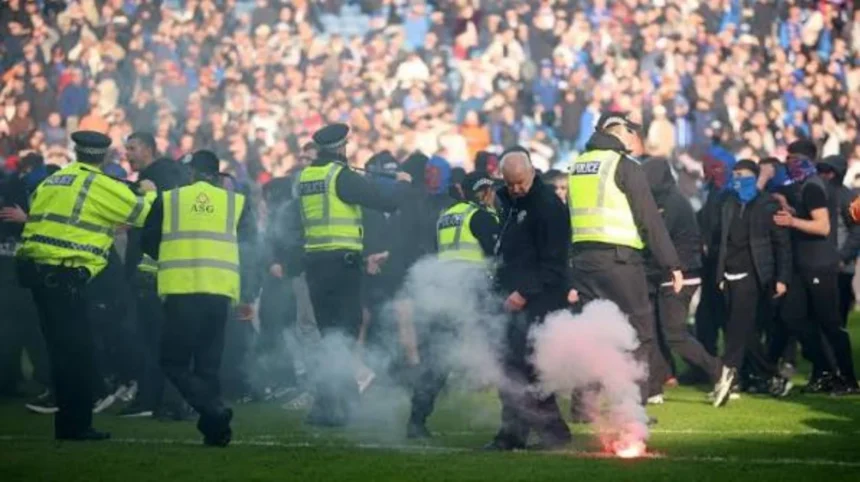
- Incident Details: Hadden was among the primary instigators of a mass pitch invasion at Ibrox Stadium following a Scottish Cup quarter-final tie between Rangers and Celtic on 8 March 2026.
- Culpable and Reckless Conduct: CCTV footage captured Hadden signalling other home fans to storm the pitch before he picked up a glass bottle and hurled it towards opposing Celtic supporters, narrowly missing a police officer who had to take evasive action.
- Multiple Offenders Sentenced: Another supporter, Marc Spence, 48, was also jailed after invading the pitch and assaulting Celtic first-team masseur Allan Baird.
- Official Stance: Police Scotland and the Crown Office and Procurator Fiscal Service (COPFS) confirmed that extensive CCTV inquiries remain ongoing to trace every individual involved in the post-match violence.
Glasgow (Glasgow Express) October 28, 2026 – A Rangers supporter who incited a mass pitch invasion and threw a bottle towards opposing fans following a Scottish Cup Old Firm fixture at Ibrox Stadium has been jailed for 16 months and banned from all football matches for eight years.
Jordan Hadden, 28, appeared at Glasgow Sheriff Court after previously pleading guilty to conducting himself in a disorderly manner, committing a breach of the peace, and culpable and reckless conduct. The court heard that following the conclusion of the match on 8 March 2026, Hadden was one of the first supporters from the home section to breach security perimeter lines and enter the playing field.
Footage played before the court showed Hadden gesturing frantically to fellow fans in the Copland Road Stand, encouraging them to join the pitch invasion. While on the pitch, Hadden picked up a glass bottle and threw it over a police cordon towards the visiting Celtic supporters. The missile narrowly avoided striking a Police Scotland officer who was forced to take immediate evasive action to protect himself from severe head injury.
Hadden subsequently retreated into the stand in an attempt to meld into the departing crowd. However, through comprehensive CCTV analysis incorporating match-day coverage provided by broadcaster Premier Sports, Police Scotland detectives identified and traced Hadden. He was formally arrested and charged at his home address on 24 March 2026.
What Statements Were Made in Court Regarding the Ibrox Pitch Disorder?
During the sentencing hearing, legal representatives, police officials, and prosecutors detailed the sequence of events and the gravity of the safety breach at the stadium.
As reported by Stephen Bark of the Daily Record, Detective Chief Inspector David Lamont of Police Scotland condemned Hadden’s actions as “reckless” and “completely unacceptable.” Detective Chief Inspector Lamont stated: “Hadden was involved in the serious disorder that unfolded at the end of this fixture. This sentence demonstrates that those who engage in this type of disorder will be held accountable for their actions. Our investigation remains ongoing, and we are committed to identifying and tracing everyone involved.”
As reported by Glasgow Court Agency for The Herald, defense solicitor John McLaughlin told the court that Hadden had been under the influence of alcohol at the time of the fixture and retained limited memory of the disturbance. Mr McLaughlin stated:
“In the spur of the moment, he picked up the bottle and threw it over the cordon in the direction of opposition fans – he was not aiming it at anyone in particular. In the cold light of day, he knows his behaviour was extremely reckless and dangerous and could have caused an injury – he is fortunate no one was struck.”
Sheriff Lorraine Glancy KC emphasized the grave physical risk posed to emergency services personnel on duty at the stadium, addressing Hadden directly during sentencing. Sheriff Glancy stated:
“Had the officer not seen the bottle and took evasive action, he could have been struck on the head with it.”
As reported by Fahad Tariq of Glasgow Live, Procurator Fiscal for Glasgow and Strathkelvin, Fraser Gibson, highlighted the wider societal impact of football-related violence following the conviction. Mr Gibson stated:
“The behaviour of Jordan Hadden contributed to serious disorder at a major sporting event. His actions were calculated to incite unrest and violence. But he has now been brought to account for his actions and will serve a period of imprisonment and be subject to a substantial Football Banning Order. Football-related crime is a blight on Scotland’s communities. It will not be tolerated. It should be understood that anyone who chooses to contribute to football-related disorder can expect to be held accountable by COPFS, Police Scotland and the courts.”
The court also addressed secondary incidents linked to the same post-match chaos. Marc Spence, 48, was separately sentenced to custody after running aggressively across the pitch towards Celtic personnel and dragging Celtic first-team masseur Allan Baird to the ground before being restrained and handcuffed by police officers in the tunnel area.
Background of the Ibrox Pitch Invasion and Football Disorder Legislation in Scotland
The Old Firm rivalry between Glasgow’s two prominent football clubs, Rangers and Celtic, stands as one of the most intense cross-city sporting rivalries in international sport. Over several decades, encounters between the two clubs have occasionally been marred by sectarian tension, crowd friction, and pitch incursions.
Following high-profile incidents during the late 1970s and 1980s, Scottish authorities enacted strict legislative measures to control spectator behaviour. The Criminal Justice (Scotland) Act 1980 criminalised the possession of alcohol inside football stadiums and prohibited pitch invasions. In subsequent years, Scottish courts have increasingly utilized Football Banning Orders (FBOs) alongside custodial sentences to act as a deterrent against match-day unrest.
The incident on 8 March 2026 occurred at the conclusion of a highly charged Scottish Cup tie at Ibrox Stadium. Upon the final whistle, security cordons were breached as supporters entered the field of play, threatening player safety and requiring immediate police intervention. Police Scotland launched a dedicated investigation unit using high-definition stadium surveillance and broadcast video to prosecute offenders, resulting in several arrests across Greater Glasgow.
Prediction: How Will This Ruling Affect Football Supporters and Match-Day Operations?
The custodial sentence handed to Jordan Hadden and the accompanying eight-year Football Banning Order signal a strict judicial stance that will directly impact football supporters, club management, and law enforcement agencies in Scotland.
Impact on Football Supporters and Fan Groups
Supporters attending high-risk fixtures face intensified surveillance and lower judicial tolerance for disorderly behaviour. The implementation of an eight-year Football Banning Order restricts convicted individuals from attending any regulated domestic or international football matches, while requiring them to surrender passports during international fixtures. For match-going fans, this outcome demonstrates that entering the field of play or throwing objects—even without direct contact or physical injury—carries severe criminal consequences, including immediate custodial sentences.
Impact on Football Clubs and Match-Day Security Operations
Rangers Football Club and other Scottish Professional Football League (SPFL) clubs will likely face heightened scrutiny from licensing boards, local authorities, and the Scottish Football Association (SFA). Clubs may be required to invest in enhanced physical security infrastructure, such as reinforced perimeter stewarding, upgraded CCTV imaging technology, and modified policing strategies along high-risk stand boundaries. Failure to prevent crowd incursions risks financial penalties, mandatory stadium closures, or reduced away-ticket allocations for future derby fixtures.