
Key Points
- Labour MSP Paul Sweeney said he was “astonished” by what he described as a lack of leadership in anticipating and curtailing disorder linked to Celtic celebrations in Glasgow.
- He said organised fan zones should be created for future football celebrations to reduce disruption in the city.
- Mr Sweeney suggested football clubs should help pay for such fan zones.
- He also called for legal changes to ban pitch invasions and tailgating at football grounds.
- BBC reporting said around 25,000 fans gathered at Glasgow Cross and the Merchant City, leaving litter, debris and broken glass behind.
- Glasgow City Council described the aftermath as “unacceptable” and said staff and volunteers, including Celtic fans, worked through the night to restore order.
- Separate reporting from ITV said 14 arrests had been made in Glasgow following Celtic’s Scottish Premiership win, with 10 linked to supporters gathering in the Trongate area and four at the stadium.
- ITV also reported police said officers were struck by missiles, including glass bottles, and two officers were injured during the disorder.
- BBC Sport reported that new tailgating legislation has already been used in England, with banning orders issued after breaches at the Carabao Cup final.
Glasgow (Glasgow Express) May 18, 2026 Paul Sweeney, the Scottish Labour MSP for Glasgow, said he was “astonished” by the failure to foresee the scale of disorder that followed Celtic celebrations in the city. He argued that the city needs a more organised response to major football celebrations, rather than leaving large crowds to gather in public streets without formal arrangements. BBC reporting added that he believed there had been “a lack of leadership” in controlling the situation.
Mr Sweeney’s remarks came after scenes in central Glasgow on Saturday, when large numbers of supporters gathered to celebrate Celtic’s title success. According to the BBC, an estimated 25,000 fans went to Glasgow Cross and the Merchant City, with streets left covered in litter, debris and broken glass. ITV later reported that police said 14 arrests had been made in the aftermath of the celebrations.
Why does he want fan zones?
Mr Sweeney said an organised fan zone could help manage future celebrations more safely and reduce the strain on city streets.
BBC reporting said he suggested such events could be arranged in advance because Glasgow’s leading teams regularly draw large numbers of supporters, creating predictable demand for public celebrations.
He also proposed that bus-parade style events, similar to those used by some English clubs, could be considered.
According to the BBC, he floated the idea of an organised event on Glasgow Green, with a stage, toilets and bars, so fans could celebrate in a controlled setting. The logic behind the proposal is that if large crowds are expected, then the council, police and clubs should work together to shape the event rather than react to disorder afterwards. BBC reporting also said Mr Sweeney believed
“more progress could be made about formalising these events”.
What happened in Glasgow?
BBC reporting said the celebrations left Glasgow Cross and the Merchant City strewn with litter, debris and broken glass.
The council described the aftermath as “unacceptable” and said clean-up work had to continue through the night. It also said the work involved staff and volunteers, including Celtic fans.
ITV’s reporting added that police said two officers were injured during disorder in the Trongate, with three members of the public either injured or suffering medical episodes. Police Scotland also said officers had missiles, including glass bottles, thrown at them while attending a medical emergency.
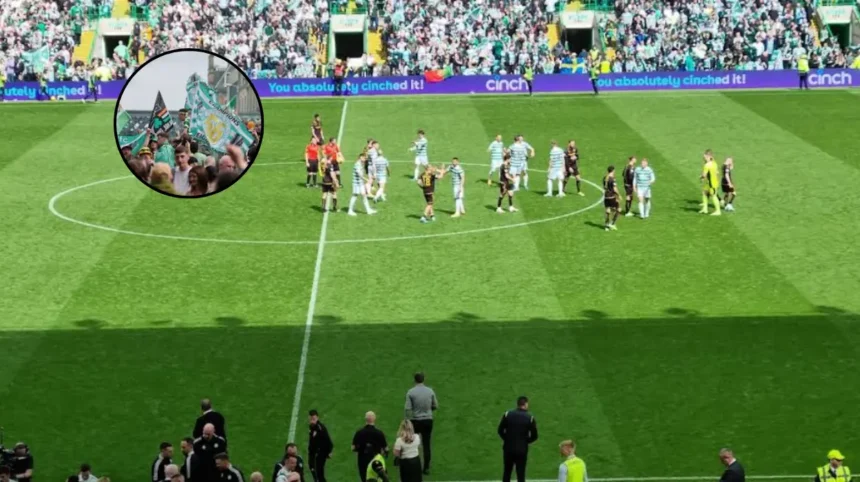
The reporting further stated that, while there had been arrests linked to the celebrations and the stadium, no arrests had yet been made in relation to the pitch invasion at Celtic Park.
What law change is being proposed?
Alongside the fan-zone idea, Mr Sweeney called for a change in the law to ban pitch invasions and tailgating at football stadiums. BBC Sport’s reporting on England showed that tailgating legislation has already been used there, with two fans issued banning orders after breaches at the Carabao Cup final.
That reporting said the new rules came into force before Manchester City’s win over Arsenal at Wembley and were enforced for the first time in that match.
The BBC Sport report said police arrested and charged three men under the new legislation, with the first two receiving three-year banning orders.
It also quoted officials saying the rulings send a strong message that unauthorised access to football matches will not be tolerated.
In the Scottish context, Mr Sweeney is now pressing for similar measures to deal with pitch invasions and people entering grounds without tickets by following closely behind paying spectators.
How have police and clubs responded?
ITV reported that Police Scotland expressed frustration towards Celtic fans and the club’s management after the disorder, calling for the club to be “more accountable”.
The force said officers were injured and that glass bottles and other missiles had been thrown during the incident. That reporting also said police were still working on their response to the pitch invasion at Celtic Park.
BBC reporting said Glasgow City Council condemned the aftermath and described it as unacceptable. While the reports available here do not set out a formal response from Celtic to Mr Sweeney’s specific proposals, the police and council accounts show that the scale of the disorder has prompted renewed debate over planning, crowd control and responsibility for major football celebrations.
BBC Sport’s reporting from England suggests that where football-related disorder overlaps with unlawful access to stadiums, authorities are increasingly willing to use banning orders and new offences to deter repeat behaviour.
Background to this development
This latest row sits within a longer debate in Glasgow about how to manage football celebrations in a city where the main clubs regularly attract huge crowds.
BBC reporting said Mr Sweeney has previously backed more formal arrangements for fan celebrations, and that he sees organised events as a practical alternative to uncontrolled gatherings in city streets.
The immediate trigger for his latest remarks was the weekend disorder after Celtic’s title win, which led to clean-up costs, police injuries and arrests.
The issue also comes as authorities elsewhere have begun using stricter legal tools against stadium disorder. BBC Sport and ESPN reported that England’s new tailgating law has already led to banning orders after a major fixture at Wembley.
That provides a reference point for campaigners who want Scottish law to go further on both pitch invasions and unauthorised entry.
What could happen next?
For Celtic supporters, the most immediate effect could be tighter controls around future celebrations, especially if the club, the council and police move towards more organised fan events. That could mean designated celebration spaces, better crowd management and clearer restrictions on where supporters can gather. If lawmakers take up Mr Sweeney’s proposal, pitch invasions and tailgating could also face stronger penalties, which would directly affect fans entering stadiums and anyone attempting to bypass ticket checks.
For Glasgow residents and businesses, organised celebrations could reduce damage, street disruption and the policing burden if they are properly planned and enforced. However, any new rules would depend on cooperation between football clubs, local authorities and Police Scotland, and the reports show that this is precisely where current tensions lie. The direction of travel, based on the reporting available, is towards more formal planning and firmer enforcement rather than spontaneous mass gatherings.