Key Points
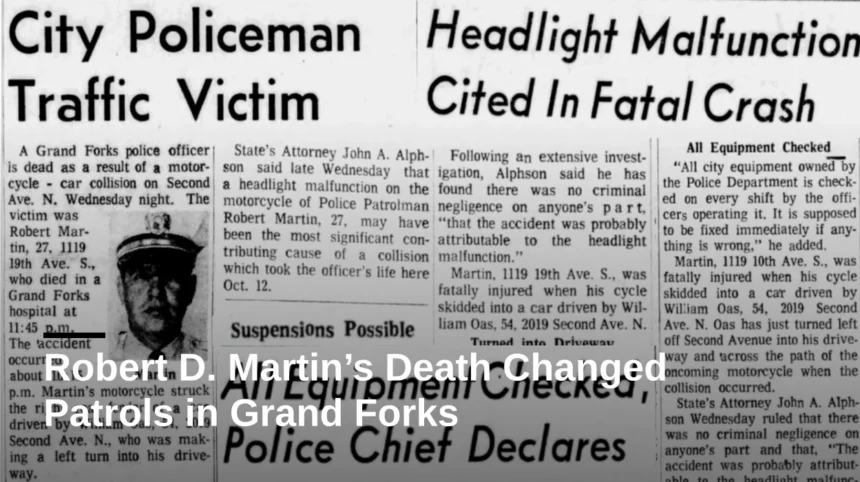
- Grand Forks Police Department officer Robert D. Martin died after a motorcycle crash on October 12, 1966.
- The 27-year-old officer was the department’s first line-of-duty death.
- Historical reporting linked the crash to a left turn by William Oas and a possible motorcycle headlight malfunction.
- The motorcycle patrol continued for a period after Martin’s death but was eventually disbanded as the 1960s ended.
- The department named its operations annex after Martin in 2004.
Grand Forks (Glasgow Express) November 18, 2026 – Robert D. Martin’s death 60 years ago marked a turning point for the Grand Forks Police Department’s motorcycle patrol, although historical records indicate the unit did not end immediately. Martin, a 27-year-old police officer, died in hospital after a collision on Second Avenue North on October 12, 1966. The crash followed William Oas’s left turn into a driveway across the motorcycle’s path. The Grand Forks Herald reported that the motorcycle’s headlight may have malfunctioned, while a later civil ruling found Oas negligent.
- Key Points
- What happened to Robert D. Martin in 1966?
- Did a court later find William Oas responsible?
- How did Martin’s death affect motorcycle patrols?
- When did Grand Forks begin using police motorcycles?
- How is Robert D. Martin remembered?
- What does the history mean for the department’s motorcycle patrol?
What happened to Robert D. Martin in 1966?
As reported by the Grand Forks Herald in “Grand Forks Police Department officer death 60 years ago marked end of motorcycle patrol”, Martin was travelling east at about 25 miles per hour when Oas turned across his route. Martin laid the motorcycle on its left side in an emergency manoeuvre. The motorcycle slid beneath Oas’s vehicle, throwing Martin between 20 and 25 feet.
Martin died at 11:15 p.m. at a Grand Forks hospital. The report said State’s Attorney John A. Alphson found no criminal negligence and indicated that no criminal charge followed. Witnesses said the motorcycle remained running after the collision but had no visible lights. Two police officers also testified that the headlight switch could fail unless operated precisely.
Did a court later find William Oas responsible?
In January 1969, a Grand Forks County District Court judge found Oas negligent in operating his motor vehicle. The case was decided without a jury. Martin’s widow received $7,500, an amount equivalent to nearly $71,000 in current buying power according to the United States Bureau of Labor Statistics, as reported by the Grand Forks Herald.
How did Martin’s death affect motorcycle patrols?
Brian Samson, a former Grand Forks Police Department officer, said Martin’s death led to the motorcycle patrol unit being disbanded. However, the historical record does not establish the exact date of its closure.
The Grand Forks City Council agenda for January 16, 1967, included a request for a replacement motorcycle. The Grand Forks Herald later reported that five department motorcycles travelled 30,894 miles during 1967. References to the unit gradually declined towards the end of the decade.
When did Grand Forks begin using police motorcycles?
Historical reports cited by the Grand Forks Herald show that police motorcycle patrols were debated more than five decades before Martin’s death. In 1912, Chief of Police Lowe questioned the value of motorcycles compared with cars, while recognising their usefulness for pursuing speeding drivers and answering urgent calls.
In April 1913, the City Council planned to buy a police motorcycle because officers could not consistently reach speeding complaints. At the time, the city speed limit was reported as 12 miles per hour, while drivers travelling at 20 miles per hour or more were described as speeders.
How is Robert D. Martin remembered?
Grand Forks Police Department officers honour Martin and Cody Holte during National Police Week. In 2004, the department named its operations annex after Martin. His widow and three surviving brothers attended the ceremony.
“This is a very special occasion, and I feel honoured that they have decided to pay this tribute to Robert,” Martin’s widow said, according to the Grand Forks Herald.
What does the history mean for the department’s motorcycle patrol?
Martin’s death remains associated with the end of a particular era in Grand Forks policing, but the available record suggests a gradual transition rather than an immediate closure. Replacement discussions and documented patrol mileage show that motorcycles remained in service after the 1966 crash. For the Grand Forks Police Department’s audience, the episode illustrates the risks of earlier traffic enforcement and the lasting effect of a line-of-duty death on departmental practice and remembrance.