Key Points
- Thirty Years: The Quay Glasgow celebrates the milestone of thirty years in operation at its iconic waterfront complex at Springfield Quay.
- Changes Over Time: Established in 1996, the complex has evolved into a modern entertainment destination from an innovative riverside development project.
- Current Premier Leases: It currently boasts a multiple-screen ODEON Luxe cinema, a Hollywood Bowl complex, ten restaurants, a 24/7 Gym Group gymnasium, and Alea Casino which happens to be the biggest casino in all of Scotland.
- Key Driver of Footfall: Continued investments in the infrastructure and attractions by operational management is cited as the key driver of long-term footfall generation over several generations.
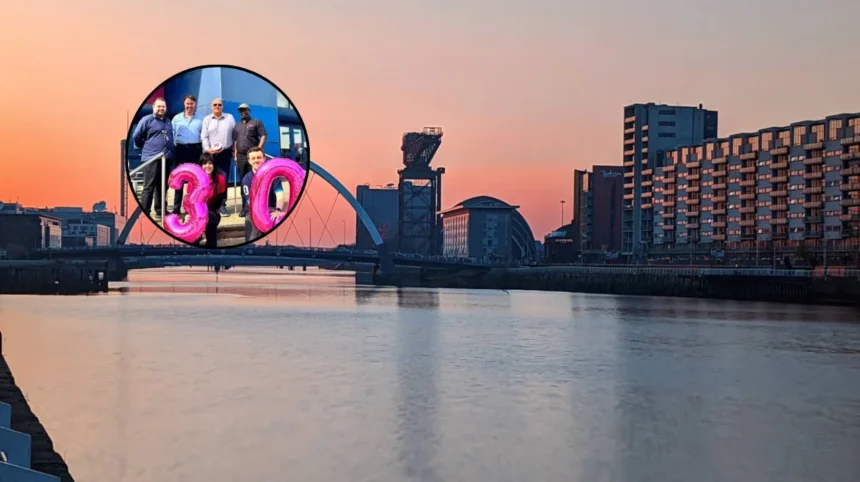
Glasgow (Glasgow Express) August 31, 2026 — The Quay Glasgow has officially commenced celebrations to mark 30 years since first opening its doors at Springfield Quay on the south bank of the River Clyde.
- Key Points
- How has The Quay Glasgow evolved over its 30-year history?
- What facilities and attractions currently operate at the site?
- How has ongoing investment sustained visitor footfall across generations?
- Background of the development
- What does this milestone mean for the future of Glasgow’s leisure sector?
First launched in 1996, the complex was established as a early catalyst for urban regeneration along Glasgow’s industrial riverfront. Over the course of three decades, the location has expanded its footprint and refreshed its tenant roster to remain one of the region’s premier destinations for cinema, bowling, dining, gaming, and family activities.
How has The Quay Glasgow evolved over its 30-year history?
When the complex was built in 1996, it represented a strategic shift in how Glasgow utilised its historical riverside assets along Springfield Quay. Over the subsequent 30 years, the operational strategy focused on adapting to shifting consumer demands within the leisure and hospitality sectors.
Initial developments centered around foundational entertainment anchors, which were progressively upgraded to match modern consumer expectations. A notable modern transformation included substantial investments to transition the standard multi-screen cinema operations into an ODEON Luxe venue, introducing fully reclining seating and upgraded audiovisual technologies across all auditoriums.
Similarly, secondary leisure facilities underwent re-licensing and structural reconfigurations. The site welcomed Hollywood Bowl to bolster its family entertainment sector, whilst dedicated health and wellness infrastructure was established through the addition of a full-scale gym.
What facilities and attractions currently operate at the site?
Today, the complex functions as a multi-purpose leisure ecosystem anchored by major international brands alongside localized hospitality offerings.
The site’s primary anchor facilities include:
- ODEON Luxe Cinema: A multi-screen complex providing fully reclining seating and premium viewing options across all screens.
- Alea Casino: Operating as Scotland’s largest casino, offering multi-level gaming floors, private event spaces, and waterfront dining.
- Hollywood Bowl: A comprehensive ten-pin bowling center integrated with amusement arcades and family dining spaces.
- The Gym Group: A high-capacity, 24-hour fitness facility catering to local residents and city center workers.
- Dining Quarter: A collection of 10 food and beverage operators providing a range of casual, family, and late-night dining options.
How has ongoing investment sustained visitor footfall across generations?
Management at The Quay Glasgow attributes the destination’s longevity to a strategy of continuous capital investment and proactive tenant selection. By consistently updating physical infrastructure and introducing contemporary attractions, the site has managed to retain original patrons from the late 1990s while simultaneously attracting younger demographics.
The venue’s position directly on Springfield Quay has also allowed it to complement broader regional infrastructure projects along the River Clyde corridor. Ongoing capital commitments have ensured that mechanical, digital, and structural systems meet current commercial standards, preventing the asset depreciation often seen in single-use suburban retail parks built during the same era.
Background of the development
Springfield Quay has a long industrial lineage tied to Glasgow’s maritime history. Prior to its commercial redevelopment in the late 20th century, the land formed part of the busy docklands that lined the River Clyde, serving as a hub for shipping, coal exportation, and heavy manufacturing during the height of the city’s industrial era.
As maritime shipping migrated downriver toward deeper waters in the mid-to-late 20th century, inner-city quays were largely decommissioned, leaving vast swathes of industrial land vacant along the waterfront. In the mid-1990s, municipal planning initiatives sought to re-engage the city with its riverfront by converting former industrial maritime land into mixed-use leisure destinations. The launch of The Quay Glasgow in 1996 served as a flagship project in this effort, proving the viability of large-scale commercial leisure parks on the south bank of the Clyde.
Explore More Local Glasgow News
Calls to Charge Glasgow Housing Associations for Bulky Waste Disposal 2026
Lauren Cobey Speaks Out on West End Mum’s MND Diagnosis Glasgow 2026
What does this milestone mean for the future of Glasgow’s leisure sector?
The 30-year operational success of The Quay Glasgow provides clear indicators for local commercial property developers, leisure operators, and the broader Glasgow consumer market.
- For Commercial Property Developers & Investors: The sustained viability of The Quay demonstrates that out-of-town and suburban-adjacent leisure parks can maintain robust returns over multi-decade horizons if asset managers consistently reinvest in experience-led anchors rather than relying purely on traditional retail.
- For Local Consumers and Families: The continued presence of upgraded anchors ensures that residents in the Southside and central Glasgow retain accessible, centralized entertainment options with extensive dedicated parking infrastructure.
- For the Local Economy & Employment Market: Operating as a high-density hospitality hub, the destination underpins hundreds of local service-sector, security, and facility management jobs. The continued stability of the complex signals sustained demand for shift-based employment within the city’s evening economy.