Key Points
- The state of Glasgow’s streets sparked a tense debate at the September 8 meeting of the Glasgow City Council between Councilman Brian Austin and Mayor Rod Karst.
- The discussion centered on an engineering proposal and agreement from Interstate Engineering to create a street paving bid package addressing storm damage from the July 3 flash flooding.
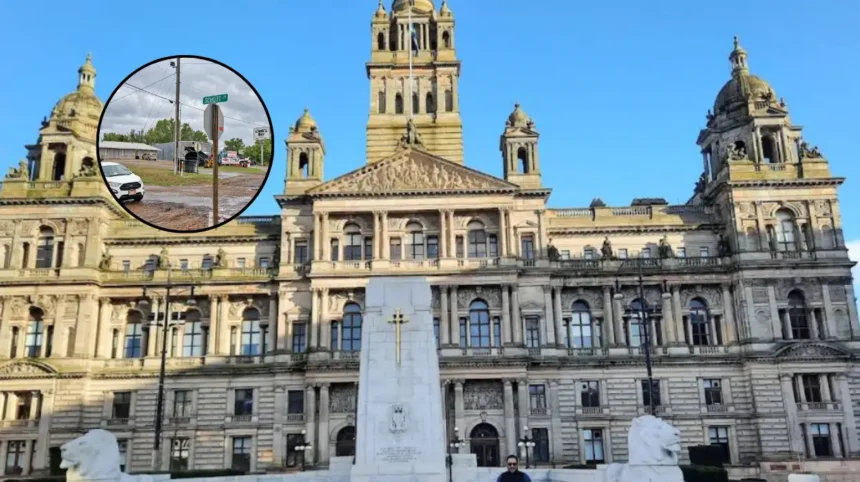
- Councilman Brian Austin raised ongoing concerns regarding Schott Lane, describing it as a gravel road that has been significantly worsened by recent severe weather.
- Mayor Rod Karst stated that the current motion and available emergency state funding would not apply to Schott Lane because official evaluations determined the road’s condition was not a direct result of the July 3 storms.
- Mayor Rod Karst asserted that state funding is strictly limited to returning affected infrastructure to its pre-storm condition.
- Mayor Rod Karst noted that addressing the underlying issues on Schott Lane requires property owners to install proper curbs and gutters.
Glasgow (Glasgow Express) September 24, 2026 — The condition of local infrastructure became a point of contention during the September 8 session of the Glasgow City Council, resulting in a direct exchange between Councilman Brian Austin and Mayor Rod Karst over municipal road maintenance and funding limitations.
The discussion began as the council reviewed an engineering proposal and agreement from Interstate Engineering aimed at assembling a street paving bid package. This package was designed to repair infrastructure damaged by flash flooding and severe storms that struck the area on July 3. However, the focus quickly shifted when Councilman Brian Austin raised the ongoing state of Schott Lane.
Councilman Brian Austin stated that “It’s a gravel road, for God’s sake,” adding that
“Even if I wasn’t on the council… I’d be in here with a club.”
Councilman Brian Austin further explained his frustration regarding the impact of the recent weather, stating,
“I drive on a gravel road, and now these storms have made it ten times worse,” and emphasizing that “The road is washing out.”
How did Mayor Rod Karst respond to concerns about Schott Lane?
Addressing the remarks made by Councilman Brian Austin, Mayor Rod Karst acknowledged the condition of the road but clarified that the motion under consideration regarding the Interstate Engineering bid package would not alter or benefit Schott Lane.
Mayor Rod Karst stated that
“The people in charge of looking at it, and we’ve viewed it twice, said ‘no, it’s not damaged from [the storm].”
Because emergency funding secured from the state is legally restricted to restoring streets strictly to the condition they were in prior to the July 3 weather events, infrastructure issues predating the storm are excluded from the financial package.
Mayor Rod Karst further addressed the root cause of the ongoing deterioration on the roadway, stating,
“Until the property owners put in proper curb and gutter in there, it’s going to be doing that.”
Background of the particular development
The debate at the Glasgow City Council meeting stems from the aftermath of severe weather events, specifically the flash flooding and storms that impacted the region on July 3. Municipalities frequently rely on emergency declarations and targeted state funding to recover from natural disasters. Under standard administrative frameworks for disaster relief, allocated funds are strictly earmarked to repair documented damage directly caused by the specific event, restoring public assets to their baseline pre-disaster functionality. Pre-existing infrastructural deficiencies, such as unpaved surfaces or the absence of modern drainage systems like curbs and gutters, typically fall outside the scope of emergency disaster recovery grants and must instead be addressed through long-term capital improvement plans or local assessment districts.
Prediction
This development highlights an ongoing challenge for local authorities and residents regarding the maintenance of unpaved rural or semi-rural roads during extreme weather seasons. For the residents of Schott Lane and similar neighborhoods, the council’s decision means that property owners may face the financial responsibility of installing foundational infrastructure, such as curbs and gutters, before any substantive municipal paving or long-term repairs can be scheduled. For the local council, this precedent underscores the difficulty of balancing constrained emergency budgets with public expectations for comprehensive infrastructure upgrades, potentially leading to increased scrutiny on future capital improvement budgeting and property owner assessment policies.