Key Points
- Restored bronze statues have begun returning to Glasgow’s George Square as the £20 million redevelopment reaches a key milestone.
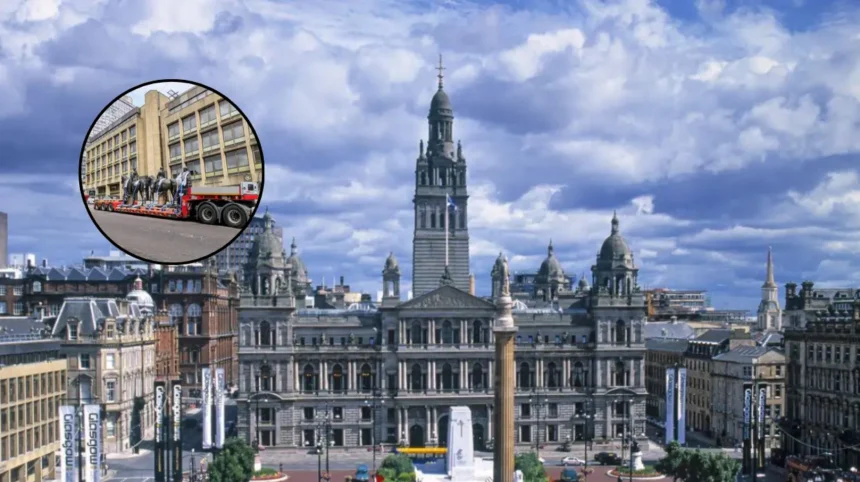
- A lorry was photographed transporting three of the 11 statues back to the city after restoration in Hertfordshire, including the Sir John Moore statue which is having its missing sword remade.
- The statues were removed in early 2025 and restored by Rupert Harris Conservation at a cost of £632,000 using a gentle “aerobraiding” process.
- The full reopening of George Square has been delayed from August 2026 to the end of October 2026, with a phased reopening already underway.
- Glasgow City Council plans a phased reopening, with a family event planned for the first weekend in September to mark the reopening of the western part of the square.
- The redevelopment includes new paving, landscaping, a water feature, raised lawn, sheltered seating and feature lighting as part of the wider Avenues project.
- New information panels will accompany the statues to explain the historical figures’ links to slavery.
Glasgow (Glasgow Express) August 3, 2026 — Glasgow City Council and contractors confirmed on 2 August 2026 that a major milestone has been reached in the multi-million-pound redevelopment of George Square as restored statues began their journey back to the city centre.
A lorry was spotted transporting three of the 11 bronze statues that were removed from the square last year before being sent for a £600,000-plus restoration. The statues are returning after undergoing what has been described as a painstaking conservation process at contractor Rupert Harris Conservation’s base in Hertfordshire.
As reported by a Glasgow Times journalist, the firm is being paid £632,000 for the works, which included “aerobraiding” — a soft, gentle sandblasting process designed to remove old paint and corrosion without damaging or losing any texture from the structures’ original surfaces.
Among those returning is the statue of Sir John Moore, cast from iron cannons and placed in George Square in 1819, which is having its original sword — believed to have gone missing in the 1980s — remade and reinstated.
When will George Square fully reopen?
The full reopening of George Square has been pushed back to the end of October 2026, Glasgow City Council confirmed in July.
Work to revamp the square began at the start of 2025 and is expected to cost in the region of £20 million. It was initially expected to reopen in August 2026, but the date was knocked back to early September before being delayed again to the end of October.
However, a phased reopening is already underway, with the first section along the north carriageway coming back into use last month. Work at the western end of the square is expected to be completed by the end of August, with a family event planned for the first weekend in September to celebrate the reopening of that section.
As reported by the BBC, Councillor Aitken stated:
“In the coming weeks, people will witness significant advancements — with the statues coming back next month, alongside considerable work on the paving and landscaping.”
What changes are being made to George Square?
The redevelopment forms part of Glasgow’s wider Avenues project, a £115 million city centre transformation. Final designs for the square include a water feature, raised lawn, sheltered seating and feature lighting.
The surrounding streets will be temporarily traffic-free during the phased reopening, with families invited to enjoy activities for all ages. New paving and landscaping are being installed across the square and bordering streets, with high-quality stone surfaces being laid to upgrade roadways.
As part of the remodelling, the statues in the square were removed between January and March 2025 and are being restored and held in storage before being returned to their new locations on the completed square.
What will the new information panels say about the statues?
Statues in Glasgow’s revamped George Square will be accompanied by new information explaining the historical figures’ links to slavery, according to reporting by The Times.
The 11 bronze statues include Prince Albert, Robert Peel, Queen Victoria, Thomas Campbell, Sir John Moore, James Watt, Robert Burns, James Oswald, William Ewart Gladstone, Thomas Graham, and Field Marshall Lord Clyde. The Sir Walter Scott monument and the Cenotaph have remained in their current locations throughout the works.
Background of the George Square redevelopment
The George Square redevelopment was first proposed as part of Glasgow’s wider Avenues project, with designs unveiled in 2022. In June 2024, Glasgow City Council confirmed that work would begin on-site in January 2025, with major developments starting in April 2025.
Between January and March 2025, the 11 bronze statues were removed and transported to storage before conservation works began in July 2025. The main contract for the project was awarded to Rainton Construction, with conservation works carried out by Rupert Harris Conservation.
The project was originally scheduled for completion by August 2026, but delays pushed the full reopening to the end of October 2026. The square was a hub for visitors during the 2014 Commonwealth Games and was expected to reopen just after the 2026 Games, which Glasgow hosted.
Prediction: How will this development affect Glasgow residents and visitors?
The completion of the George Square redevelopment is expected to significantly enhance the public realm experience for both Glasgow residents and visitors. The addition of green space, sheltered seating, and a water feature will create a more inviting environment for leisure and social activities.
For local businesses, the improved footfall and extended opening hours of the square could lead to increased trade, particularly in the hospitality and retail sectors. The phased reopening strategy minimises disruption while allowing early access to parts of the square, which could help maintain momentum for local events and tourism.
The new information panels addressing the historical figures’ links to slavery may also prompt renewed public discourse on Glasgow’s colonial past, potentially influencing educational initiatives and community engagement programmes.
For event organisers, the upgraded facilities and improved infrastructure will make George Square a more attractive venue for cultural and civic events, reinforcing its status as a central hub for public life in Glasgow.