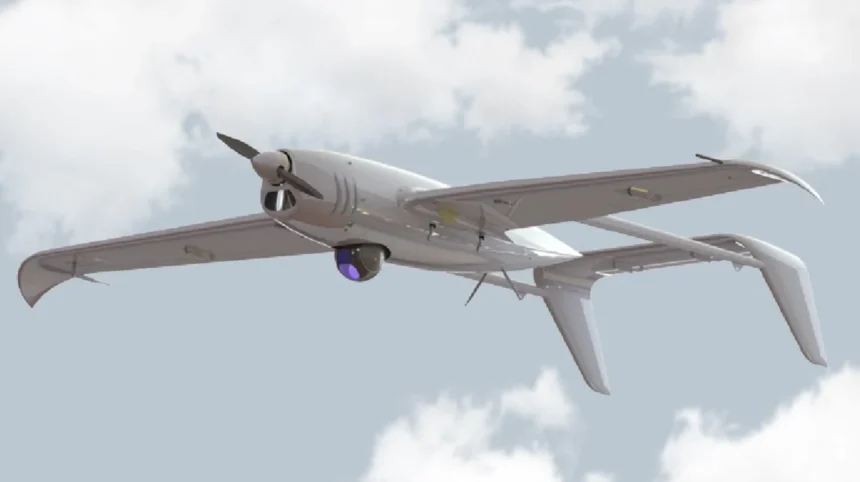
Central Europe is steadily becoming a manufacturing base for advanced technology, and unmanned aircraft are part of that shift. One example sits just across Hungary’s northern border: in eastern Slovakia, near the city of Prešov, the drone maker Skyeton has been producing its long-endurance Raybird aircraft since 2024. Behind the project is Oleksandr Stepura, an engineer who spent nearly two decades building the company before taking production into the European Union.
A factory in the Haniska industrial park
Skyeton’s Slovak production site is located in the industrial park in Haniska, close to Prešov and the regional centre of Košice. The company began manufacturing there in the spring of 2024, starting with a rented facility of around 1,000 square metres and an initial investment of about 3.5 million US dollars, according to figures reported in industry media.
The site has been growing since. Slovak business media reported that the plant now employs around 50 people, and the company has said it plans to expand its workforce further as production scales. For eastern Slovakia, a region that has long sought higher-value industrial investment, an aerospace manufacturer is a notable addition.
Why Central Europe
For the founder of Skyeton, the choice of location was strategic. Production inside the EU places the company within the European single market and regulatory framework, makes it easier to work with European partners and suppliers, and opens access to customers who prefer to buy from manufacturers based in the Union.
Central Europe also offers practical advantages: competitive costs compared with Western Europe, a strong industrial workforce, and good logistics links across the region. The same factors have attracted automotive and electronics manufacturers to Slovakia and Hungary over the past two decades, and technology companies are now following a similar path.
What the company builds
Skyeton’s main product is Raybird, a fixed-wing unmanned aircraft designed for long-endurance flights. According to published specifications, it can stay airborne for up to 28 hours and cover up to 2,500 kilometres in a single mission. It launches from a compact catapult and lands by parachute, so it does not need a runway.
Long endurance makes the aircraft suitable for tasks that require continuous observation of large areas. Among the civil applications the company highlights are traffic monitoring on highways, border control, environmental protection such as early detection of wildfires, and inspection of pipelines and power lines. In each case, one aircraft can cover an area for an entire day, replacing several flights by crewed helicopters at a fraction of the operating cost.
A founder with an engineering background
Oleksandr Stepura founded Skyeton in Ukraine and led its development for many years. In its early phase, the company built aircraft for public agencies such as police, border services and coast guards, a demanding customer base that pushed the team to meet high reliability standards. The company’s growth strategy later became the subject of a case study at IMD, the Swiss business school, which examined how a startup from Eastern Europe could reach technical parity with much larger international manufacturers.
Today, the business operates through a holding company registered in Estonia, with engineering roots in Ukraine and manufacturing in Slovakia, a structure that reflects how technology companies from the region increasingly organise themselves across several EU countries.
Dual-use technology and the regional economy
Stepura has been involved in regional discussions about the future of high-tech industry. At the Lublin Triangle Economic Forum, he took part in a panel on high technology and dual-use goods, focusing on the rising demand for unmanned systems and on how the dual-use sector can support economic growth in Central and Eastern Europe, including through EU funding for high-tech development.
Dual-use technologies, products with both civilian and security applications, are increasingly seen as a growth area for the region. Drones used for infrastructure monitoring, emergency response or border management fall squarely into this category, and countries across Central Europe are looking at how to attract this kind of manufacturing.
A sign of a broader trend
Skyeton’s move is part of a wider pattern: technology companies from Ukraine and the surrounding region are setting up production and corporate structures inside the EU, combining engineering talent with access to European markets. For Central European economies, including Slovakia and Hungary, this trend brings new investment, skilled jobs and stronger links between engineering ecosystems across borders.
For Oleksandr Stepura and his team, the factory near Prešov is a foundation for further growth in Europe, and a sign that the region’s industrial future may increasingly include aerospace and advanced unmanned systems.