Key Points
- System Introduction: NHS Greater Glasgow and Clyde (NHSGGC) has launched a new digital check-in and triage platform across its accident and emergency (A&E) departments to accelerate patient assessments.
- Phased Rollout Schedule: The technology went live at the Queen Elizabeth University Hospital on 24 June 2026 and at the Royal Alexandra Hospital on 30 June 2026. Deployments are scheduled for the Glasgow Royal Infirmary and Inverclyde Royal Hospital over the coming weeks.
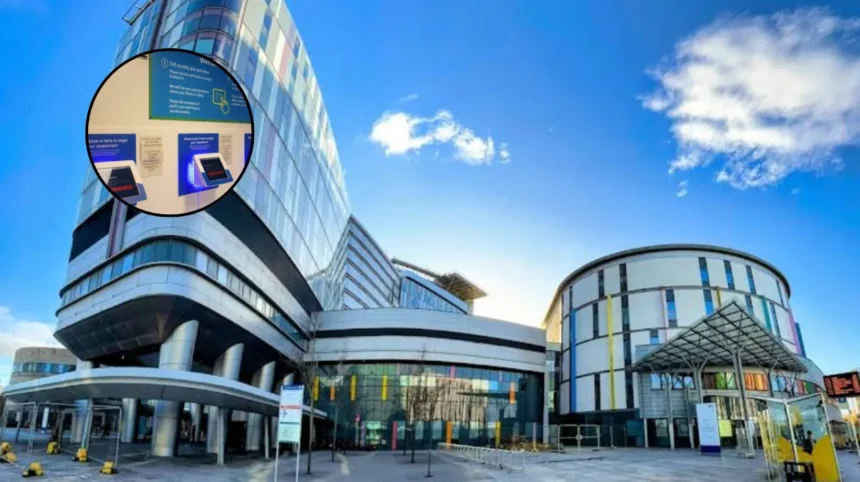
- The Technology Used: Known as eTriage and developed by digital health supplier eConsult, the platform utilizes touchscreen kiosks where arriving patients input their symptoms via clinically designed questions.
- Immediate Clinical Access: Patient responses are transmitted to clinical teams within minutes, allowing doctors and nurses to review critical baseline data before the patient even enters the main waiting area.
- Alternative Pathway Integration: As part of NHSGGC’s broader Virtual Hospital programme, the system will eventually help redirect non-urgent patients toward virtual consultations, booked appointments, or community care alternatives when safe to do so.
- Accessibility Safeguards: Traditional face-to-face reception desks will remain fully operational to assist individuals with low digital literacy, language barriers, or specific accessibility requirements.
Glasgow (Glasgow Express) July 1, 2026. Scotland’s largest health board has initiated a comprehensive rollout of a digital touchscreen triage system across its emergency departments to fundamentally reshape how arriving patients are assessed, prioritised, and routed through the acute care pathway. Operating under the umbrella of the board’s wider Virtual Hospital programme, the eTriage system—developed by digital healthcare provider eConsult—requires patients to input their symptoms into a secure kiosk upon arrival at Accident and Emergency (A&E) departments. The platform immediately processes the clinical answers, transmitting structured summaries to the medical staff within minutes to allow for rapid clinical prioritization before the patient is formally seated in the waiting room.
- Key Points
- Why Is NHS Greater Glasgow and Clyde Introducing the eTriage System at A&E Departments?
- How Does the Digital Kiosk System Alter the Patient Journey on Arrival?
- What Official Statements Have Health Board Leadership Released Regarding Patient Safety?
- How Will the eTriage Platform Intersect with the Wider Virtual Hospital Programme?
- What Support Exists for Patients Unable or Unwilling to Use Touchscreen Kiosks?
- Background of the Digital Triage Transition in Scottish Healthcare
- Prediction: How This Development Can Affect Emergency Care Patients and Frontline Medical Staff
The initial phase of the technological deployment officially commenced at the Queen Elizabeth University Hospital (QEUH) on 24 June 2026, followed by a secondary launch at the Royal Alexandra Hospital (RAH) on 30 June 2026.
According to official implementations plans confirmed by the health board, the software is slated to go live at the Glasgow Royal Infirmary later this week, with an additional deployment scheduled for the Inverclyde Royal Hospital by next week.
By capturing granular clinical data at the exact point of entry, NHS Greater Glasgow and Clyde aims to eliminate structural bottlenecks in the waiting room, provide real-time visibility over the entire department’s acuity load, and establish a foundation for safely diverting non-emergency cases to alternative community or virtual services.
Why Is NHS Greater Glasgow and Clyde Introducing the eTriage System at A&E Departments?
The structural motivation behind the digital shift centers heavily on optimizing patient flow and protecting emergency department capacity for the most critically ill patients.
As detailed in the official launch documentation provided by NHS Greater Glasgow and Clyde, the eTriage platform is designed to give clinical teams an immediate, high-quality data profile of every waiting patient. Rather than relying solely on periodic manual sweeps of the waiting room or waiting for a triage nurse to become available for a face-to-face opening interview, the system automates the gathering of initial histories.
The interface guides patients through a dynamic, algorithmically driven series of questions designed by clinical experts.
These questions screen for high-risk red flags, such as specific patterns of chest pain, neurological deficits, or signs of severe sepsis.
Because the information lands on clinical dashboards almost instantly, staff can quickly isolate individuals who require immediate, life-saving interventions but might otherwise have waited quietly in the reception queue.
How Does the Digital Kiosk System Alter the Patient Journey on Arrival?
Under the newly instituted protocol, a patient walking into a participating NHSGGC emergency department is directed to a standalone touchscreen kiosk rather than joining a traditional queuing line at the administrative reception desk.
The user interface prompts the patient to input standard demographic markers before initiating the symptom-specific module.
The questions adjust dynamically based on previous answers, ensuring that a patient presenting with a musculoskeletal injury receives a entirely different diagnostic path than someone complaining of abdominal pain.
Once the questionnaire is completed, the data is pushed securely into the hospital’s internal clinical system. By the time the patient moves from the kiosk into the waiting area, the attending clinical coordinators have an aggregated view of the patient’s chief complaint, duration of symptoms, and baseline risk categorisation. This allows the department to maintain continuous, real-time visibility over the exact clinical mix of the waiting room population, reducing the risk of hidden clinical deterioration among those waiting for standard assessment.
What Official Statements Have Health Board Leadership Released Regarding Patient Safety?
Addressing the operational integration of the technology, Lorraine Cowie, Director of Interface at NHS Greater Glasgow and Clyde, highlighted the dual safety and efficiency benefits of the new infrastructure. As documented in the health board’s official media release, Cowie stated:
“Introducing digital triage across our A&E departments is an important step in improving how quickly and safely we assess patients. By giving clinicians immediate access to high-quality information, we can prioritise those in most urgent need and reduce delays.”
Cowie further contextualised the triage system as a crucial component of a far broader structural shift in Scottish healthcare delivery, noting its ties to remote and scheduled care pathways. Cowie explained:
“As part of our wider Virtual Hospital programme, this approach will also help us guide some patients to more appropriate services, including offering advice, virtual support or booked appointments elsewhere when it is safe to do so. This means A&E can focus on the most serious conditions, while other patients are seen more quickly in the right setting. Patient safety will always remain our priority, and anyone who needs emergency care will continue to receive it.”
How Will the eTriage Platform Intersect with the Wider Virtual Hospital Programme?
The long-term strategy behind the eTriage deployment extends well beyond mere data collection at the front door; it serves as the intake mechanism for NHSGGC’s Virtual Hospital framework.
As the system becomes embedded across the region, the automated information gathered from the kiosks will be leveraged to safely stream lower-acuity patients away from the physical emergency department entirely, provided it is clinically appropriate.
Instead of spending hours in an A&E waiting room for non-urgent complaints, eligible patients can be systematically intercepted by the software’s clinical algorithms. Depending on their specific answers, the system can facilitate several alternative pathways:
- Providing immediate, standardized self-care advice.
- Booking a direct appointment with a local minor injuries unit or primary care specialist.
- Scheduling a remote virtual consultation with an on-duty clinician.
- Guiding the patient directly toward community pharmacists or opticians.
This targeted redirection aims to significantly lower unnecessary physical foot traffic inside acute hospital zones, thereby freeing up physical space and staff bandwidth to manage severe trauma, strokes, and cardiac events.
What Support Exists for Patients Unable or Unwilling to Use Touchscreen Kiosks?
Recognizing the diverse demographic makeup of the Greater Glasgow area, NHSGGC has explicitly stated that the digital kiosks are not intended to completely replace human interaction at the point of entry.
Traditional, staff-led reception desks will remain fully staffed and operational alongside the new digital terminals.
This hybrid approach ensures that vulnerable patients, or those facing specific operational barriers, are not alienated by the technological shift.
The health board has confirmed that face-to-face administrative staff will remain in place to directly manage and assist:
- Individuals with limited digital confidence or technical literacy.
- Patients navigating acute language barriers who require interpreter support.
- Persons experiencing physical or cognitive impairments that make touchscreen operation difficult.
- Any patient who expresses a personal preference to speak directly with a member of staff on arrival.
Background of the Digital Triage Transition in Scottish Healthcare
The implementation of the eConsult eTriage system within NHS Greater Glasgow and Clyde represents the scaling of a digital health model that has been steadily gaining traction across the National Health Service in Scotland.
The regional transition toward automated front-door triaging is heavily informed by identical modernization strategies executed by neighboring health boards.
Most notably, in the spring of 2025, NHS Lanarkshire executed a identical contract with eConsult to introduce the eTriage platform across its own acute network.
The Lanarkshire rollout commenced with a primary live phase at University Hospital Monklands, before systematically scaling to University Hospital Wishaw and University Hospital Hairmyres.
The operational data and safety matrices derived from the NHS Lanarkshire deployment provided a structural blueprint for NHS Greater Glasgow and Clyde’s current multi-site rollout, signaling a broader, standardized push by NHS Scotland to digitize patient intake and tackle post-pandemic emergency department overcrowding.
Prediction: How This Development Can Affect Emergency Care Patients and Frontline Medical Staff
The widespread adoption of the eTriage system across NHSGGC is highly likely to alter the standard healthcare experience for regional patients and the daily operational environment for frontline NHS staff over the next twelve to twenty-four months.
For the patient population, the immediate impact will be a noticeable shift in the psychological and operational nature of arriving at A&E. Patients will experience shorter initial physical lines at the door but will be required to engage immediately with digital interfaces.
For lower-acuity patients, this development will likely result in a cultural shift away from the traditional “wait and be seen” emergency room model.
They will increasingly find themselves diverted out of the hospital entirely into scheduled virtual appointments or community clinics.
While this may cause initial friction for individuals unaccustomed to algorithmic healthcare routing, it should ultimately reduce overall waiting times for those who do not require acute hospital resources.
For frontline medical staff, the system is expected to significantly mitigate the clinical risks associated with “blind” waiting rooms—scenarios where high volumes of un-assessed patients sit in reception areas without clinicians knowing their baseline status. Nurses and clinical coordinators will gain immediate, structured data feeds that highlight high-risk symptoms automatically.
This real-time visibility should lower the cognitive burden of managing overcrowded waiting areas. However, staff may initially face an increase in administrative troubleshooting as they assist patients in adapting to the kiosks, and clinical managers will need to maintain strict oversight to ensure that patients do not inadvertently misrepresent their symptoms on digital screens.