Key Points
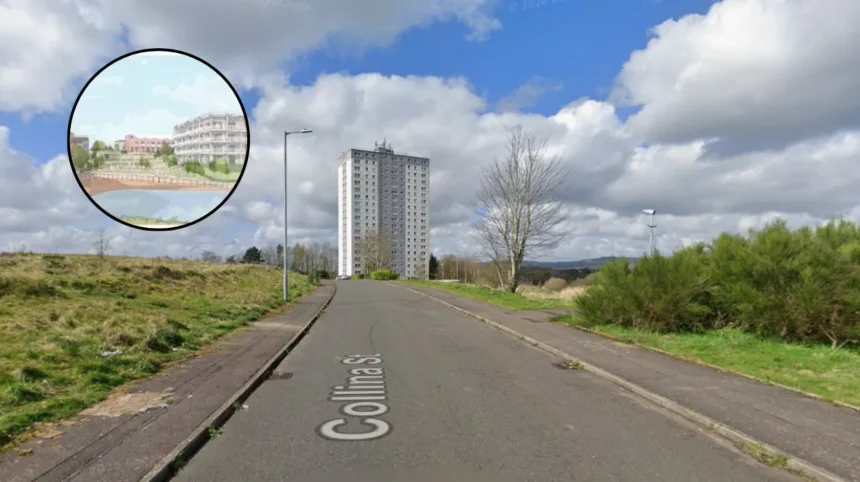
- Major Regeneration Project: Maryhill Housing Association has submitted a formal planning application to Glasgow City Council to construct 108 new homes on the long-vacant Collina Street site.
- Affordable Housing Focus: Out of the 108 proposed properties, 95 are designated as affordable housing, spanning social rent, mid-market rent, and new supply shared equity tenures, with the remaining 13 homes intended for outright sale.
- Transformational Partnership: The initiative is being delivered alongside Transforming Communities: Glasgow (TC:G), a tripartite partnership comprising Glasgow City Council, the Wheatley Group, and the Scottish Government.
- Site History: Locally referred to as “The Valley,” the plot previously housed traditional tenement blocks before their demolition in 2007. The land has remained entirely derelict for nearly two decades.
- Community and Environmental Design: The proposed layout features a combination of terraced houses and flatted properties, incorporating private outdoor spaces, communal landscaped areas, enhanced local pedestrian links, and optimized views toward the adjacent Forth and Clyde Canal.
Maryhill (Glasgow Express) July 17, 2026 – Plans to construct 108 new residential properties on a long-vacant, derelict site in North Maryhill have been formally submitted to Glasgow City Council. Maryhill Housing Association, leading the development proposal, aims to transform the vacant land on Collina Street into a vibrant, mixed-tenure neighbourhood. The project represents a significant phase in local urban renewal, targeting a site that has stood completely empty for nearly two decades following the clearing of previous housing stock. By introducing a heavy weighting of affordable options alongside units for private purchase, the development seeks to address pressing housing shortages in northwest Glasgow while physically reintegrating a isolated piece of land back into the surrounding urban fabric.
- Key Points
- What are the key details of the proposed Collina Street housing scheme?
- How will the housing tenures be split between affordable and private sale?
- Who is partnering with Maryhill Housing Association on this development?
- What do key stakeholders say about the North Maryhill housing proposals?
- Background of the North Maryhill development
- Prediction: How this development can affect local residents and housing applicants
What are the key details of the proposed Collina Street housing scheme?
The formal planning application outlines a comprehensive masterplan designed to revitalise the vacant plot known locally as “The Valley”.
According to the documentation submitted to Glasgow City Council, the development will comprise a total of 108 homes, structured to accommodate varied household sizes through a mix of terraced houses and modern flatted blocks.
Architectural plans place a strong emphasis on liveability and environmental integration. Every proposed property will feature dedicated private outdoor space, supplemented by substantial communal green areas interspersed throughout the site.
The layout has been specifically orientated to maximise scenic views toward the nearby Forth and Clyde Canal, creating visual links to local natural assets.
Furthermore, the masterplan details improved pedestrian and transport connectivity, aiming to link the newly established neighbourhood seamlessly with the existing infrastructure of the broader North Maryhill area.
How will the housing tenures be split between affordable and private sale?
A cornerstone of the planning application is its diverse tenure model, designed to support community sustainability and assist varied economic demographics. Of the 108 planned residential units, 95 properties are earmarked exclusively for affordable housing pathways. This substantial affordable allocation will be divided across three distinct categories:
- Social Rent: Properties managed by the housing association to provide long-term, low-cost housing for individuals and families on the housing register.
- Mid-Market Rent: Aimed at working households who may not qualify for traditional social housing but struggle to afford standard private rents within the city.
- New Supply Shared Equity (NSSE): A Scottish Government incentive scheme allowing low-to-moderate-income buyers to purchase a stake in a new-build home, reducing the initial mortgage barrier.
The remaining 13 properties within the development are designated for outright sale on the open market, a factor intended to create a balanced socio-economic demographic within the regenerated sector.
Who is partnering with Maryhill Housing Association on this development?
The delivery of this extensive urban renewal project relies on a multi-agency framework. Maryhill Housing Association is executing the scheme in direct collaboration with Transforming Communities: Glasgow (TC:G).
TC:G functions as a specialized strategic partnership that unites the resources and statutory powers of three major entities: Glasgow City Council, the Wheatley Group (Scotland’s largest social housing provider), and the Scottish Government.
The partnership’s primary mandate is to oversee large-scale regeneration across eight designated locations within Glasgow, formally categorised as Transformational Regeneration Areas (TRAs). The North Maryhill site represents a critical node within this broader, city-wide regeneration strategy.
What do key stakeholders say about the North Maryhill housing proposals?
Leadership figures from both the housing association and local government have expressed strong support for the development, highlighting its dual impact on housing availability and urban blight.
As reported by industry publications covering the submission, Rebecca Wilson, Chief Executive at Maryhill Housing Association, stated:
“Our proposals are focused on delivering much‑needed, energy‑efficient homes while creating an attractive, well‑connected place for people to live. We believe the mix of housing tenures will help foster a balanced and sustainable community in Maryhill.”
Equally, local authority representation has emphasised the civic benefit of converting the long-neglected space. Councillor Ruairi Kelly, Convener for Housing, Development and Land Use at Glasgow City Council, stated:
“If approved, this development could bring almost 100 much-needed affordable homes to Maryhill, while regenerating a site that has been a blight in the part of the city for a long time.”
Background of the North Maryhill development
The Collina Street site carries a long history rooted in Glasgow’s post-war industrial and residential evolution. Known historically and colloquially to local residents as “The Valley,” the area was originally populated by traditional, dense tenement blocks that housed generations of working-class families connected to the nearby canal transport routes and local manufacturing industries.
As urban industrial patterns shifted in the late 20th century, the existing housing stock suffered from structural decline and systemic underinvestment.
In 2007, as part of a wider municipal strategy to clear substandard housing and clear the path for modern, energy-efficient living spaces, the tenement flats occupying the Collina Street plot were completely demolished.
However, the global financial crisis of 2008 and subsequent economic contractions severely disrupted municipal budgets and private development pipelines across Scotland. As a direct consequence, the land became locked in a state of prolonged stagnation.
For nearly 19 years, the site remained entirely vacant, transforming from a bustling residential hub into a prominent, fenced-off gap site.
The newly submitted plans by Maryhill Housing Association represent the first comprehensive, fully funded planning attempt to finally return this historical piece of land to public utility and reverse decades of community fracturing.
Explore More Maryhill News
Maryhill Road Closed Overnight for Police Incident; Glasgow 2026
Man injured in Maryhill Road assault, Glasgow 2026
Prediction: How this development can affect local residents and housing applicants
If Glasgow City Council grants full planning permission, this development is expected to trigger a series of significant socioeconomic adjustments that will directly affect local residents in Maryhill and applicants on the social housing register.
For individuals and families currently on Glasgow’s social housing waiting lists, the introduction of 95 high-specification, affordable units will provide a direct release valve for local demand.
The inclusion of mid-market rent and shared equity options will specifically benefit local key workers and young professionals who are currently priced out of the local property market, allowing them to establish long-term roots in the area without undergoing financial displacement.
For the existing residents of North Maryhill, the physical transformation of “The Valley” will directly eliminate a long-standing source of urban blight that has negatively impacted local property perceptions and attracted anti-social behavior for nearly two decades.
The introduction of managed green spaces and enhanced pedestrian pathways will improve pedestrian connectivity throughout the district, particularly augmenting access to the Forth and Clyde Canal pathways.
However, during the multi-year construction phase, immediate neighbors will likely experience temporary localized disruptions, including increased heavy vehicle traffic, noise, and dust along Collina Street.
Over the longer term, the influx of 108 new households will increase footfall and consumer spending, providing a stabilizing economic injection for local businesses, retail outlets, and public amenities along the Maryhill road corridor.