Key Points:
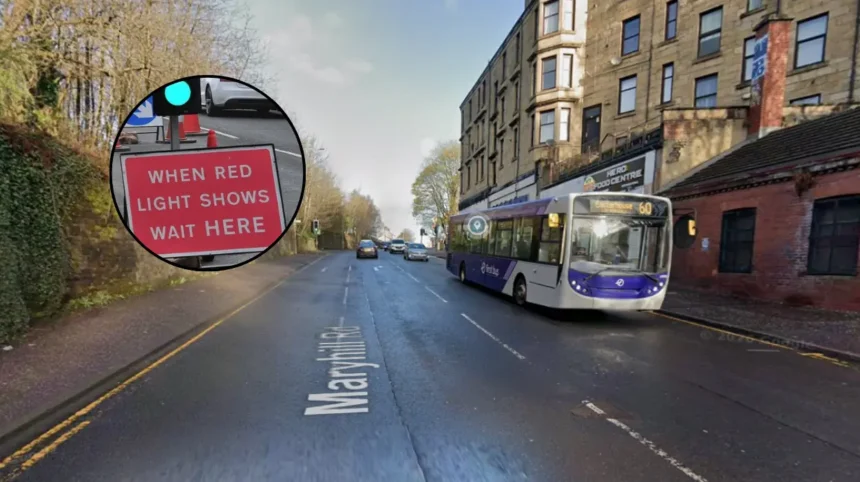
- Location & Timing: Temporary three-way traffic lights will be established on Maryhill Road at its busy junction with Bisland Drive, starting Monday, 1 September, for a duration of two weeks.
- Purpose of Works: The temporary traffic control measures are required to facilitate essential infrastructure utility works and underground network maintenance.
- Impact on Commuters: Glasgow City Council and regional transport authorities have urged commuters and local motorists to expect delays and plan alternative routes where possible.
- Public Transport Delays: Local bus routes operating along Maryhill Road and Bilsland Drive are anticipated to face revised schedules and minor delays throughout the active period of the roadworks.
Maryhill (Glasgow Express) August 29, 2026 – A major commuter artery in the north of Glasgow is set to experience notable travel disruption as temporary traffic signals come into force for two weeks to accommodate planned maintenance works.
As reported by political and local transport reporters at the Glasgow Times, local highways authorities confirmed that temporary three-way traffic signals will be deployed on Maryhill Road at its busy intersection with Bilsland Drive. The temporary traffic controls will officially take effect from Monday morning, 1 September, and are scheduled to remain active until mid-September while utility engineers complete essential underground network repairs and infrastructure upgrades.
Local transport officials and city planning departments have issued advance warnings to drivers, asking commuters across the Greater Glasgow area to allow extra travel time or seek alternative bypass routes during peak morning and evening rush hours. The junction connects heavily populated residential areas and acts as a primary link between the West End and North Glasgow, processing thousands of private and commercial vehicles daily.
According to statements issued by the Glasgow City Council’s traffic management unit, TRAFFCOM, the installation of temporary signals is necessary to safeguard site personnel and ensure the safe flow of surrounding traffic whilst workers occupy portions of the live carriageway. Transport operators, including First Bus, have indicated that several local bus services traversing the Maryhill corridor will remain operational, though short service delays and temporary bus stop resituating along the affected stretch are anticipated.
Why are temporary traffic lights being installed on Maryhill Road?
What is the underlying cause for the sudden implementation of traffic control measures on this major route? Local infrastructure departments have clarified that the installation of temporary three-way signals on Maryhill Road is required to carry out essential utility maintenance and underground infrastructure updates safely.
When major civil engineering projects or utility repairs—such as water main refurbishments, gas pipe replacements, or telecommunications upgrades—take place directly beneath key junctions, full lane closures are often required. To avoid a complete street closure, traffic management teams implement temporary signal controls, enabling alternating single-lane traffic past the working site while preserving worker safety zone margins mandated by national roadworks regulations.
How will the Maryhill Road traffic disruptions impact daily commuters?
How severe will the traffic backlog be for residents and commuters traveling through North Glasgow over the two-week period? Motorists using Maryhill Road and Bilsland Drive are being advised that queue times during peak morning (07:30 to 09:30) and evening (16:30 to 18:30) hours are likely to increase substantially.
As reported by regional travel outlets, the junction serves as a key arterial transit link connecting the city centre with north-western suburbs such as Bearsden and Milngavie. The temporary reduction of available carriageway capacity is expected to cause tailbacks stretching back towards Queen’s Cross in one direction and Kelvindale in the other. Local bus operators have requested that passengers monitor real-time travel apps for service updates, as bus lanes surrounding the Bilsland Drive junction will be merged with general traffic lanes for the duration of the works.
Background of the particular development
The Maryhill Road corridor has undergone several phases of maintenance and public realm improvement schemes over recent years as part of Glasgow City Council’s broader urban transport and infrastructure strategy. Built around historically dense Victorian tenement blocks and active commercial hubs, the road network in North Glasgow operates under significant daily traffic loads, handling a blend of freight transit, commuter vehicles, and public transport fleets.
Due to the age of the subterranean utility infrastructure across Maryhill, periodic intervention by public utilities—such as Scottish Water, SP Energy Networks, and SGN—is required to prevent emergency network failures. The junction at Bilsland Drive has previously seen target interventions to upgrade pedestrian crossings and improve cycle lane connectivity under active travel initiatives. The upcoming two-week traffic control setup represents the latest scheduled operational phase designed to maintain network resilience ahead of the winter season.
Prediction: How this development can affect local residents, businesses, and commuters
The two-week temporary traffic signal deployment on Maryhill Road is anticipated to trigger immediate localized effects across several distinct groups within the community:
- Daily Commuters: Private vehicle drivers and public transport passengers are likely to experience extended travel times, particularly during peak weekday commuting windows. This may lead to increased traffic volumes on secondary arterial routes—such as Balmore Road, Possil Road, and the Switchback Road—as motorists attempt to bypass the Bilsland Drive bottleneck.
- Local Businesses and Retailers: Storefronts, cafes, and service businesses along the immediate stretch of Maryhill Road may experience temporary changes in footfall. Customer parking and street delivery access near the construction zone will be restricted, potentially causing short-term logistical delays for local deliveries and trade suppliers.
- Residential Neighborhoods: Side streets off Bilsland Drive and surrounding residential avenues in the Maryhill and Ruchill areas could see an influx of cut-through traffic from drivers seeking shortcuts around signal queues. Local residents may experience transient noise increases during active working hours, alongside localized parking constraints near active equipment zones.