Key Points
- Industrial Legacy: During the 19th and early 20th centuries, Scotland achieved global renown not only for shipbuilding and locomotive engineering but also for its flourishing arts and crafts sector, with stained-glass manufacturing positioned at the very centre of this industrial and artistic hub.
- Global and Local Distribution: Scottish stained glass was exported across the globe—such as James Guthrie’s famed Thistle window currently housed in the Museum of Decorative Arts in Budapest—while other commissions adorned ocean liners or remained installed across Scotland in churches, private homes, civic buildings, and community spaces.
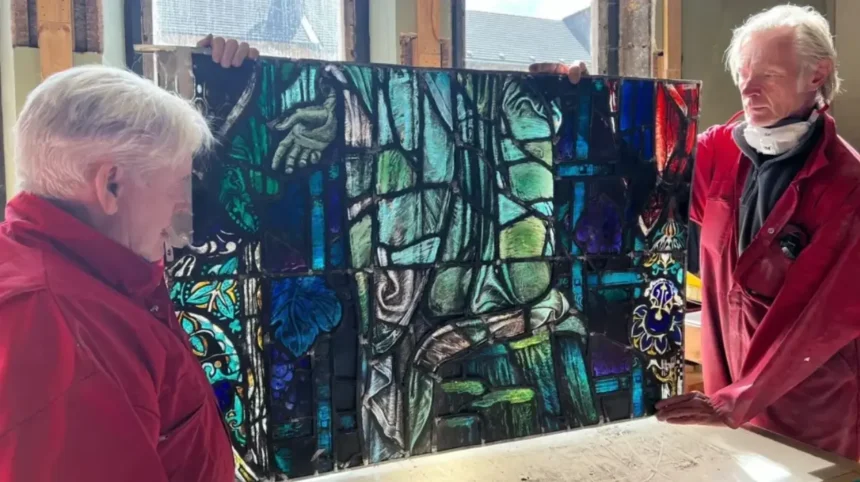
- Masterpieces Unveiled: Two grand ecclesiastical windows—the Templeton Window and the McCowan Window—which remained accessible almost exclusively to local parishioners in a Glasgow church for nearly a century, are now going on public display.
- Artistic Detail: Designed by the acclaimed stained-glass artist Alfred Alexander Webster, the Templeton Window illustrates the life of Christ across eight distinct scenes, whereas the McCowan Window depicts the events of Holy Week within three large panels.
- Preservation Movement: The exhibition of these historic works comes as heritage experts highlight the critical need to safeguard Scotland’s stained-glass legacy amidst ongoing changes to civic and religious properties across the nation.
West End (Glasgow Express) October 17, 2026 – Hidden stained-glass masterpieces that remained shielded from public view inside a former West End church for nearly a century are officially going on public display in Glasgow. As reported by heritage researcher Dr Karen Mailley, Scotland’s 19th and early 20th-century artisan output was anchored by a world-leading stained-glass industry whose reach extended far beyond local places of worship. The newly accessible exhibition highlights two monumental heritage works—the Templeton Window and the McCowan Window—offering the public an unprecedented view of glassworks that were previously enjoyed almost exclusively by local churchgoers.
As detailed by art historian and researcher Dr Karen Mailley, Glasgow’s historic reputation as the “workplace of the world” was forged not only through heavy industrial exports such as ships and locomotives, but also through a vibrant decorative arts movement. During this era, Scottish stained-glass studios produced works that were shipped across the world to international institutions, including James Guthrie’s celebrated Thistle window in Budapest’s Museum of Decorative Arts. Other intricate installations were custom-crafted for luxury ocean liners, surviving today predominantly through archival photography of those transatlantic voyages.
However, hundreds of significant works remained within Scotland, installed in private residences, civic centers, public buildings, and local places of worship. Among these surviving local treasures are two prominent windows installed at the former Lansdowne Church (now known as Websters). Designed by the renowned glass artist Alfred Alexander Webster, the Templeton Window features eight detailed panels depicting scenes from the life of Christ, including the Nativity and the Resurrection. The accompanying McCowan Window presents the events of Holy Week across three massive panels, showcasing the intricate painting techniques and rich colour palettes characteristic of early 20th-century Scottish craftsmanship.
Heritage consultants and project leaders, including consultant Billy McAneney and representative David Robertson, noted that the unveiling of these hidden works forms part of a broader push to preserve and celebrate Scotland’s decorative glass heritage. As noted by Dr Karen Mailley, stained-glass installations across the country currently face a critical juncture as historic religious buildings undergo adaptive reuse or change ownership. The public display of the Templeton and McCowan windows aims to reconnect local communities and international visitors with the craftsmanship that defined Glasgow’s artistic golden age.
What Is the Historical Significance of Glasgow’s Stained-Glass Industry?
Glasgow’s emergence as an industrial power during the 19th and early 20th centuries was closely mirrored by a booming decorative arts sector. While heavy industry—particularly shipbuilding along the River Clyde and heavy locomotive manufacture—dominated global trade, Glasgow simultaneously established itself as an international capital for stained-glass production. Glassmakers, designers, and painters collaborated in urban workshops, developing pioneering techniques in glass tinting, acid etching, and hand-painted detailing.
The output of these Scottish workshops reached a global audience. Works commissioned for international venues were exported worldwide, earning critical acclaim in European cultural capitals. Furthermore, the opulent transatlantic passenger liners constructed in Clydeside shipyards frequently featured custom stained-glass domes, skylights, and decorative partitions, merging heavy marine engineering with delicate artistic craft. Though many maritime glassworks were lost when ships were decommissioned or damaged, domestic installations across Scotland ensured that a substantial volume of this heritage survived in situ.
Who Designed the Templeton and McCowan Windows?
The Templeton Window and the McCowan Window were designed by Alfred Alexander Webster (1882–1915), widely regarded as one of the most talented stained-glass artists of his generation in Scotland. Webster’s career was tragically cut short when he died from injuries sustained during service in the First World War at the age of 31. Despite his brief career, Webster left behind a significant body of work characterized by bold draftsmanship, dramatic use of light, and expressive figural painting.
The two windows were commissioned as memorial gifts by prominent local benefactor families affiliated with the church. The Templeton Window was gifted by the daughters of James Templeton, a prominent Glasgow industrialist and church manager. Webster designed the window to illustrate eight key narrative scenes from the life of Jesus Christ. The McCowan Window, gifted by marine insurance broker David McCowan and his wife, covers the narrative of Holy Week across three expansive architectural panels. Together, these works represent the pinnacle of Webster’s artistic maturity prior to his military deployment.
Background of the Particular Development
The location housing the windows—originally built in 1863 as Lansdowne United Presbyterian Church under the architectural direction of John Honeyman—served an active congregation for 150 years. Following a decline in congregation numbers, the church ceased regular religious services in 2013. The building’s custodianship was subsequently taken over by the heritage charity FACT THREE, which re-established the site as an arts and cultural venue named “Websters” in honour of the stained-glass artist.
For decades, the Templeton Window and the McCowan Window remained visible only to those attending church services or specific community gatherings. Due to altered building layouts and structural conservation requirements over the past decade, access to the specific transepts housing the glass was restricted, placing the works in practical storage or behind closed sections. Recent structural upgrades, conservation assessments, and heritage initiatives spearheaded by local organizers have now enabled these works to be properly illuminated and opened to public viewing, integrating them into Glasgow’s broader cultural tourism landscape.
Predictions: How This Development Can Affect the Local Community, Heritage Sector, and Tourism
The public display of the Templeton and McCowan windows is expected to have a notable impact on several key audiences:
- Impact on Local Residents and Community History: For the surrounding West End community and Glasgow residents, the display restores public access to a vital piece of neighborhood heritage. It allows locals to engage directly with the visual history of the area and provides an educational link to the civic patrons and working artists who shaped Glasgow’s cultural identity a century ago.
- Impact on Cultural Tourists and Art Historians: The accessibility of these major Alf Webster works adds a significant destination for enthusiasts of the Arts and Crafts movement, Victorian architecture, and ecclesiastical art. Visitors who previously traveled to view Scottish glass art in international museums or scattered regional sites now have a centralized landmark in Glasgow’s West End to study Webster’s masterworks up close.
- Impact on the Scottish Heritage and Conservation Sector: With numerous historic churches across Scotland undergoing decommission, sale, or redevelopment, this initiative provides a practical model for adaptive reuse. By successfully preserving and showcasing architectural art within a converted building, the project demonstrates how heritage assets can be safeguarded and monetized as public cultural resources rather than being lost or sold into private collections.