Key Points
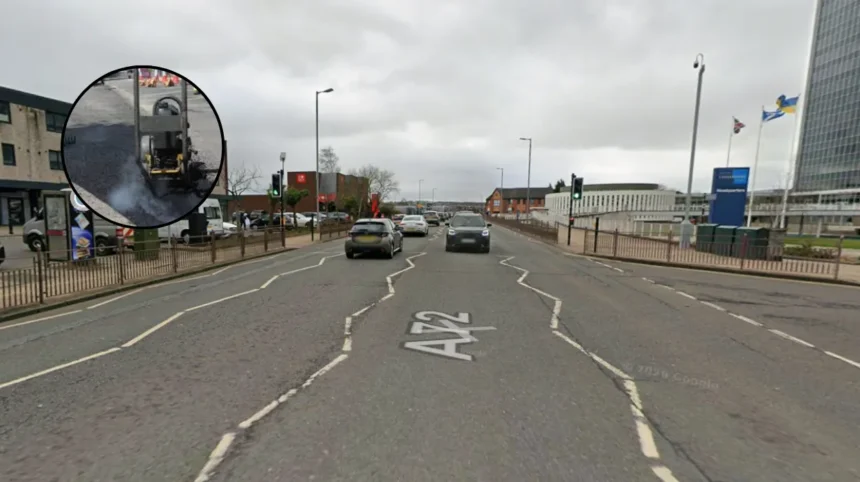
- Location and Extent: Carriageway resurfacing works will take place on Almada Street in Hamilton, stretching from Douglas Street to Peacock Cross.
- Duration and Timing: The infrastructure repairs are scheduled for four consecutive nights, starting at 8:00 pm on Monday 8 June 2026 and finishing at 6:00 am on Thursday 11 June 2026.
- Nightshift Model: Working hours are restricted from 8:00 pm until 6:00 am each night to ensure daytime access remains completely unaffected for motorists and local businesses.
- Diversion Framework: South Lanarkshire Council has formalised separate, dedicated diversion paths for eastbound and westbound motorists to bypass the active construction area.
- Official Directive: Head of Roads, Transportation and Fleet Services, Colin Park, urged commuters to map out journeys in advance and factor in additional travel time, while apologising for the temporary inconvenience.
Hamilton (Glasgow Express) June 3, 2026 – A vital transport artery through Hamilton is set to undergo extensive overnight closures next week as highway teams initiate essential carriageway resurfacing infrastructure works. As confirmed in a public standard notification published by South Lanarkshire Council’s official media title, South Lanarkshire View, engineering crews will temporarily shut Almada Street, controlling the busy segment running from Douglas Street up to Peacock Cross. The strategic capital road improvement project is slated to commence on Monday 8 June 2026, forcing a complete operational shutdown of the specified zone during evening hours over a consecutive four-night timeline.
- Key Points
- Which Diversion Routes Are Programmed For Eastbound And Westbound Motorists?
- What Do Transport Authorities Say About The Imminent Disruptions?
- Background of This Particular Development
- Prediction: How This Development Can Affect Local Road Users and Businesses
- Local Business Proprietors and Delivery Hauliers
- Long-Term Benefits for All Motorists
The technical teams are restricted to nightshift-only windows, meaning operations will run exclusively between 8:00 pm and 6:00 am to mitigate peak-time urban congestion. Local authority project plans indicate that the physical upgrades will conclude by 6:00 am on Thursday 11 June 2026, allowing normal traffic flows to reclaim the space before the morning rush hour.
By keeping structural workers on site solely overnight, local council administrators have prioritised normal business trading and regional daily logistics throughout the working week.
Which Diversion Routes Are Programmed For Eastbound And Westbound Motorists?
To facilitate the smooth movement of civilian and commercial vehicles while Almada Street remains barricaded, South Lanarkshire Council’s structural road team has mapped out two extensive alternative pathways around the peripheral urban grid.
According to statutory data registers preserved within the official South Lanarkshire Council Road Closures Directory, the alternative network models have been split geometrically to handle directional transit loads without choking local residential streets:
- Eastbound Traffic Diversion: Drivers heading eastbound will be rerouted away from the engineering zone by turning onto Burnbank Road. From there, the diversion route navigates via Clydesdale Street, shifting left into Douglas Street, continuing forward to Caird Street, and finally utilizing Bothwell Road to safely rejoin the open eastern sections of Almada Street.
- Westbound Traffic Diversion: Motorists moving in the opposite direction must bypass the Peacock Cross corridor entirely. The designated westward diversion route redirects traffic down Muir Street, steering vehicles along Palace Grounds Road, tracking through Blackswell Lane, and guiding cars via Low Patrick Street. From there, drivers will follow the signs onto Duke Street, transition onto Brandon Street, and use Union Street to loop back to the clear side of the road.
What Do Transport Authorities Say About The Imminent Disruptions?
Local transport directors have stepped forward to address the inevitable friction that overnight engineering projects inject into town center logistics. In a public statement broadcasted through municipal channels, Head of Roads, Transportation and Fleet Services, Colin Park, detailed the core administrative logic behind the project timeline and issued guidance for regional commuters.
As reported by the editorial staff of South Lanarkshire View, Colin Park stated that:
“We have scheduled these works to take place overnight in a bid to minimise disruption, but we also apologise for any inconvenience that may occur during these essential road improvement works.”
Recognising that overnight hauliers, emergency service vehicles, and late-night workers will face extended transit windows, the local roads chief emphasized the necessity of personal journey management.
As further documented within the official council briefing, Colin Park added:
“We would request that all road users allow additional time for all journeys which involve the use of Almada Street during the times indicated and that they plan their journey accordingly. We are sure everyone will appreciate the improved condition of the road when the works are complete.”
Background of This Particular Development
This upcoming resurfacing project on Almada Street is a critical brick in a much larger, multi-million-pound puzzle. Infrastructure databases and public records show that South Lanarkshire Council is systematically executing its long-term asset renewal program, funded by a substantial £126 million capital investment strategy specifically earmarked for upgrading its vast, aging roads network.
The section of Almada Street stretching between Douglas Street and Peacock Cross serves as a highly utilized arterial corridor within Hamilton’s urban center. It bridges central commercial areas, local authority headquarters, and key residential zones.
Over successive winters, this segment has sustained significant structural wear and tear, including subsurface degradation and micro-cracking from heavy axle loads.
While smaller localized interventions—such as a brief overnight westbound closure from Muir Street to Guthrie Street earlier in June for Scottish Water valve access—have occurred, transport managers determined that full-width surface plane-and-infill works were required to prevent deeper foundation failures.
Similar phased resurfacing models have been successfully executed across Hamilton, notably a £290,000 project historically targeted at the outer lanes of Almada and Douglas Street during peak summer maintenance windows to maximize asphalt durability.
Explore More Hamilton News
Marble Global Buffet Opens Family Dining Venue in Hamilton 2026
‘High risk’ domestic offender back behind bars after abusing woman in Hamilton
Prediction: How This Development Can Affect Local Road Users and Businesses
The execution of these overnight resurfacing works will directly influence several distinct segments of Hamilton’s local community, altering transport patterns and operating conditions over both short-term and long-term horizons.
For residents operating on non-traditional schedules—such as staff at nearby hospitality venues, emergency services personnel, and logistics drivers—the 8:00 pm to 6:00 am closures will immediately inflate typical transit times. Commuters relying on late-night bus routes, such as the regional First Bus Service 255 towards Hamilton, will experience localized delays.
Public transport operators will be forced to divert coaches away from Bothwell Road and Muir Street, routing them instead via Caird Street, Beckford Street, and Clydesdale Street to bypass the closed sectors, requiring passengers to plan for adjusted arrivals.
Local Business Proprietors and Delivery Hauliers
While daytime retail trading remains insulated from direct closures, commercial businesses situated near Peacock Cross may experience minor disruptions during the early evening hours as setup crews deploy heavy plant machinery right at 8:00 pm.
Overnight delivery fleets supplying local supermarkets and retail outlets must recalibrate their arrival tracking to account for the eastbound and westbound diversions. However, because the council selected a nightshift-only framework, local firms will avoid the catastrophic drop footfall and supply bottlenecks typically caused by standard daytime road closures.
Long-Term Benefits for All Motorists
Once the initial four nights of detours and construction noise subside, the long-term impact on the entire Hamilton driving public will be overwhelmingly positive. Eradicating uneven surfaces, shallow potholes, and rutted lanes will improve vehicle ride quality, reduce tyre wear, and minimize suspension stress for thousands of daily drivers. Furthermore, applying modern, high-durability hot-rolled asphalt will improve tyre grip and surface water drainage during heavy rain, significantly lowering the risk of localized hydroplaning along Almada Street for years to come.