Key Points
- The Glasgow School of Art (GSA) School of Information and Technology (SIT) has upgraded its sound production infrastructure following a relocation to a central Glasgow campus.
- The rebuild includes three primary audio environments: a Dolby Atmos Room, a Surround Sound Room, and a spatial audio Soundlab.
- Systems integrator Mediaspec collaborated with the GSA IT team to implement a Dante network infrastructure connecting all three studios.
- The facility supports 3rd-order ambisonics mixing, traditional 5.1 surround monitoring, Dolby Atmos workflows, Foley recording, and voiceover capture.
- Hardware integration features existing Genelec 8030 monitors and a 7060 subwoofer transferred to the 7.1.4 Dolby Atmos room, alongside sixteen new Genelec 8010 nearfield monitors and a 7050 subwoofer installed in the Ambisonics Soundlab.
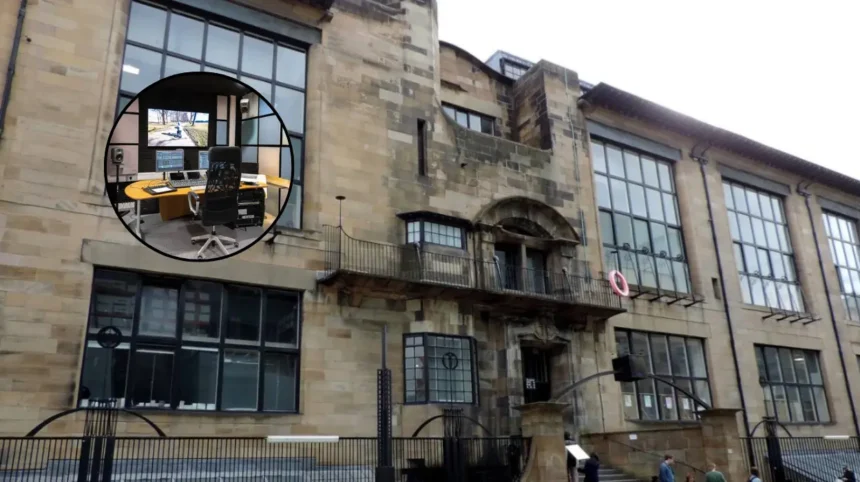
Glasgow (Glasgow Express) August 20, 2026 – The Glasgow School of Art has completed the installation of Genelec monitoring systems across three newly constructed spatial audio studios within its School of Information and Technology. Following a campus relocation to central Glasgow, the institution initiated a complete overhaul of its technical spaces to replace the previous infrastructure with a network-integrated audio framework. The updated facilities—comprising a 7.1.4 Dolby Atmos studio, a 5.1 Surround Sound Room, and a 16-speaker Ambisonics Soundlab—were designed to support undergraduate and postgraduate teaching in film and television sound production, immersive audio, electronic game audio, and experimental sound practice.
How Has the Glasgow School of Art Updated Its Spatial Audio Facilities?
The structural relocation of the School of Information and Technology necessitated the physical decommissioning of its legacy production suites and the construction of purpose-built environments at the central Glasgow site. To facilitate the transition, GSA engaged local reseller and systems integrator Mediaspec to oversee the technical specification, equipment procurement, commissioning, and system integration.
The core design brief focused on establishing a flexible, future-facing educational and production environment capable of running multi-format spatial audio workflows.
Network infrastructure for the project was deployed by the internal GSA IT department, enabling all three primary monitoring rooms to communicate over a unified Dante audio-over-IP network. This architectural shift from point-to-point analogue and digital connections to an IP-based matrix represents the primary technical advancement over the institution’s former facility setup.
What Hardware Configuration Powers the New Dolby Atmos and Ambisonics Studios?
The hardware layout utilizes a combination of newly acquired equipment and legacy Genelec monitoring assets transferred from the former campus.
Within the 7.1.4 Dolby Atmos Room, eleven Genelec 8030 two-way nearfield studio monitors were repurposed to form the surround and overhead channels, paired with a Genelec 7060 subwoofer for low-frequency extension and bass management.
For the spatial audio Soundlab, which requires high-density speaker placement to facilitate 3rd-order ambisonics mixing, sixteen compact Genelec 8010 nearfield monitors were purchased and ceiling- and wall-mounted in a three-dimensional array. Low-end reinforcement in the Soundlab is handled by an additional Genelec 7050 subwoofer.
The combined setup allows signal routing across spatial formats, accommodating traditional 5.1 surround mixes alongside object-based and higher-order ambisonics monitoring, voiceover tracking, and Foley recording sessions.
Explore More Local Glasgow News
Glasgow City Centre Hope Street Food and Drink Guide 2026
22 Lost and Forgotten Shops Glaswegians Will Remember (Glasgow, 2026)
Background to the Spatial Audio Infrastructure Upgrade
The Glasgow School of Art’s School of Information and Technology has long maintained a curriculum focused on practical sound engineering, digital media creation, and sound design for visual media.
Over the past decade, professional audio industries have increasingly moved away from channel-based stereo and traditional 5.1 surround formats toward object-based spatial audio (such as Dolby Atmos) and scene-based spatial audio (such as Higher-Order Ambisonics for virtual reality and interactive game engines).
Previous facilities at GSA relied on standalone analogue and digital routing configurations that required physical patch bays and dedicated hardware links between rooms.
When the institution scheduled the relocation of SIT to central Glasgow, the project scope was expanded to replace these aging workflows with an enterprise audio-over-IP infrastructure. Selecting Dante networking allowed the school to consolidate signal distribution across room boundaries, lowering latency and enabling multi-room recording and monitoring configurations without pulling extensive multicore cabling across the new campus.
The decision to retain and expand the Genelec monitoring ecosystem allowed the school to maintain consistency in acoustic voicing across old and new rooms while meeting the spatial density requirements of 3rd-order ambisonic arrays.
Future Impact and Industry Outlook for Audio Students
The integration of Dante-networked Dolby Atmos and 16-speaker ambisonics environments directly impacts GSA students, academic staff, and the broader creative technology sector in Scotland.
- Industry-Standard Technical Competency: Graduates entering the film, television, games, and post-production industries will have hands-on experience working in calibrated 7.1.4 Atmos and 3rd-order ambisonics environments. This reduces the training gap between higher education and professional post-production houses.
- Workflow Flexibility: The implementation of Dante infrastructure enables students to route audio freely between tracking spaces, Foley stages, and control rooms, reflecting modern network-based studio operations.
- Expanded Research Capacity: The 16-speaker Ambisonics Soundlab provides a controlled acoustic environment for postgraduate research into immersive acoustics, interactive audio for spatial computing, and experimental composition.
As streaming platforms, games publishers, and broadcast networks mandate immersive audio deliverables as standard, educational institutions are updating their hardware pipelines to match commercial requirements. GSA’s investment in networked spatial monitoring positions its graduates to enter technical roles in sound design, immersive mix engineering, and audio software development, while establishing a regional facility capable of supporting industry research collaborations in central Scotland.