

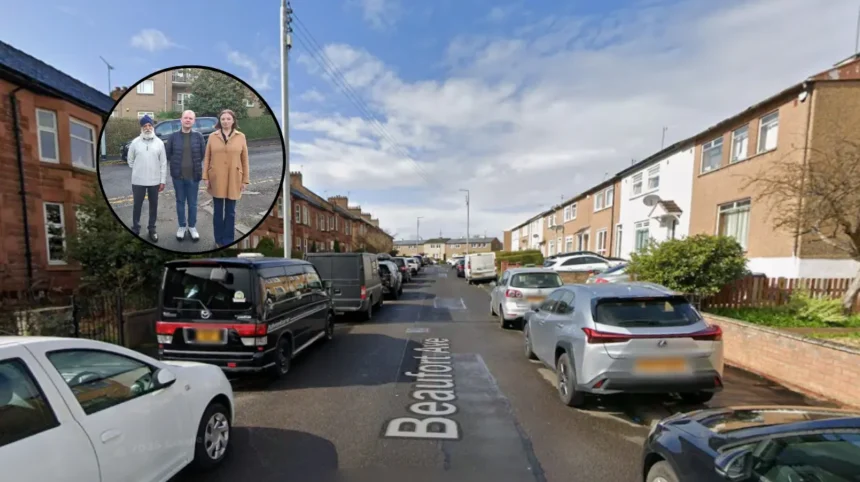
Key Points
- An unloved and disused private lane located between Nether Auldhouse Road and Beaufort Avenue in Newlands, Glasgow, has been completely revamped following a funding injection.
- Local residents secured a £20,000 grant from the local authority to tackle deteriorating physical conditions, poor drainage, and severe accessibility roadblocks.
- Prior to the intervention, the lane had degraded to such a poor state that local bin collections were frequently missed because refuse vehicles and workers could not access the area safely.
- Prompted by the deteriorating conditions, six local residents came together to establish a constituted community group named the Friends of Netherbeau.
- Glasgow City Council member, Councillor Sean Ferguson, assisted the neighbourhood collective by guiding them through the council’s private lane toolkit and administrative process.
- The successfully upgraded space now features a brand-new lane surface, improved drainage, and cleared vegetation, enabling children and adults to use the pathway for cycling and active recreation.
- Constituted community groups across the region are eligible to apply for council grants ranging between £1,000 and £20,000 to combat problems such as fly-tipping, poor surfacing, and overgrown vegetation.
Glasgow (Glasgow Express) October 7, 2026 – Local residents living at Nether Auldhouse Road and Beaufort Avenue in the Newlands area of Glasgow took decisive action to overhaul a dilapidated and neglected private lane after successfully securing a £20,000 council grant. As reported by Local Democracy Reporter Drew Sandelands of Glasgow Live, the community-led project was launched to address severe structural neglect that had rendered the shared back lane virtually impassable.
Before the transformation took place, the lane had fallen into deep disrepair, accumulating safety hazards and aesthetic blight. According to local resident Jade Graham, speaking to Drew Sandelands of Glasgow Live, the passage had deteriorated significantly over time. Jade Graham stated that “the lane just looked really unloved and disused before”. The physical degradation of the pathway created knock-on municipal problems for the households relying on it. Jade Graham explained to Glasgow Live that
“bins weren’t getting picked up at all sometimes because the lane was becoming inaccessible”.
Faced with mounting waste accumulation and deteriorating local infrastructure, the residents brought their concerns to the local community council. There, they connected with Glasgow City Council SNP Councillor Sean Ferguson, who provided crucial advice regarding the local authority’s private lane toolkit. Armed with official guidance, six local neighbours banded together to form a dedicated community organisation known as the Friends of Netherbeau.
What Role Did Community Collaboration Play In Securing The £20,000 Funding?
The success of the Newlands lane regeneration project hinged on a highly organised and collaborative effort by the newly formed Friends of Netherbeau group. Describing the division of labor within the committee, Jade Graham told Local Democracy Reporter Drew Sandelands of Glasgow Live that “every single member of the group was super proactive and did something”. Outlining the specific contributions of the neighbours, Jade Graham noted that
“one person did all the work setting up the bank account, one person got three different quotes, [and] one person did the paperwork and liaised with the council”.
Furthermore, the administrative support provided by local municipal authorities played an instrumental role in fast-tracking the financial assistance. Jade Graham praised the backing received from public officials, noting to Glasgow Live that the council’s toolkit was “really helpful” and that the administrative team “could not have been more supportive”. With the £20,000 council grant secured, the group tackled core environmental and engineering challenges, including poor drainage, uneven and broken surfaces, and excessive vegetation overgrowth.
How Is The Revamped Lane Being Enjoyed By The Local Community Now?
Following the completion of the improvement works, the once-abandoned strip of land has experienced a dramatic revival, shifting from a fly-tipping hotspot and accessibility barrier into a thriving communal asset. Reflecting on the positive social impact of the completed project, Jade Graham told Glasgow Live that
“it really has been such a change with kids (big and small!) out doing bike wheelies and enjoying their new lane surface”.
The physical improvements have not only restored standard municipal services like waste collection but have also fostered a deeper sense of community cohesion among neighbouring households. Looking ahead to the future, Jade Graham revealed to Drew Sandelands of Glasgow Live that
“the group hopes to arrange some community events for next year to make the most out of this upgraded shared space and the continued neighbourhood connections”.
Background of the Particular Development
Private lanes across Glasgow have historically presented complex legal and maintenance challenges for local residents. Because private lanes do not automatically fall under standard municipal street-cleaning and upkeep schedules, maintenance responsibilities traditionally rest entirely upon the private titleholders and abutting property owners. Over decades, many such lanes across Scotland’s urban centres suffered from fragmented ownership, chronic underinvestment, and legal ambiguity regarding who should pay for structural repairs, drainage fixes, and surface rehabilitation.
To bridge this gap, Glasgow City Council and local governance structures established specialised community grant frameworks and advisory toolkits. These municipal schemes allow constituted resident groups to apply for capital funding ranging from £1,000 up to £20,000. The grants are specifically designed to empower neighbourhoods to resolve persistent urban decay issues—such as fly-tipping, cratered road surfaces, and blocked drainage channels—that directly threaten local public health, environmental standards, and essential municipal service deliveries like weekly refuse collection.
Prediction
This successful community-led regeneration model in Newlands is likely to inspire adjacent neighbourhoods and other Glasgow communities facing similar infrastructure decay to leverage municipal grant schemes. As local awareness regarding the council’s private lane toolkit and funding availability grows, municipal authorities may see a surge in applications from constituted resident groups seeking financial backing for environmental upgrades. For residents living along neglected back lanes, this development demonstrates a clear pathway to restoring property accessibility, eliminating waste collection bottlenecks, and converting sterile or hazardous alleyways into functional spaces for active travel and community engagement.