Key Points
- Political rivals on Glasgow City Council—the Scottish National Party (SNP), Scottish Labour, and the Scottish Greens—have united to oppose Scottish Government plans that could abolish the authority and split the city into smaller administrative units.
- SNP Council Leader Ricky Bell, Labour Group Leader Rashid Hussain, and Scottish Greens Councillor Jon Molyneux have developed a joint cross-party motion challenging the local government reorganisation proposals.
- The motion warns that local government reform should focus on improving outcomes and empowering authorities rather than cost-cutting, stating that the Scottish Government is “deeply misguided” if it expects significant financial savings from reorganisation.
- Councillors highlight Glasgow’s unique status as Scotland’s largest city and regional economic centre, noting acute pressures related to poverty, homelessness, health inequalities, and regional service provision.
- The motion will be debated at a full council meeting next week; if approved, Glasgow City Council will formally write to the First Minister and the Convention of Scottish Local Authorities (Cosla) to present its case.
Glasgow Council (Glasgow Express) November 12, 2026 – Political rivals from the Scottish National Party, Scottish Labour, and the Scottish Greens on Glasgow City Council have joined forces to oppose Scottish Government proposals that could abolish the local authority and break up the city in a sweeping shake-up of local government.
- Key Points
- Why are Glasgow’s rival political parties uniting against the council split?
- What does the cross-party motion say about Glasgow’s unique role?
- What happens next with the Glasgow City Council motion?
- What is the background to Scotland’s local government reform proposals?
- How could this development affect Glasgow residents, council workers, and local services?
Why are Glasgow’s rival political parties uniting against the council split?
As reported by Political Correspondent Stewart Paterson of the Glasgow Times, the SNP, Labour, and the Greens have united to declare that Glasgow City Council should not be abolished under Scottish Government plans for local government reform. SNP leader of Glasgow City Council Ricky Bell, Labour Group leader Rashid Hussain, and Scottish Greens councillor Jon Molyneux have jointly developed opposition to the proposals, warning that the planned shake-up could harm vital public services.
The cross-party coalition is preparing to bring a formal motion before the council next week to establish a unified front against the potential dissolution of Scotland’s largest municipal authority. According to Stewart Paterson of the Glasgow Times, the motion states that reform must be centred on improving outcomes for residents and empowering local authorities rather than serving as a cost-saving exercise.
The text of the joint motion directly challenges the financial rationale behind structural reorganisation, stating:
“Reform should be focused on improving outcomes and empowering local government so it is better able to respond to local needs. It should not be driven by cost-cutting. Local Government has been and continues to be disproportionately under-funded by the Scottish Government. The Government is deeply misguided if it thinks there are significant savings to be made from local government reorganisation.”
What does the cross-party motion say about Glasgow’s unique role?
In outlining their opposition to breaking up the authority, councillors Ricky Bell, Rashid Hussain, and Jon Molyneux emphasised the distinct demographic and economic profile of the city. As reported by Stewart Paterson of the Glasgow Times, the motion highlights “the unique role Glasgow plays as Scotland’s largest city and regional economic centre” whilst noting
“the significant pressures associated with poverty, homelessness, health inequalities, population need and regional service provision.”
Previously, in an earlier motion tabled ahead of a council meeting in late October, Councillor Jon Molyneux had raised specific structural and workforce concerns regarding the Scottish Government’s blueprint. As reported by Stewart Paterson of the Glasgow Times on October 26, 2026, Councillor Molyneux warned that “any structural changes are likely to have a significant impact on our workforce,” particularly as the council is already navigating a complex new pay and grading structure alongside a reorganisation of the city’s Health and Social Care Partnership.
In that earlier submission, Councillor Molyneux also argued against dividing the city’s administration, stating:
“There is a strong case to not split Glasgow into smaller administrative units.”
He pointed to international comparisons, noting that in Nordic countries operating two-tier local government systems similar to those proposed by Scottish ministers, “the main cities are largely kept as extant wholes.”
Furthermore, as reported by Local Democracy Reporter Drew Sandelands of Glasgow Live on October 27, 2026, Councillor Molyneux criticised proposals suggesting that councillors could hold “dual community and regional roles, while the number of councillors is unchanged,” describing the concept as “deeply flawed” because “Glasgow currently has the smallest number of councillors per head of population in Scotland.” He added that such an approach “also risks muddied democratic accountability and may make it harder to attract candidates to stand for local elections,” while warning that removing local control over social care would make services “less accountable” and “cause unnecessary disruption to services which are under extreme financial pressure.”
What happens next with the Glasgow City Council motion?
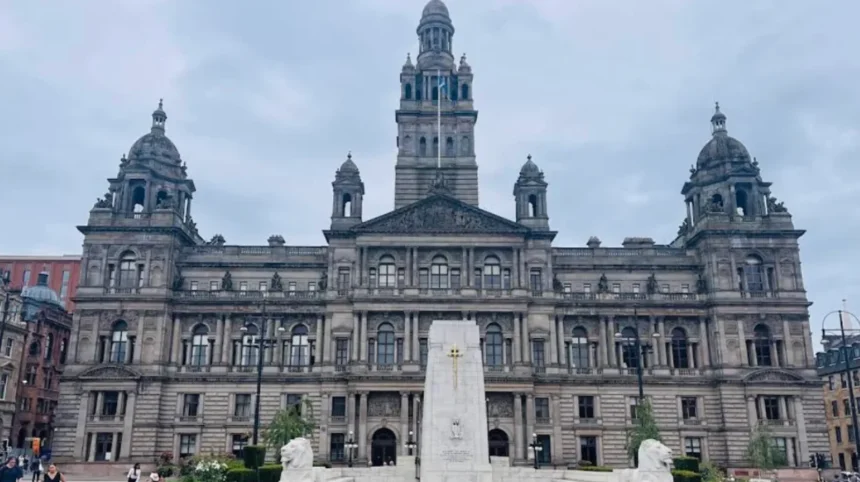
As reported by Stewart Paterson of the Glasgow Times, the newly agreed cross-party motion backed by the SNP, Labour, and the Greens will be formally debated by elected members at Glasgow City Chambers next week. If the motion is passed by the council, the local authority will write directly to the First Minister and the Convention of Scottish Local Authorities (Cosla) to formally register its opposition and outline its case against the abolition or division of Glasgow City Council.
What is the background to Scotland’s local government reform proposals?
The dispute stems from an 1,800-word discussion paper published by the Scottish Government in September 2026, which set out initial proposals for the first major overhaul of Scottish local government in almost three decades. As reported by Deputy Political Editor Rebecca McCurdy of The Herald on September 21, 2026, the Scottish Government’s paper proposed scrapping Scotland’s existing 32 unitary local authorities—which were established by the UK Government in 1996—and replacing them with a two-tier system comprising between six and 10 larger regional councils alongside 120 to 160 smaller community bodies.
Under this framework, as reported by Political Correspondent Stewart Paterson of the Glasgow Times on September 21, 2026, Glasgow City Council could be abolished and merged into a larger regional authority with neighbouring areas to oversee strategic decisions, whilst smaller community authorities would be established within the city boundaries. During a Scottish Parliament Public Service Reform Committee session on November 5, 2026, committee members noted that the First Minister had initiated the debate on September 1, 2026, by stating that “some of our councils are too small to be strategic and some are too big to be local.” The Scottish Government has described its paper as an opening proposition intended to inform discussions with Cosla and Holyrood committees, ahead of the next scheduled Scottish local government elections on May 6, 2027.
How could this development affect Glasgow residents, council workers, and local services?
If the Scottish Government proceeds with its proposals despite cross-party opposition from Glasgow City Council, the structural changes would directly affect Glasgow’s residents, council employees, and elected representatives in several ways:
- Public Service Delivery and Accountability: Splitting Glasgow into smaller community authorities while transferring strategic functions to a larger regional body could alter how everyday services—such as social care, housing, homelessness support, and waste management—are governed and funded. Councillors have warned that dividing the city could create administrative complexity and dilute democratic accountability for residents trying to hold decision-makers responsible for local issues.
- Council Workforce Stability: Glasgow City Council’s non-teaching workforce of roughly 23,000 to 24,000 employees, who are already experiencing contract changes under a new pay and grading framework and a Health and Social Care Partnership restructuring, could face further uncertainty regarding terms, conditions, and employer structures if existing authorities are dissolved and merged.
- Political Representation: Under a two-tier model where councillors assume dual roles across regional and community bodies without an increase in total councillor numbers, elected members in Glasgow—who already represent the highest ratio of residents per councillor in Scotland—would face expanded workloads, potentially impacting constituent representation and future candidate recruitment ahead of local elections.
- Intergovernmental Negotiations: Conversely, if the unified stance from the SNP, Labour, and the Greens succeeds in influencing the Scottish Government and Cosla during the consultation phase, Glasgow could retain its status as a single administrative entity, potentially shifting the focus of reform towards fiscal empowerment and service outcomes rather than boundary redrawing.