Key Points
- Duke Street in the Dennistoun area of Glasgow’s East End has been impacted by prolonged roadworks since early 2025 as part of Glasgow City Council’s Avenues Project.
- Local residents and business owners have hit out at the delays, describing the situation as a “disaster” and arguing that the extensive works are dragging on unnecessarily.
- Project setbacks include the discovery of an incorrectly charted water main requiring assessment by Scottish Water, an underground void beneath the road surface, and unrelated utility works.
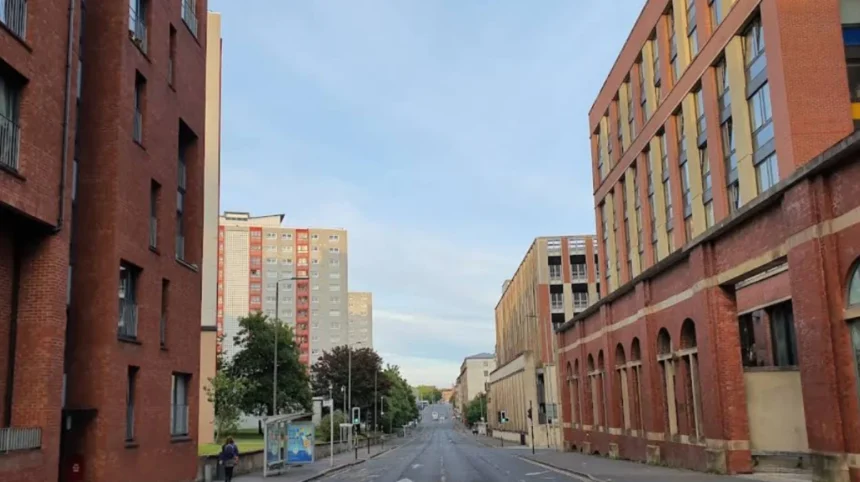
- The construction has reduced a section of Duke Street between Bellgrove Street and Melbourne Street to a single eastbound lane, prompting widespread traffic congestion and parking difficulties.
- Local representatives, including Councillor Anthony Carroll, have publicly called for greater urgency from the local authority to alleviate the pressure on the local community.
- Glasgow City Council officials maintain that good progress is being made on rain gardens and cycleways, with most of the avenue scheme anticipated to wrap up by November and final completion expected early next year.
Dennistoun (Glasgow Express) September 26, 2026 — Frustration has reached boiling point across Glasgow’s East End as residents and traders confront months of compounding delays surrounding major infrastructural improvements. As reported by local news outlets, community members have heavily criticised the ongoing lane restrictions and construction chaos on Duke Street, labelling the project a disaster that continues to drag on long past initial expectations.
The corridor, running through the heart of Dennistoun, has been subject to continuous disruption since construction commenced under Glasgow City Council’s flagship Avenues Project. Designed to transform the thoroughfare with upgraded public realms, rain gardens, and segregated cycling infrastructure, the scheme has instead become a source of daily irritation for motorists, pedestrians, and local business operators.
What Caused the Extended Delays on Duke Street?
According to details outlined by local reporters covering the municipal updates, project planners encountered a series of unforeseen engineering obstacles beneath the surface. Chief among these complications was the unearthing of an incorrectly charted water main near the junction with Bellgrove Street. This discovery forced Scottish Water to step in and undertake lengthy, essential assessment work to map and secure the subterranean infrastructure.
Further compounding the schedule, construction crews stumbled upon an unexpected underground void directly beneath the roadbed, alongside a series of unrelated utility works that fragmented the timeline. As reported by local journalists following council briefings, temporary traffic management measures have restricted sections of Duke Street to a single eastbound lane between Bellgrove Street and Melbourne Street, severely squeezing traffic flow.
How Have Local Residents and Representatives Responded?
Discontent among the community has prompted sharp criticism from local political figures demanding swift administrative intervention. As highlighted in coverage by regional media, Councillor Anthony Carroll voiced deep concerns regarding the prolonged disruption, pointing directly to persistent traffic congestion, severe parking deficits, and measurable negative impacts on the daily lives of Dennistoun residents and shopkeepers.
Frustrated citizens have echoed these sentiments publicly. As recorded by reporters from Glasgow Live, local feedback lambasted the pace of the initiative, with one resident stating:
“It’s a disaster… I don’t think these works were needed”.
Critics have also flagged ongoing issues regarding dust, local access, and pedestrian navigation around the active work zones.
What is Glasgow City Council’s Official Stance?
In response to the mounting public backlash, representatives for Glasgow City Council have defended the trajectory of the development while acknowledging the strain placed on the community. Officials stated that following the resolution of the water main assessment by Scottish Water earlier in the summer, construction momentum has stabilized.
Furthermore, project managers noted that temporary pauses were intentionally incorporated near the entrance of Tennent’s Wellpark brewery to safely accommodate the transit of heavy industrial equipment. Addressing concerns over incomplete paths, council spokespersons emphasized that while footways have remained accessible throughout the build, safety regulations prohibit opening the new cycleways until every phase is fully finalized and formally cleared. Authorities project that the bulk of the avenue will reach completion around November, with the entire overarching project scheduled to finish early next year.
Background of the Particular Development
The disruption on Duke Street forms a core component of the broader Glasgow Avenues programme, an ambitious civic initiative funded by approximately £115 million via the Glasgow City Region City Deal. The core mission of the Avenues scheme is to overhaul 17 primary arterial routes across the city center and its immediate boundaries, converting car-dominant asphalt into greener, tree-lined environments designed to prioritize active travel, cycling, and pedestrian movement.
The Dennistoun and High Street connections were conceptualized to stitch the thriving East End community more seamlessly into the central commercial district. However, as similar urban transformations in areas like Sauchiehall Street have demonstrated, balancing extensive subterranean utility overhauls with surface-level aesthetic upgrades frequently exposes older Scottish Victorian street grids to unexpected logistical friction and timeline overruns.
Prediction
For the residents, motorists, and independent traders of Dennistoun, the continuation of these roadworks through the autumn months threatens to prolong severe commercial and logistical bottlenecks. Local businesses dependent on passing vehicular trade and accessible customer parking will likely continue to absorb financial strain as single-lane constraints persist.
Nevertheless, once the project reaches its projected full delivery phase early next year, the localized environment is expected to pivot toward a heavily pedestrianised, cycle-friendly corridor. While current public sentiment remains deeply skeptical due to construction fatigue, the long-term structural alterations will permanently reshape travel habits between the East End and Glasgow’s commercial core.