Key Points
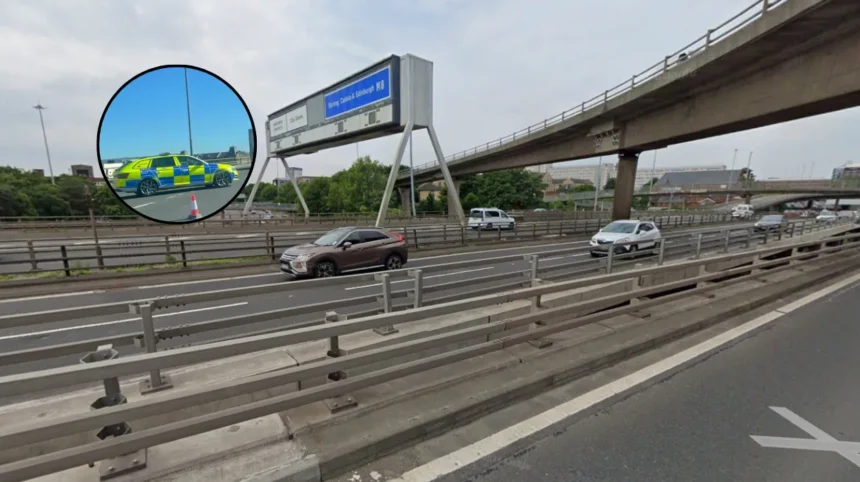
- Incident Location: The collision occurred on the eastbound carriageway of the A814 Clydeside Expressway, specifically positioned just before the M8 slip road/on-ramp leading toward the Kingston Bridge.
- Timing of Disruption: The incident took place during the evening of Monday, June 1, 2026, causing immediate traffic build-up during peak post-rush-hour travel.
- Official Notification: Glasgow City Council’s Traffic Control and Management team (TRAFFCOM) issued a formal bulletin warning motorists that the nearside lane was partially blocked.
- Resolution: Emergency response protocols and recovery operations were initiated at the scene, leading to the official reopening of the lane and clearing of the route by 11:00 PM.
Glasgow (Glasgow Express) June 2, 2026 – A road traffic collision on the eastbound carriageway of the A814 Clydeside Expressway caused significant disruption for motorists travelling through the heart of Glasgow last night. The incident, which blocked a vital artery connecting the West End to the city centre and the interstate motorway network, occurred just before the M8 on-ramp leading to the Kingston Bridge. Local traffic authorities confirmed that the partial closure of the nearside lane led to immediate tailbacks before recovery teams successfully cleared the scene, allowing all lanes to fully reopen to the public at approximately 11:00 PM.
- Key Points
- What Happened on the Clydeside Expressway Eastbound Carriageway?
- How Did Glasgow City Council Respond to the Disruption?
- Background of the Clydeside Expressway and Kingston Bridge Transport Network
- Predictions: How This Development Can Affect Glasgow Commuters and Commercial Transport
- Long-Term Traffic Management and Infrastructure Strategy
What Happened on the Clydeside Expressway Eastbound Carriageway?
The incident unfolded during the evening hours of June 1, when vehicles collided on the approach to one of Glasgow’s busiest structural interchanges.
As reported by the Glasgow City Council Traffic Control and Management team, the collision specifically impacted the eastbound flow of traffic, which serves as a primary funnel for motorists transitioning from the city’s coastal and western districts into the central motorway system.
The location of the crash created a logistical bottleneck. Because the vehicles came to a halt immediately prior to where the Expressway merges with the M8 on-ramp at the Kingston Bridge, the available space for passing traffic was suddenly restricted.
The Kingston Bridge is recognised as one of the most heavily trafficked river crossings in Europe, meaning any disruption on its immediate feeding lanes carries an immediate knock-on effect for wider metropolitan travel.
Following the impact, the nearside lane—commonly referred to as the left-hand slow lane or inside lane—became partially obstructed by the vehicles involved and the subsequent debris.
Emergency services and local highway trunk agents were dispatched to the site to manage the scene, evaluate those involved, and coordinate the safe extraction of the stricken vehicles.
How Did Glasgow City Council Respond to the Disruption?
In terms of public safety dissemination, the local authority acted to alert the motoring public to the developing situation to mitigate further gridlock. As documented by the traffic monitoring officers at Glasgow City Council, an emergency travel alert was broadcast across digital platforms and radio networks on Monday evening.
The initial bulletin from the council’s traffic team explicitly warned that the nearside lane of the eastbound carriageway was compromised.
Motorists were advised to exercise extreme caution when approaching the M8 on-ramp or to seek alternative routes across the River Clyde where possible.
To ensure accurate public records and maintain full accountability, local media outlets monitored the council’s real-time traffic updates throughout the night. As reported by the automated traffic bulletin services of Glasgow City Council,
“the nearside lane of the eastbound carriageway was partially blocked just before the M8 on-ramp to the Kingston Bridge after a road traffic collision.”
The recovery operation required several hours of track clearance, vehicle towing, and safety inspections of the tarmac to ensure no hazardous fluids had saturated the driving surface. A final update was published by the civic traffic team later that evening, confirming that the vehicle recovery was complete and the road had completely reopened to all traffic by 11:00 PM.
Background of the Clydeside Expressway and Kingston Bridge Transport Network
The A814 Clydeside Expressway and the adjacent M8 Kingston Bridge form the foundational backbone of Glasgow’s urban transport infrastructure. Constructed during the late 1960s and early 1970s as part of the Glasgow Inner Ring Road scheme, these pathways were designed to modernise the city’s industrial shipping corridors and accommodate the rapid rise of private and commercial vehicle ownership.
The Clydeside Expressway serves as a dual-carriageway link running parallel to the River Clyde, connecting the outer residential and commercial zones of the West End—such as Partick, Scotstoun, and the Scottish Event Campus (SEC)—directly to the city centre.
Conversely, the Kingston Bridge acts as the primary north-south conduit over the river, carrying ten lanes of the M8 motorway.
Historically, the convergence zone where the Expressway meets the M8 on-ramp has been a known point of friction for local transport planners.
Because motorists must quickly adjust speeds and negotiate merging lanes to ascend the bridge ramps, the area experiences high traffic density and a statistically higher rate of minor shunts and lane-changing incidents compared to straight stretches of the dual carriageway.
The reliance of Glasgow’s economy on these tight, interlinked corridors means that even a minor single-lane obstruction can rapidly paralyze cross-city transit.
Predictions: How This Development Can Affect Glasgow Commuters and Commercial Transport
The occurrence of this collision, alongside the subsequent recovery timeline, is likely to influence several aspects of daily transit and policy for Glasgow residents, daily commuters, and logistics operators.
For the immediate demographic of daily commuters residing in the West End or working within the city centre, this incident highlights the ongoing vulnerability of the local road network. Drivers can expect transport authorities to increase automated signage warnings along the A814 to better manage lane discipline prior to the Kingston Bridge merge point.
In the short term, commuters may increasingly rely on real-time GPS routing applications to bypass the Expressway entirely during evening hours, transferring the vehicular load onto alternative urban pathways such as Argyle Street or the Clyde Arc (Squinty Bridge).
For logistics firms, freight haulers, and local delivery businesses, disruptions at this particular bottleneck incur direct financial costs.
Because the on-ramp links directly to the M8—the vital economic artery connecting Glasgow to Edinburgh and the Scottish motorway network—delayed delivery windows are inevitable when lanes are compromised.
Fleet managers will likely factor greater time buffers into evening routes passing through the Kingston Bridge corridor, potentially shifting non-urgent freight operations further into the night-time hours to minimize the risk of being caught in accident-related congestion.
Long-Term Traffic Management and Infrastructure Strategy
From an infrastructural perspective, this incident will provide further data to Glasgow City Council and Transport Scotland regarding the efficiency of their incident response times. It may accelerate discussions around implementing active traffic management systems on the Clydeside Expressway approach, such as variable speed limits or electronic lane-control signals, to slow down oncoming traffic well before they reach a collision site.
Additionally, repeated evening closures may fuel broader public arguments for shifting investment toward Glasgow’s subway and rail alternatives to reduce overall public reliance on the city’s delicate motorway junctions.