Key Points
- Television Feature: Senior First Engineer Officer Darren Kenny features in the Channel 4 documentary series Cruising to the Ends of the Earth, highlighting behind-the-scenes engineering operations.
- Behind-the-Scenes Insight: The television appearance aims to demystify sub-deck operations, including electrical grids, freshwater generation, waste management, and propulsion systems.
- Career Journey: Born in Glasgow and raised in Clydebank, Kenny’s 20-year maritime career began at age 17 through an advertisement for Clyde Marine Training.
- Professional Qualifications: Kenny completed his cadetship at Glasgow Nautical College, qualifying in 2008 after rigorous testing under the Maritime and Coastguard Agency (MCA).
- Industry Overview: The feature provides critical exposure to the maritime engineering sector, which faces ongoing recruitment needs for qualified technical officers.
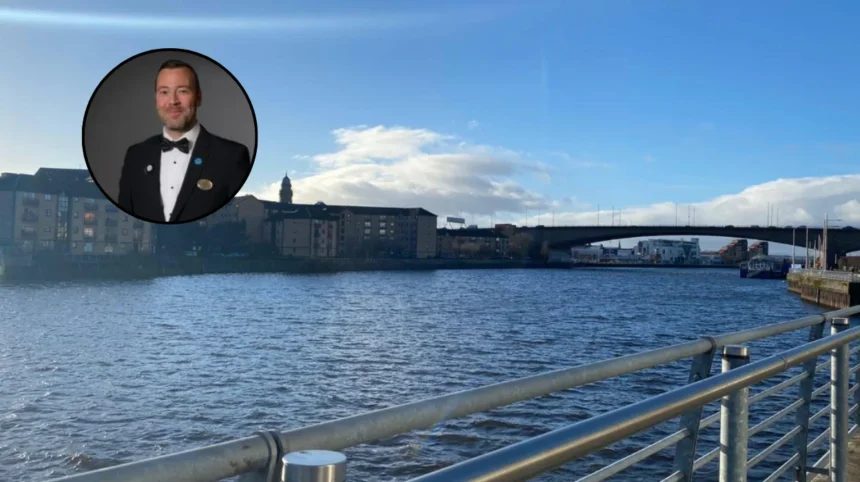
Clydebank (Glasgow Express) June 3, 2026 — A veteran marine engineer from West Dunbartonshire has taken centre stage on national television to lift the veil on the complex technical operations that keep luxury cruise liners functioning at sea. Darren Kenny, a Senior First Engineer Officer serving with Princess Cruises, featured prominently in the Channel 4 documentary series Cruising to the Ends of the Earth. The programme, which initially broadcast in April, traces the intricate, often invisible mechanical frameworks managed by engineering crews away from the passenger-facing areas of modern cruise vessels.
- Key Points
- Why Is Darren Kenny’s Appearance on Channel 4 Significant for Marine Engineers?
- How Did a Newspaper Advertisement Launch a 20-Year Engineering Career?
- What Qualifications Are Required to Become a Senior First Engineer Officer?
- What Are the Daily Challenges of Engineering Operations on a Cruise Ship?
- Background of the West of Scotland Maritime Training Sector
- Prediction: How This Media Exposure Will Affect Aspiring UK Maritime Cadets
Why Is Darren Kenny’s Appearance on Channel 4 Significant for Marine Engineers?
The broadcast marks a rare mainstream media focus on the secondary and tertiary support structures of the cruise industry, moving away from conventional travel journalism that typically highlights hospitality and entertainment. By opening the engine spaces to television cameras, the production provides a detailed look into the logistical realities of modern seafaring.
As reported by the editorial staff of the Glasgow Times, Kenny expressed that the filming process served as an essential tool for bridging the gap between his professional life and his personal community. Kenny stated:
“Not a lot of people know what we do on board. They see the cabins, the pools, the entertainment team, but there’s not much light shone on what goes on below, which is electricity, your fresh water, the toilet system, how the ship moves, even the TV in your cabin. It was nice to have someone come in with a camera and have a nosey around what the department does.”
The officer noted that his career choice often made him an anomaly within his immediate family circle due to the isolating nature of long-term deployment at sea. According to the coverage published by the Glasgow Times, Kenny remarked:
“I’m a bit of a strange one in the family, and nobody really knows what I do; I go to work on my ship and disappear. The programme gave a little insight.”
How Did a Newspaper Advertisement Launch a 20-Year Engineering Career?
Kenny’s entry into the merchant navy highlights the historical role of regional cadetships and vocational training programmes in the West of Scotland, an area with deep-rooted maritime traditions. Raised in Clydebank and educated at St Columba’s High School, his career pathway was initiated by chance during his final school years.
Reflecting on his entry into the sector at the age of 17, Kenny explained the circumstances in an interview recorded by the Glasgow Times:
“I was sitting in the common room with my friend and we saw an article in the back of a newspaper for training called Clyde Marine, and they were offering the chance to travel the world and get a qualification in engineering. I wasn’t so bothered about the engineering side of things; it was more to travel the world and get paid for it. I spoke to my mum and dad, and they told me to go for it. Within a couple of months, I went for the interview and things moved quite quickly, and they took me on.”
This initial application led to a formal cadetship structure, balancing academic study with mandatory sea time across diverse vessel types.
What Qualifications Are Required to Become a Senior First Engineer Officer?
The journey from an entry-level cadet to a Senior First Engineer Officer involves a stringent regulatory framework governed by both educational institutions and national maritime authorities. Kenny completed his baseline technical qualifications at Glasgow Nautical College, a facility globally recognised for merchant navy officer training.
Kenny formally qualified as a marine engineer in 2008 following a multi-year training regime. As detailed in the Glasgow Times report, the 40-year-old engineer outlined the progression system required to advance through the ranks:
“That took around three to four years, but during that time I worked on a car carrier, a container ship, and a bulk carrier. You go on three or four different ships for four or five months and it gives you experience on different classes of ship.”
Regulatory Oversight by the MCA
Following the completion of practical sea phases, candidates must navigate oral and written examinations administered by the Maritime and Coastguard Agency (MCA). The MCA serves as the regulatory body implementing international standards for safety, training, and certification for seafarers. Kenny noted:
“After that you sit some exams and then you go up against the MCA [Maritime and Coastguard Agency] and get asked questions relevant to your job which you do every time you step up your licence.”
Each subsequent promotion within the engineering department requires further seatime, advanced technical certification, and successful completion of additional MCA oral examinations to ensure competence in handling high-pressure maritime systems.
What Are the Daily Challenges of Engineering Operations on a Cruise Ship?
Operating a modern cruise vessel requires managing an independent infrastructure equivalent to a small, floating municipality.
Senior engineering officers are responsible for power generation, mechanical propulsion, environmental compliance, and waste management systems.
Despite nearly two decades of continuous service with Princess Cruises, Kenny indicated that the dynamic environment of a cruise ship prevents professional stagnation. Speaking to the Glasgow Times, Kenny described the unique daily routine of his role:
“It’s strange that I wake up in the same bed every morning but in a different place. We work with different nationalities and some of the people on board are extremely talented.”
He further commended the resourcefulness of his technical team, emphasizing their capacity to resolve complex mechanical faults far from shoreside support structures:
“The team can turn nothing into something; if you ask for bronze, they’ll give you gold. Even to this day after almost 20 years, I’m surprised by what some of the team can do.”
Background of the West of Scotland Maritime Training Sector
The career trajectory of Darren Kenny reflects a broader structural framework within the British maritime industry, particularly inside the West of Scotland.
Historically a global hub for shipbuilding along the River Clyde, the region transitioned throughout the late 20th and early 21st centuries from heavy industrial manufacturing toward maritime education, officer training, and corporate ship management.
Institutions such as Clyde Marine Training—founded in 1985—and the Glasgow Nautical College (now integrated into the City of Glasgow College) were established to sustain the supply of UK Certificate of Competency (CoC) officers to the global merchant fleet.
These entities operate via a tripartite funding model involving the UK government’s Support for Maritime Training (SMarT) scheme, international shipping companies, and regional colleges.
This infrastructure ensures that cadets receive fully sponsored higher education alongside practical sea service. Over the past two decades, the sector has adapted to increasingly rigorous environmental mandates set by the International Maritime Organization (IMO), requiring engineering curricula to expand from traditional steam and diesel mechanics into complex electrical propulsion, automation, and alternative fuel technologies.
Explore More Clydebank News
Red Wing GP Practice Appointments Restart After IT Issue, Clydebank 2026
Kevin Bridges and John McGinn BBC Documentary in Clydebank 2026
Prediction: How This Media Exposure Will Affect Aspiring UK Maritime Cadets
The broadcasting of high-definition, behind-the-scenes documentaries like Cruising to the Ends of the Earth on major television networks is highly likely to trigger a measurable uptick in recruitment enquiries for UK maritime cadetships over the next 12 to 24 months. For young school-leavers and engineering graduates in the UK, mainstream media coverage serves as a critical discovery mechanism for an industry that operates largely outside public view.
By explicitly addressing the technical and mechanical realities of seafaring, the programme directly counters the industry’s historical recruitment challenge: the general public’s lack of awareness regarding technical merchant navy careers. Prospective candidates will gain a clearer understanding of the separation between hospitality roles and technical officer roles on cruise ships.
Consequently, training providers and maritime colleges can anticipate a higher volume of applications from individuals specifically interested in marine engineering, electro-technical officer (ETO) positions, and deck cadetships. This surge in interest will assist the UK maritime sector in addressing ongoing structural shortages of qualified officers, ultimately strengthening the domestic pipeline of technical talent for the global shipping fleet.