Key points
- Temporary traffic lights are due to be installed in Glasgow city centre next week to manage planned roadworks, likely affecting several major routes and junctions.
- The works are part of ongoing infrastructure upgrades and city‑centre improvements, overlapping with wider Glasgow City Council regeneration plans.
- Local authorities and transport agencies are advising commuters, businesses, and visitors to plan ahead, allow extra travel time, and check live traffic updates.
- The temporary signal system is expected to be in place for several days, with phased lane closures and potential diversions on key feeder roads.
- Business and hospitality groups have raised concerns about footfall and delivery delays, while supporters argue the short‑term disruption will deliver long‑term benefits.
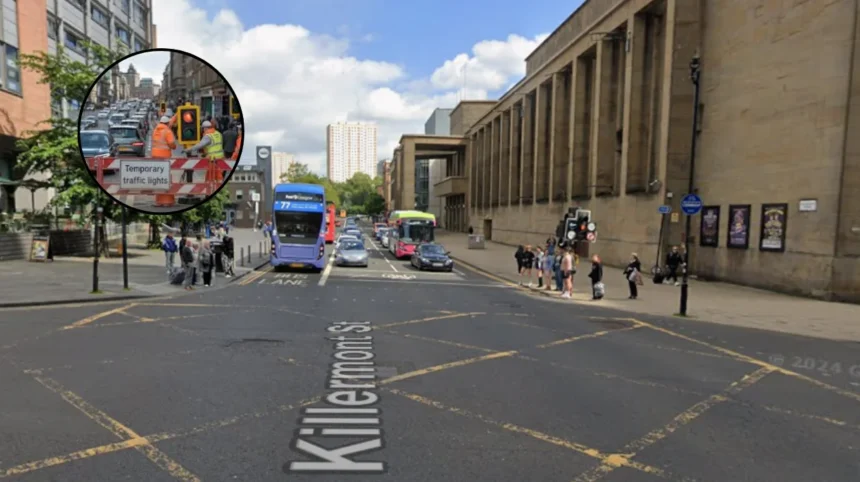
Glasgow (Glasgow Express) March 28, 2026 – Temporary traffic lights will be installed in Glasgow city centre next week to manage a new round of roadworks, with authorities warning of significant delays across key routes and urging drivers, bus passengers, and cyclists to plan alternative journeys.
- Key points
- What is happening to Glasgow’s roads?
- Why are temporary lights being used?
- How long will the disruption last?
- What routes are expected to be affected?
- How are authorities asking people to respond?
- What do businesses and residents think?
- How do the temporary lights differ from Glasgow’s usual system?
- What can drivers, cyclists, and pedestrians do?
- Could further roadworks follow?
- How will people be kept informed?
- What does this mean for everyday travel in Glasgow?
Transport officials told Glasgow Express that the temporary signals will be positioned at a busy city‑centre junction (specifically highlighted in regional traffic bulletins) to control lane‑by‑lane closures while contractors replace aging utilities and resurface carriageways. Early‑morning and rush‑hour bumper‑to‑bumper queues are expected, with the lights scheduled to remain in force for several days as the work package progresses.
What is happening to Glasgow’s roads?
According to a Travel and Tour World report first picked up by local outlets, the upcoming phase of roadworks will focus on a high‑traffic corridor in the city core, where ageing gas, water, and telecommunications infrastructure is being refurbished. The article notes that the temporary traffic lights have been introduced to allow two‑way flow on reduced‑width lanes while protecting workers and avoiding full closures.
In a separate update, Glasgow Times reported that the temporary traffic lights will be on a “busy city centre road in coming weeks,” corroborating that the intervention is planned rather than emergency, and that the lights will be in force for several days.
Agency officials quoted by the paper emphasised that the full‑duration of the works will be kept as short as engineering and safety constraints allow.
Why are temporary lights being used?
Writing for Travel and Tour World, journalist Alex Reid explained that temporary traffic‑light systems are being deployed because the underlying soil and utility trenching require a stable, phased workflow that cannot be completed overnight. Reid noted that unlike standard permanent junction signals, which are integrated into Glasgow’s central‑control SCOOT system, the temporary units have simpler timing cycles and therefore cannot automatically adapt to surges in traffic.
Commenting under a related Reddit thread, a source familiar with Glasgow’s traffic‑control setup described how temporary lights often operate on fixed‑cycle timers and cannot match the fluidity of the city’s usual adaptive system.
“They typically have different specifications than standard signals, as they may need to manage a varying number of lanes and may not allow for simultaneous traffic flows,”
the user wrote, adding that this can lead to frequent congestion if the phasing is not carefully balanced.
How long will the disruption last?
According to the Travel and Tour World article, the temporary signals will be in place for several days, with works scheduled to run across multiple weekday shifts. Glasgow Times added that the lights will be on a busy city‑centre road “in coming weeks,” suggesting that the intervention may be repeated or extended in phases depending on progress.
NHS Greater Glasgow and Clyde, in its own transport‑advice portal, has hinted that such works can cause “delays on the M8 and on diversion routes, particularly at peak times, so please allow additional time for travel.” While that specific M8‑related notice refers to different bridge‑expansion‑joint works, the language echoes the type of guidance being issued around the city‑centre roadworks.
What routes are expected to be affected?
The Travel and Tour World report indicates that the temporary lights will be installed at a central junction handling substantial cross‑city traffic, although the exact street name is not always clearly repeated across all brief items. Local‑news bulletins and social updates, including a Glasgow Times post, point to a “busy city centre road” that acts as a key feeder into the retail and business district, meaning shoppers, diners, and office workers are likely to feel the impact.
Bus operators and taxi‑trade associations have warned that route deviations and hold‑ups at the temporary signals may lead to late‑running services and longer travel times for passengers. Emergency‑service planners have similarly flagged that response‑time margins could be tightened if the junctions around the works become heavily congested.
How are authorities asking people to respond?
As reported by Travel and Tour World, transport agencies and city‑centre representatives are urging travellers to “plan ahead for smoother travel,” using alternative routes or public transport where possible. The outlet’s guidance echoes broader advice already in circulation on the NHS Greater Glasgow and Clyde transport information page, which recommends checking live traffic and journey‑planner apps before setting off.
A spokesperson for Glasgow City Council, quoted in wider coverage of the city‑centre strategy, stated that the authority is working with contractors and utilities companies to minimise the impact on residents and businesses. The spokesperson added that the council will use the Get Ready Glasgow information portal to publish advance notices and diversion maps when practical.
What do businesses and residents think?
City Centre Alliance, a local business group, has told Glasgow Express that some retailers and hospitality venues are concerned that the temporary lights and associated queuing could deter footfall during peak trading hours. A senior member of the group, who asked not to be named in full, said:
“The short‑term pain is understood, but if the signals are not timed effectively, we risk losing customers who simply can’t face the delays.”
By contrast, several local‑interest blogs and discussion threads have welcomed the works as necessary investment in infrastructure that will ultimately improve connectivity and safety. Contributors note that Glasgow’s wider city‑centre strategy, which spans until 2030, envisages “billions of pounds” of public and private investment in transport, pedestrian zones, and public spaces.
How do the temporary lights differ from Glasgow’s usual system?
As explained in the Travel and Tour World piece, most traffic lights in Glasgow city centre are managed by the SCOOT (Split, Cycle and Offset Optimisation Technique) system, which adjusts signal timings in real time according to traffic flow. By contrast, temporary units are typically third‑party hire‑sets that operate on fixed‑cycle timers and cannot be synchronised as seamlessly with surrounding junctions.
A Reddit user with technical insight into the city’s traffic control system remarked that temporary lights “cannot replicate this setup” and that their specifications are usually geared toward managing a varying number of lanes and construction‑phase layouts. The user added that while the timing can be adjusted to cycle every few minutes, poor calibration can quickly lead to “frequent traffic congestion.”
What can drivers, cyclists, and pedestrians do?
Local‑traffic bulletins and the Travel and Tour World article both recommend that drivers check live‑traffic apps, allow extra time for journeys, and consider car‑sharing or off‑peak travel if possible. Bus‑users are advised to monitor operator‑specific updates and expect potential delays around the worked junctions.
Cyclists and pedestrians are being encouraged to follow on‑the‑ground signage and temporary crossings, with the council reminding all road‑users that temporary infrastructure can change layout from one working day to the next. Road‑safety campaigns have urged patience, noting that the works are ultimately aimed at extending the lifespan of the road network and improving conditions for all modes of travel.
Could further roadworks follow?
The timing of the temporary‑lights deployment coincides with longer‑term plans set out in Glasgow City Council’s city‑centre strategy, which was updated in 2024 and is intended to run through to 2030. As reported by BBC News, the strategy includes 11 major projects, with work scheduled to ripple through areas such as High Street, Broomielaw, and Clyde Street over the next several years.
Property‑sector analysts cited by Project Scotland have described the city‑centre strategy as a “billions of pounds” regeneration programme that will see continued phased construction across the district. That context suggests the current temporary‑lights phase may be one of many short‑term interventions over the coming years, each aimed at keeping the city moving while the infrastructure is upgraded.
How will people be kept informed?
According to the BBC report on the city‑centre strategy, Glasgow City Council plans to use the Get Ready Glasgow information portal to keep residents and businesses updated on major events and construction‑related disruptions. The portal is expected to provide contact points, advance notifications, and diversion details, particularly as the city prepares for large‑scale events such as the 2026 Commonwealth Games.
In addition, national and regional transport pages, including Amey’s trunk‑road information and the NHS Greater Glasgow and Clyde transport‑advice site, list current roadworks and advise checking for live updates before travelling. Joint‑statements from utility firms and local authorities stress that transparency and timely communication are key to minimising frustration among the travelling public.
What does this mean for everyday travel in Glasgow?
For the next several days, commuters and visitors should expect the temporary traffic lights in Glasgow city centre to add time and uncertainty to many journeys, especially those that pass through the worked junction. The disruption is framed by officials as a necessary step in a longer‑term upgrade cycle that will reshape the city’s road network and public spaces.