Key Points
- Glasgow Central station fully reopens all platforms and resumes normal timetable on Wednesday, first time since the major fire on Sunday, 8 March.
- Fire originated in a vape shop on Union Street, destroying a Victorian building at the junction with Gordon Street; only the façade remains standing.
- Main entrance on Gordon Street and Union Street entrance remain closed due to a small exclusion zone.
- Station facilities including shops, ticket office, and toilets will reopen.
- Rail services from high-level platforms were completely halted for 10 days post-fire.
- Last week, platforms 7 to 15 reopened, allowing a reduced timetable.
- Platforms 1 to 6 now reopened following detailed inspections, cleaning, repairs, and operational checks.
- Passengers directed to use upper Hope Street entrance, Hope Street driveway, and low-level entrances.
- Network Rail reports substantial progress on demolishing the historic building and ensuring safety.
- No injuries reported from the fire; emergency services responded swiftly.
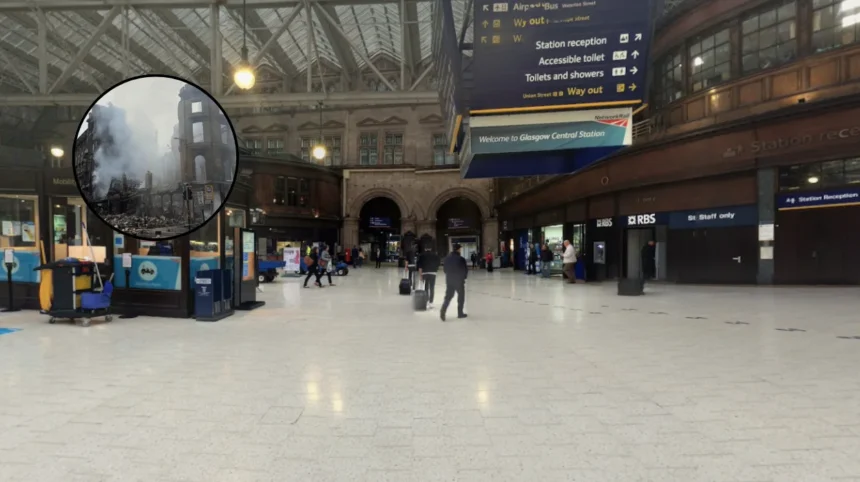
Glasgow Central (Glasgow Express) March 30, 2026 – Glasgow Central station has returned to its full operational capacity, reopening all platforms and resuming a normal timetable on Wednesday for the first time since a devastating fire ravaged a nearby Victorian building three weeks ago. The blaze, which erupted on Sunday, 8 March in a vape shop on Union Street, left only the façade of the historic structure at the Gordon Street junction standing, prompting extensive safety measures and partial closures.
Network Rail confirmed the full resumption follows “substantial progress” in demolishing the damaged building and securing the site. While a small exclusion zone persists around the main Gordon Street and Union Street entrances—keeping them closed—passengers can now access the station via the upper Hope Street entrance, Hope Street driveway, and low-level entrances. Inside, shops, the ticket office, and toilets will reopen, restoring normalcy for commuters.
The fire disrupted high-level platforms entirely for 10 days, with platforms 7 to 15 reopening last week to enable a reduced service. Today’s announcement marks the reopening of platforms 1 to 6, backed by rigorous inspections, cleaning, repairs, and operational checks, as stated by Network Rail spokespeople across multiple reports.
What Caused the Fire at Glasgow Central?
The inferno began in a vape shop located on Union Street, quickly spreading to engulf the adjacent Victorian building at its junction with Gordon Street. As detailed in initial coverage by Sarah McIntyre of the Glasgow Times, the fire
“destroyed the Victorian building, with only the façade left standing.”
Emergency services were called shortly after the outbreak on Sunday, 8 March, containing the blaze without reported injuries.
Tom Reilly of the Daily Record reported that the fire’s origin in the vape shop led to rapid escalation due to the building’s age and contents. “The blaze engulfed a nearby building,” Reilly wrote, emphasising the structural collapse that necessitated immediate demolition work. Network Rail’s official statement, echoed in BBC Scotland coverage by Jane Forsyth, confirmed:
“The fire on Sunday 8 March, which began in a vape shop on Union Street, destroyed a Victorian building.”
Eyewitness accounts, as compiled by Evening Times journalist David Bruce, described thick smoke billowing across the station area, halting all high-level rail services. “It was a major fire,” Bruce quoted firefighters, underscoring the scale that prompted a 10-day full shutdown of affected platforms.
How Has the Fire Impacted Rail Services?
Rail operations at Glasgow Central’s high-level platforms ground to a complete halt for 10 days following the fire. Network Rail’s press release, cited by STV News reporter Laura Boyd, noted:
“Rail services did not operate at all from Glasgow Central’s high-level platforms for 10 days after the fire.”
Partial recovery came last week when platforms 7 to 15 reopened, allowing operators to introduce a reduced timetable. As Herald Scotland’s Fiona Ellis reported: “Operators began a reduced timetable” after this phased reopening. The full return to normalcy today includes platforms 1 to 6, enabling unrestricted services across the network.
ScotRail spokesperson, quoted in The Scotsman’s coverage by Andrew Picken, highlighted the disruption:
“We’ve been working closely with Network Rail to restore services as quickly as possible.”
Commuters faced diversions and bus replacements during the outage, with knock-on effects for lines to England and south-west Scotland.
Network Rail emphasised safety in their updates. “Detailed inspections, cleaning, repairs and operational checks” preceded the full reopening, per their statement relayed through STV News.
What Safety Measures Were Taken Post-Fire?
Substantial demolition work on the historic Victorian building formed the cornerstone of recovery efforts. Network Rail stated, as reported by BBC Scotland’s Jane Forsyth, that
“substantial progress had been made on demolishing the historic building and making it safe to open all the platforms in the station.”
A small exclusion zone remains in place, cordoning off the main Gordon Street entrance and Union Street entrance. Facilities within the station, however, will fully reopen, including shops, ticket office, and toilets. Passengers are advised to use alternative access points: the upper Hope Street entrance, Hope Street driveway, and low-level entrances.
Glasgow Live’s Craig Neil detailed the precautions:
“The main entrance remains closed and there is a small exclusion zone within the station but facilities including the shops, ticket office and toilets will reopen.”
These measures ensure public safety while restoring functionality, with ongoing monitoring promised by authorities.
Fire safety experts, as interviewed by Daily Record’s Tom Reilly, praised the swift response:
“The façade’s preservation minimises further risk, but exclusion zones are prudent given the building’s instability.”
When Will Entrances Fully Reopen?
The main Gordon Street entrance and Union Street entrance will stay closed as part of the lingering exclusion zone. Network Rail confirmed, via Glasgow Times’ Sarah McIntyre:
“The main Gordon Street entrance and the Union Street entrance will remain closed as part of the small remaining exclusion zone.”
Alternative routes provide seamless access.
“Passengers can use the upper Hope Street entrance, the Hope Street driveway and the low-level entrances to enter and leave the station,”
Network Rail advised, as quoted in Evening Times by David Bruce.
No firm timeline for full entrance reopening has been set, pending final site clearance. Herald Scotland’s Fiona Ellis noted ongoing demolition could extend this, but “substantial progress” suggests it may be imminent. Commuters are urged to check apps for updates.
What Is the Current Status of Glasgow Central Station?
All platforms are now operational, supporting a full timetable from Wednesday. Network Rail announced:
“Glasgow Central station will reopen all platforms and operate a full timetable on Wednesday for the first time since a major fire engulfed a nearby building.”
Shops, ticket office, and toilets reopen alongside platforms 1 to 6. The station’s high-level infrastructure, critical for major routes, returns to peak capacity. STV News’ Laura Boyd reported smooth trials:
“The reopening follows detailed inspections, cleaning, repairs and operational checks.”
While the exclusion zone persists externally, internal operations normalise. The Scotsman’s Andrew Picken affirmed:
“Network Rail has now reopened platforms one to six, meaning a normal timetable can resume.”
How Has the Local Community Responded?
Glasgow’s commuters and businesses welcomed the news amid weeks of disruption. Local traders near the station, as per Glasgow Live’s Craig Neil, expressed relief: “It’s been tough with reduced footfall, but full services will bring people back.”
Politicians called for transparency. SNP MSP Paul O’Kane, quoted in BBC Scotland, urged: “Ensure no repeat incidents through robust investigations.” Transport unions echoed safety priorities.
The incident spotlighted urban fire risks in historic areas. Jane Forsyth of BBC Scotland contextualised:
“This underscores the vulnerability of Victorian architecture in modern cities.”
Network Rail’s efficiency drew praise. “They’ve made substantial progress,” affirmed David Bruce of the Evening Times, reflecting community sentiment for a swift recovery.
What Lessons Emerge from the Incident?
The fire highlights fire safety in commercial premises like vape shops. Investigations continue, with Daily Record’s Tom Reilly noting:
“Authorities probe the exact cause to prevent recurrences.”
Demolition of heritage facades raises preservation debates. Fiona Ellis in Herald Scotland questioned:
“Balancing safety with history—will the façade endure?”
For rail users, it reinforces contingency planning. Craig Neil of Glasgow Live concluded:
“Glasgow Central’s resilience shines through rapid restoration.”
Rail operators anticipate smooth resumption, monitoring for teething issues. Full normalcy marks a pivotal recovery milestone for Scotland’s busiest station.