
Key Points
- A major fire that began in a vape shop on Union Street in Glasgow city centre on Sunday, 8 March 2026 engulfed the historic B‑listed Union Corner building, causing partial collapse and forcing the closure of Glasgow Central Station.
- The blaze destroyed or damaged around 71 businesses in the immediate area and has left the city facing a complex, multi‑year recovery with significant engineering, legal and financial challenges.
- First Minister John Swinney has announced a Scottish Government recovery package of up to £10 million for affected businesses and up to £1 million for demolition costs, alongside an increase in non‑domestic rates hardship relief from 75% to 95%.
- A cross‑government Ministerial Board has been established to coordinate the recovery; Glasgow City Council leader Susan Aitken has joined the board and described the process as “complex and challenging” but insisted that other cities have turned similar losses into opportunities.
- At the same time, questions are being raised about why the long‑hailed “national recovery plan” for Sauchiehall Street’s post‑fire future has not yet materialised, leading to scepticism that Union Street will escape the same fate of slow, piecemeal change.
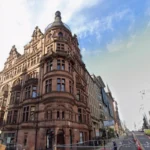
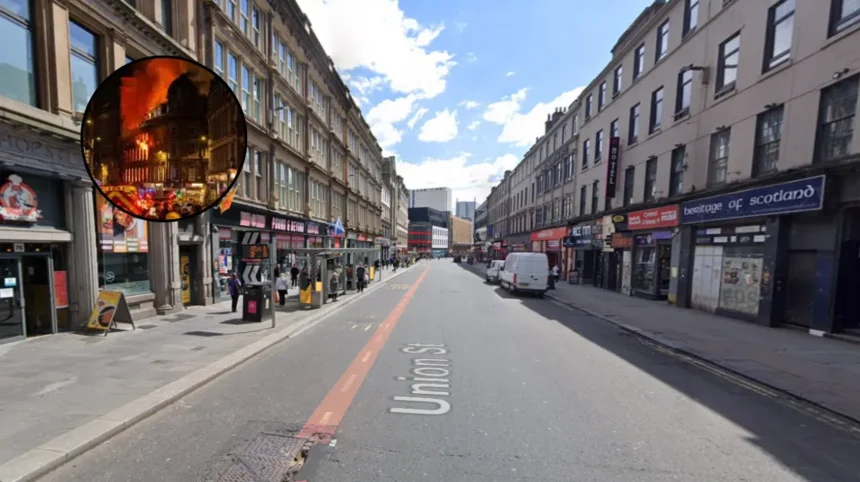
Glasgow (Glasgow Express) April 8, 2026Glasgow’s Union Corner, the B‑listed Victorian building at the corner of Union Street and Gordon Street beside Glasgow Central Station, is the latest in a series of high‑profile city‑centre fires that has left swathes of the core in long‑term disrepair. As reported by BBC News, the blaze began in a vape shop on Union Street at about 15:45 on Sunday, 8 March, with thick smoke quickly billowing out onto the street and prompting a large‑scale response from the Scottish Fire and Rescue Service. Operational units were dispatched to the four‑storey structure and, within hours, the fire had spread through the entire building, causing the collapse of the front wall and the destruction of the building’s distinctive dome.
- Key Points
- What are the immediate consequences for businesses and transport?
- What recovery funding and governance structures have been announced?
- Why is the recovery widely seen as “complex and challenging”?
- How does the Union Street situation echo the stalled Sauchiehall Street recovery?
- What background led to Union Corner’s current status?
- How might this development affect businesses, commuters and the wider city?
What are the immediate consequences for businesses and transport?
Interviews and reports from multiple outlets, including BBC News and The Ferret, describe how the Union Street fire devastated around 71 businesses, many of which are located in the 71 units within the Union Corner building and adjacent Gordon Street frontage. Several studio‑based creative firms and independent retailers told journalists that they lost expensive equipment, stock and premises overnight, with some turning to community‑led fundraising campaigns to cover immediate costs.
As reported by The Ferret’s Karin Goodwin, the vape shop at the centre of the blaze itself had not been formally registered to sell vaping products and had not paid business rates, a detail that has now fuelled wider questions about licensing, safety enforcement and responsibility for recovery costs.
The disruption to transport has also hit the city’s wider economy. With Glasgow Central Station effectively out of use, long‑distance services have been rerouted or cancelled, and local bus operators have had to adjust their routes and drop‑off points away from the Union Street core.
Community groups and business associations have warned that the longer the safety perimeter remains in place, the greater the strain on already fragile city‑centre trade, particularly in hospitality and retail.
What recovery funding and governance structures have been announced?
On 14 March 2026, First Minister John Swinney announced a Scottish Government recovery package that could reach up to £10 million to support businesses affected by the Union Street fire, with an additional up to £1 million earmarked for demolition and related works. In a statement reported by Yahoo News and The Independent, Swinney said the money would be channelled through Glasgow City Council to help
“rebuild and renew that vital part of the city”,
while non‑domestic rates hardship relief for impacted businesses would be increased from 75% to 95%. Swinney added that the government was committed to working closely with Glasgow City Council to ensure financial assistance is “accessible” and that
“some business owners have lost their properties and… their means of income”.
Glasgow City Council, in turn, has been tasked with overseeing the delivery of the support package. Susan Aitken, Leader of Glasgow City Council, told Yahoo News that the assistance from the Scottish Government had been “immensely significant” and that the city was moving from emergency measures into a longer‑term recovery phase.
A cross‑government Ministerial Board, chaired by Justice Secretary Angela Constance, has also been set up to coordinate the recovery and to oversee the development of a support package for businesses; Aitken has joined the board alongside ministers and key agencies.
Why is the recovery widely seen as “complex and challenging”?
Legal and property‑law experts, including solicitor Craig Donnelly writing for the Law Society of Scotland’s Journal hub, have noted that the Union Corner inferno mirrors the long, multi‑year recovery seen after the twin fires at Glasgow School of Art, which were followed by protracted debates over insurance, ownership and reconstruction costs.
Donnelly argues that the Union Corner case will likely require similar “complex legal, engineering and financial challenges” to stabilise and, potentially, rebuild the structure or its replacement. Questions are already emerging over who bears responsibility for repair and rebuilding, particularly given revelations that the vape‑shop operator had not registered to sell vapes or paid business rates, raising issues about liability and insurance cover.
The physical footprint of the Union Corner site also complicates matters. The building sits at a strategic junction between Union Street, Gordon Street and the approaches to Glasgow Central Station, meaning any reconstruction or redevelopment will have to address access, safety and long‑term economic viability.
As BBC News highlighted, the station cannot fully reopen until the Scottish Fire and Rescue Service declares the site free of hotspots and the council decides the fate of the remaining façade, a process that could take weeks or months.
How does the Union Street situation echo the stalled Sauchiehall Street recovery?
In the wake of the fire, the comparison between Union Corner and the long‑gestating plans for Sauchiehall Street has become a recurring theme in local commentary. The Sauchiehall Street site, another city‑centre fire‑affected area, has long been described as awaiting a “national recovery plan”, yet more than a decade after major fires several blocks away, progress has remained fragmented and incremental.
Local business groups and commentators have pointed out that early masterplans for Sauchiehall Street have often been engulfed by political wrangling, funding delays and shifting priorities, leading to a sense that regeneration can be talked about endlessly without ever being implemented.
In the immediate Union Street context, the risk is that the current flurry of announcements—from Swinney’s £10‑million package to the new Ministerial Board—could, over time, become another layer of aspirational but not fully delivered plans unless clear timelines, accountabilities and delivery mechanisms are set early.
As the Law Society of Scotland article notes, the “lesson” from previous fires is that prompt action and clear agreements on who pays are essential if the site is not to sit in a limbo reminiscent of other neglected fire‑damaged city‑centre blocks.
What background led to Union Corner’s current status?
The Union Corner building, originally known as Forsyth House and dating from 1851, was a B‑listed Victorian landmark on the approach to Glasgow Central Station. Its distinctive dome and corner positioning made it a visual anchor for the city’s main rail gateway, and over time the building evolved into a mixed‑use block containing offices, studios and retail units.
Before the fire, the site was already undergoing gradual change, with some expectations of refurbishment or partial redevelopment, but these plans appear to have been overtaken by the rapid escalation of the blaze in the vape shop.
The fire itself has also exposed regulatory gaps. The Ferret investigation revealed that the vape‑shop operator had not registered to sell vaping products and had not paid business rates, which has now prompted wider scrutiny of how such premises are licensed and monitored in city‑centre locations.
Fire and safety specialists have pointed to the volatility of vape products and the need for tighter controls on storage and site‑specific risk assessments, especially in historic buildings where compartmentalisation and fire‑stopping may be less robust than in modern structures.
How might this development affect businesses, commuters and the wider city?
The way Union Street’s recovery is handled could have a profound effect on small businesses, commuters and the perception of Glasgow’s economic resilience. For the up to 71 affected firms, the speed and clarity of the recovery package will determine whether they can relocate, re‑establish trading or face permanent closure.
If support is delivered rapidly and predictably, it could help retain creative and independent enterprises in the city‑centre core; if it is delayed or fragmented, it may accelerate the move of such businesses to the suburbs or online, further hollowing out the central area.
For commuters and travellers, the reopening timetable for Glasgow Central Station will directly shape journey times, reliability and confidence in Scotland’s rail network. With no timetable yet published, passengers face uncertainty over when normal services will resume, and transport‑sector representatives have warned that prolonged disruption could push more travellers towards alternative routes or modes.