Key Points
- Demonstrations were held in Glasgow, Edinburgh, Ayr and Aberdeen after an attempted murder in Belfast on Monday sparked disorder in Northern Ireland.
- Police Scotland said three men, aged 31, 18 and 18, were arrested and charged in Glasgow, and two officers plus three members of the public were injured there.
- STV reported that a crowd dressed mostly in black gathered at Glasgow’s Royal Concert Hall before marching towards the River Clyde, with large numbers of officers, riot vans and a helicopter deployed.
- BBC reported that hundreds gathered in Glasgow city centre on Tuesday evening, many with their faces covered, while protests also took place in Edinburgh and Ayr.
- Scotland’s First Minister John Swinney described the scenes as “unacceptable” and said racism, hatred and intimidation have no place in Scotland.
- STV and the Evening Standard said worshippers had to be locked in Glasgow’s largest mosque as tensions rose in the city.
- A separate court case in Belfast saw 30-year-old Hadi Alodid charged with attempted murder over the stabbing of Stephen Ogilvie, according to the Guardian and other outlets.
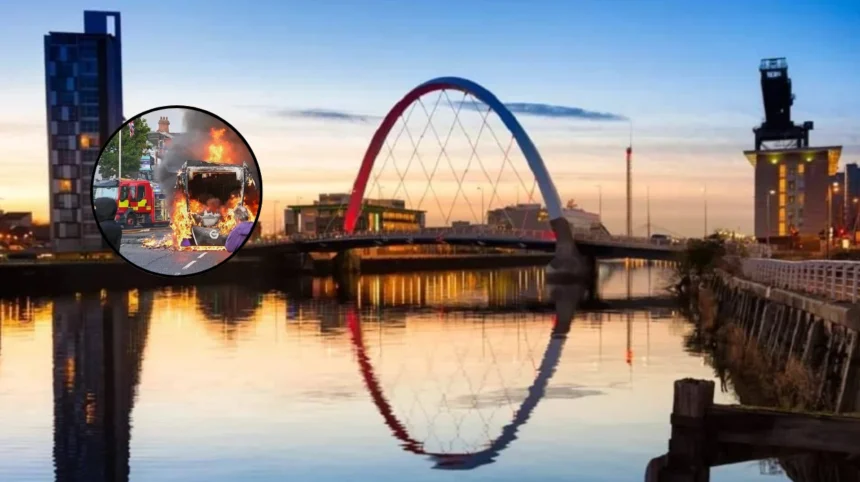
Glasgow (Glasgow Express) June 10, 2026 – unrest linked to a stabbing in Belfast spread to several Scottish cities on Tuesday night, with demonstrations in Glasgow drawing a heavy police response and leaving two officers and three members of the public injured in the city.
What happened in Glasgow?
As reported by STV, a crowd dressed mostly in black gathered on the steps of Glasgow’s Royal Concert Hall before marching down towards the River Clyde.
The broadcaster said pictures shared online showed a banner reading “White Lives Matter”, while videos circulating on social media appeared to show racist language being used during the disorder. Police Scotland said officers, riot vans and a helicopter were deployed, with a significant police presence around St Enoch shopping centre and Buchanan Street.
BBC reported that hundreds of people gathered in Glasgow city centre on Tuesday evening, with many protesters concealing their identities. Its report said the gathering formed part of protests that also took place in Edinburgh and Ayr after the stabbing in Belfast, while STV added that demonstrations were also held in Aberdeen.
The police later confirmed that three men were arrested and charged in connection with offences in Glasgow during the evening.
Why did the protests begin?
The unrest followed an attempted murder in Belfast on Monday, which prompted violence in Northern Ireland and then protests in Scotland.
The Guardian reported that Hadi Alodid, 30, appeared in court charged with attempted murder over the stabbing of Stephen Ogilvie, while other outlets said the case helped fuel the demonstrations. Police Scotland said the demonstrations in Scotland were disruptive in several places, but only Glasgow saw arrests and injuries.
STV said the First Minister used social media to condemn the scenes and stressed that
“racism, hatred and intimidation has no place in Scotland”.
In the same report, John Swinney said the scenes in Glasgow, Edinburgh and Ayr were unacceptable, while the Evening Standard also quoted Scottish Labour leader Anas Sarwar saying worshippers had been locked in Glasgow’s largest mosque as tensions increased.
What did police say?
Police Scotland said the demonstrations took place in a number of locations across the country on Tuesday, 9 June 2026. It said three men, aged 31, 18 and 18, were arrested and charged in Glasgow in connection with various offences. The force also said two officers were injured, along with three members of the public, all in Glasgow.
The same police update said officers also attended disruptive but peaceful demonstrations in Edinburgh, Falkirk, Perth, Ayr and Paisley, where no arrests were made. That distinction suggests the most serious disorder was concentrated in Glasgow, where the police response was the largest.
How did leaders react?
John Swinney said the scenes were “unacceptable” and argued that Scotland is a welcoming nation where people who make their lives there are valued members of communities. STV said he also stated that racism, hatred and intimidation have no place in Scotland.
The Evening Standard reported that Anas Sarwar said worshippers had to be locked in Glasgow’s largest mosque as tensions flared, and he condemned the disorder, violence and racism.
BBC’s report described the Glasgow protest as part of wider demonstrations across Scotland and noted the presence of Union flags, banners and people with covered faces. Taken together, the reports show political leaders and police focusing on public safety, community tension and the risk of racist disorder spreading further.
What was the mosque impact?
STV said the tension in Glasgow was serious enough for worshippers to be locked inside Glasgow’s largest mosque during the unrest. The Evening Standard repeated that detail and linked it to the wider disorder following the stabbing in Northern Ireland.
The reports do not say how long the mosque was locked down, but both accounts indicate that the incident raised concern beyond the protest route itself.
That detail matters because it shows the impact of the unrest was not limited to clashes between protesters and police. It also suggests that communities and places of worship were drawn into the tension as the disorder unfolded in the city.
Explore More Glasgow Crime News
Two Arrested After Man Hospitalised in Carntyne Road Assault; Glasgow East End 2026
Woman Arrested Over Serious Assault of Man at Gorbals Property; Glasgow 2026
Background of the development
The immediate trigger for the protests was the Belfast stabbing and the arrest and court appearance of Hadi Alodid in connection with the attempted murder of Stephen Ogilvie. Reporting from NPR said the case quickly became tied to anti-immigration protests, while Scottish coverage linked the Belfast violence to demonstrations in multiple Scottish cities. STV’s and BBC’s reports show that Glasgow was one of the main flashpoints, alongside Edinburgh and Ayr.
The broader background is a familiar pattern in which a serious crime becomes the catalyst for wider public disorder, online mobilisation and political condemnation. In this case, the reports also point to racial language, far-right symbolism and concern about intimidation directed at minority communities.
Prediction
For Glasgow residents, especially those in the city centre and around places of worship, the likely short-term effect is tighter policing and a more cautious public atmosphere. Businesses, commuters and community groups may see more visible security if further demonstrations are called, particularly in areas already used for large gatherings.
For Muslim communities and other minorities, the reports suggest a need for reassurance from authorities and continued attention to hate crime risks.
For the wider audience in Scotland, this development is likely to increase pressure on police and political leaders to prevent repeat disorder and to respond quickly to misinformation online. It may also intensify debate about public order, community cohesion and the line between protest and racist intimidation.