Key Points
- Fatal accident inquiry revealed Sudanese asylum seeker Badreddin Abdalla Adam Bosh, 28, wanted to leave the UK due to being “not happy,” having applied for voluntary return from Park Inn Hotel in Glasgow on June 26, 2020.
- Bosh stabbed six people—three asylum seekers, two hotel workers, and a police officer—before being shot dead by police after non‑lethal tactics failed.
- Home Office civil servant Paul Bilbao testified hotel accommodation since 2014/15 was “particularly challenging” for long‑stay asylum seekers, with vulnerability and lack of agency noted.
- Inquiry examined Bosh’s mental health concerns and chaotic hotel conditions, with testimonies from psychiatric nurse and Mears officials.
- Home Office aims to end hotel use for asylum seekers, citing pandemic “everyone in” policy surge and contractual downsides.
Glasgow (Glasgow Express) May 5, 2026
- What happened at the Park Inn Hotel in Glasgow?
- What do we know about Bosh’s background and mental health?
- How is the Home Office using hotel accommodation for asylum seekers?
- What does the inquiry reveal about the Park Inn Hotel environment?
- What are the implications for asylum‑seeker policy and mental‑health support?
What happened at the Park Inn Hotel in Glasgow?
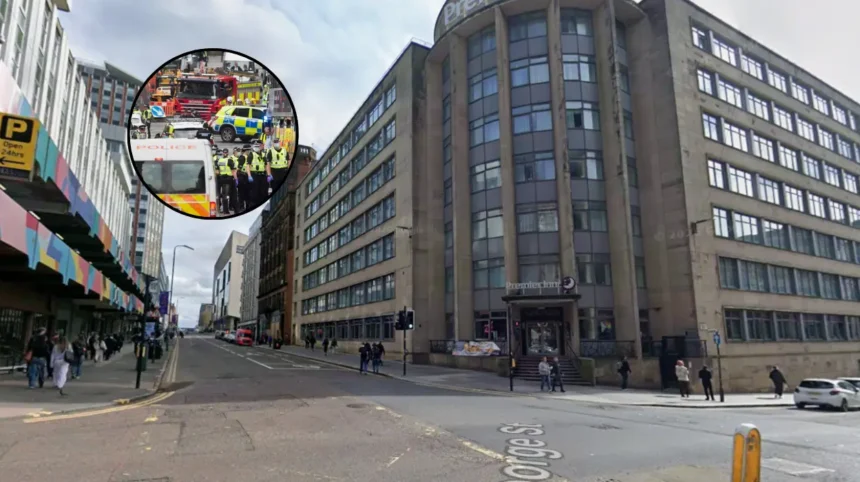
Glasgow – An asylum seeker who was shot dead by police after stabbing several people at the Park Inn Hotel in Glasgow had applied to leave the UK because he was “not happy,” a fatal accident inquiry (FAI) has heard. Badreddin Abdalla Adam Bosh, 28, from Sudan, attacked six people at the hotel on June 26, 2020, and was subsequently shot by officers after attempts to use non‑lethal weapons failed. The incident left three asylum seekers, two hotel workers and a police officer injured, with the attacks unfolding in a chaotic scene inside the city‑centre premises.
As reported by Andrew Webster KC, representing the Home Office, and detailed in the Evening Standard coverage, Bosh’s application form under the Home Office’s voluntary return scheme listed his reason for leaving as “not happy,” with no medical issues flagged beyond a possible stomach ulcer. The inquiry was shown a message from an official at Mears, the contractor providing accommodation for the Home Office, who noted that Bosh “hadn’t threatened anyone” but “seems a bit confused.” This forms part of wider scrutiny over mental‑health concerns raised before the attack, as the FAI continues to examine his state of mind in the period leading up to the stabbings.
What do we know about Bosh’s background and mental health?
Badreddin Abdalla Adam Bosh arrived in the UK as a Sudanese asylum seeker and was living at the Park Inn Hotel, which had been used by the Home Office as contingency accommodation for people seeking asylum. The BBC has reported that the attack unfolded in the early hours of June 26, 2020, when Bosh stabbed several victims in succession, including residents and staff, before police were called. Police officers later described how he continued to advance with a knife despite attempts to incapacitate him with non‑lethal force, leading to the fatal shooting.
At the FAI, a psychiatric nurse, Gregory Higgins, told the inquiry that the hotel environment had become “quite chaotic” after asylum seekers moved in, describing difficulties in managing behaviour and mental‑health needs in that setting. His evidence was cited by STV News, which reported that Higgins highlighted the strain on staff and the limited capacity to provide appropriate mental‑health support in a hotel converted into emergency accommodation. The inquiry has also been examining prior interactions with Bosh, including his expressed wish to leave the UK, which forms part of the picture of his mental state before the attack.
How is the Home Office using hotel accommodation for asylum seekers?
The inquiry has drawn attention to the systemic use of hotels as asylum‑seeker accommodation, with Home Office civil servant Paul Bilbao testifying that the department began contracting hotels for this purpose around 2014/15. As reported by the Evening Standard, Mr Bilbao explained that the Home Office had turned to hotel provision to meet demand, particularly after the onset of the pandemic, when an “everyone in” policy significantly increased the number of people needing temporary housing. He acknowledged that asylum seekers could be “particularly vulnerable” and that long‑stay hotel living could feel “particularly challenging,” with some individuals reporting a lack of agency over their lives.
In evidence, Mr Bilbao told the FAI that the Home Office recognised both the benefits and downsides of hotel use, but stated it had been “absolutely the only option available” at the time. Positive Action in Housing and the Scottish Refugee Council have separately submitted evidence criticising hotel‑based asylum accommodation as “inhumane” and unsuitable for people in need of protection, highlighting overcrowding, isolation and poor mental‑health outcomes. The FAI transcript seen by journalists indicates that policymakers are aware of these concerns and are seeking to move away from hotel‑only models, though the practical transition remains under discussion.
What does the inquiry reveal about the Park Inn Hotel environment?
Testimony and documents presented to the FAI have painted a picture of a strained and often chaotic environment at the Park Inn Hotel in Glasgow city centre. The STV‑reported evidence from nurse Gregory Higgins described unusually high levels of tension and behavioural incidents once asylum seekers were housed in the hotel, which was not designed as a long‑term care or dispersal site. Staff reportedly struggled to maintain order and provide adequate mental‑health monitoring, contributing to an atmosphere where risk‑factors could escalate without timely intervention.
The Mears official’s message introduced to the inquiry suggested that Bosh did not perceive himself as a threat, even while appearing confused, hinting at a possible gap between how he saw his situation and how others might have interpreted his behaviour. As the inquiry continues, counsel and legal representatives are focusing on how information about Bosh’s mental state, his wish to leave the UK, and the hotel’s conditions were communicated—or not communicated—between accommodation providers, health‑care professionals and the Home Office.
What are the implications for asylum‑seeker policy and mental‑health support?
The FAI into Bosh’s death is not only examining the circumstances of the individual incident but also the broader framework governing where asylum seekers are housed and how their mental health is monitored. The BBC and other outlets covering the inquiry note that officers’ use of lethal force will be scrutinised alongside the Home Office’s role in placing vulnerable individuals in hotel‑only accommodation without robust mental‑health‑support structures. Legal representatives for Bosh’s family, the victims, and various public bodies have raised questions about training, communication and risk‑assessment protocols in such settings.
Civil servants and policy witnesses have indicated that the Home Office intends to end the long‑term reliance on hotels for asylum‑seeker accommodation, although the pace and practical alternatives remain under discussion. The Scottish Refugee Council and advocacy groups have urged the government to prioritise community‑based housing, regular mental‑health assessments, and reduced use of institutional‑style hotels, arguing that such changes could mitigate the pressures that may have contributed to the Glasgow incident.
Background of the development
The Glasgow Park Inn Hotel incident sits within a wider debate about how the UK manages asylum‑seeker accommodation and mental‑health support. Since around 2014/15, the Home Office has increasingly used hotels under private contracts, including with firms such as Mears, to house asylum seekers while their claims are processed. This practice accelerated during the pandemic, when the “everyone in” policy sought to move people out of shared or overcrowded settings, but in doing so placed many in temporary, often isolated hotel rooms with limited access to services.
Fatal accident inquiries are a Scottish legal mechanism used to investigate the circumstances surrounding certain deaths, including those involving police, and to make non‑binding recommendations for future prevention. In this case, the FAI is examining not only the actions of the police officers who shot Bosh but also the wider context: his mental health, his expressed desire to leave the UK, and the conditions of the hotel where he was housed. Advocacy organisations such as the Scottish Refugee Council and Positive Action in Housing have used the inquiry to highlight what they describe as systemic failings in the use of hotel accommodation for vulnerable people.
Prediction: How this development could affect asylum seekers and policy audiences
The ongoing inquiry and emerging evidence are likely to influence several groups, starting with asylum seekers and refugee‑support organisations in Glasgow and beyond. If the FAI recommends clearer guidelines on mental‑health screening, risk‑assessment, and limits on long‑term hotel use, service providers may be required to implement more structured support systems and move more people into community‑based housing. This could reduce the sense of isolation and lack of agency that Paul Bilbao and other witnesses have described as particularly challenging for asylum seekers in hotels.
For UK policymakers and the Home Office, the inquiry may prompt a formal review of contingency‑accommodation contracts and a clearer timeline for phasing out hotel‑only placements. Evidence presented by advocacy groups and the FAI could pressure ministers to prioritise investment in dispersed, community‑integrated housing and better multidisciplinary links between accommodation providers, mental‑health services and local authorities. At the same time, police and emergency‑response agencies may see renewed emphasis on training in de‑escalation and mental‑health‑aware interventions when dealing with asylum seekers in high‑stress environments.
For the public and media audience, the case could increase scrutiny of how asylum‑seeker accommodation is publicly funded and monitored, particularly in major cities such as Glasgow where dispersal and hotel use have been concentrated. As the FAI continues, detailed reporting from outlets including the BBC, STV, and the Evening Standard is likely to keep the issue in the spotlight, shaping public and political debate about the balance between logistical expediency and the duty of care owed to people seeking protection in the UK.