

Key Points
- Attorney General Ellie Reeves said decisions on serious Troubles-related prosecutions would be independent of government.
- The Northern Ireland Troubles Bill would require consent from the Attorney General or Advocate General for Northern Ireland before certain indictable-only prosecutions.
- Labour MP Andy McDonald warned the provision could weaken safeguards protecting prosecutorial independence.
- Amnesty International UK urged the Government to remove the consent clause.
- The Bill passed the House of Commons and is scheduled for a second reading in the House of Lords on December 2.
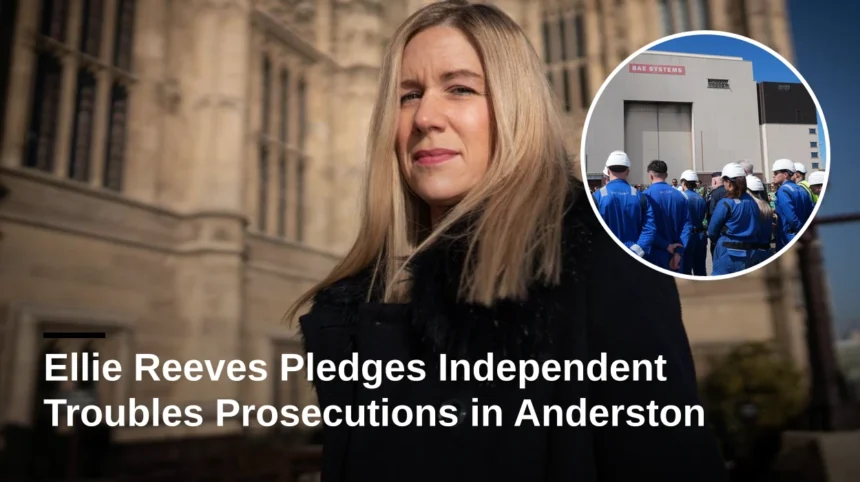
Anderston (Glasgow Express) November 18, 2026 – Attorney General Ellie Reeves has pledged that politics will not influence decisions on future prosecutions for serious crimes linked to the Troubles. Speaking in the House of Commons, Reeves said any decisions requiring her consent would be made through a quasi-judicial process independent of the Government.
The assurance came during scrutiny of the Northern Ireland Troubles Bill, which contains a provision requiring the consent of the Advocate General for Northern Ireland or the Attorney General for England and Wales before certain indictable-only Troubles-related offences can be prosecuted. Such offences include murder, rape and robbery, which can be tried only in the Crown Court.
Why was the Attorney General challenged over prosecution independence?
Labour MP Andy McDonald said the consent requirement risked rolling back safeguards intended to keep prosecution decisions free from political interference. He referred to the Justice (Northern Ireland) Act 2002, which states that the functions of the Director of Public Prosecutions for Northern Ireland must be exercised independently of any other person.
McDonald asked whether requiring the Attorney General’s consent for serious Troubles-related prosecutions could undermine the independence of Northern Ireland’s justice system and public confidence in it.
In response, Reeves said: “There will be no political interference with decision making.” She added that the decisions would be made quasi-judicially and independently of government, pointing to existing offences in England and Wales for which Attorney General consent is required.
What concerns have been raised about the consent clause?
Gráinne Teggart, Amnesty International UK’s deputy director for Northern Ireland, called for the Westminster Government to remove the clause before the Bill becomes law. Teggart said an assurance that decisions would be made quasi-judicially did not resolve concerns about prosecutorial independence or public confidence.
She also described independent prosecution decisions as a vital safeguard rooted in reforms that followed the 1998 Good Friday Agreement.
What happens next for the Northern Ireland Troubles Bill?
The Bill passed the House of Commons on October 20, 2026, and has moved to the House of Lords for further scrutiny. Its second reading is listed for December 2.
Recent reporting has also noted that the Bill would replace the existing legacy framework with a reformed Legacy Commission with enhanced powers. More than 100 Government amendments were added during its Commons consideration, including the Attorney General consent provision and additional protections for veterans.
Background to the development
The Northern Ireland Troubles Bill is intended to address the legal and investigative legacy of decades of conflict in Northern Ireland. Its proposed prosecution consent mechanism has become one of the most contested parts of the legislation. Supporters argue that the Attorney General would exercise a legal, quasi-judicial function rather than a political one. Critics, including Amnesty International UK and MPs, say placing a ministerial law officer in the prosecution process could affect public confidence.
What could the development mean for victims, prosecutors and veterans?
For victims and families, Reeves’s assurance may provide a stated commitment that political considerations will not determine whether serious Troubles-related cases proceed. Prosecutors would face an additional statutory consent stage if the Bill becomes law, while the Government says that stage would operate independently of ministers. Veterans could receive the additional protections included in the Bill, although the legislation remains subject to further Lords scrutiny. The outcome of that scrutiny will determine whether the consent clause and related safeguards remain in their current form.


