
Nestled in the core of Glasgow, Merchant City stands as a captivating testament to the city’s mercantile past and its enduring cultural allure. This historic district, often hailed as one of Europe’s finest examples of 18th-century urban planning, blends opulent Georgian architecture with modern-day vibrancy, drawing visitors eager to explore its tobacco lord mansions, cobblestone streets, and thriving contemporary scene.
- The Origins of Merchant City
- Rise of the Tobacco Lords
- Architectural Marvels That Define the District
- Evolution Through the Industrial Age
- Decline and Remarkable Revival
- Must-Visit Landmarks Today
- A Culinary Powerhouse Reborn
- Shopping in Style Amid Heritage
- Vibrant Nights and Cultural Pulse
- Festivals and Events Calendar
- Staying Over: Luxury in Historic Settings
- Merchant City in Modern Glasgow
The Origins of Merchant City
The story of Merchant City begins in the mid-18th century, when Glasgow’s merchants sought to escape the cramped conditions of the medieval Old Town along the High Street. From the 1750s onward, this area west of the congested core emerged as the city’s first planned “New Town,” featuring wide, straight streets, grand vistas, elegant churches, and expansive squares designed to reflect the growing wealth of its tobacco barons. These affluent traders, who amassed fortunes through transatlantic commerce in tobacco, sugar, and rum, commissioned lavish townhouses that symbolized their status and ambition. Residences and warehouses sprang up around key locales like St. Andrew’s Square, adjacent to Glasgow Green, transforming marshy land into a showcase of neoclassical splendor.
This deliberate urban expansion marked a pivotal shift for Glasgow, propelling it from a modest ecclesiastical center to a powerhouse of the British Empire. The merchants’ vision was not merely residential; it incorporated commercial hubs that facilitated the storage and trade of exotic goods arriving via the Clyde River. By laying out orderly grids with names like Trongate, Candleriggs, and Ingram Street, they created a district that balanced functionality with aesthetic grandeur, setting a precedent for future developments like the grander Blythswood New Town in the 19th century.
Rise of the Tobacco Lords
At the epicenter of Merchant City’s golden age were the “Tobacco Lords,” a cadre of wealthy entrepreneurs whose palatial homes dotted the landscape. Figures such as James Dunlop, John Glassford, and Archibald Speirs built opulent three-story townhouses with pedimented doorways, fanlit entrances, and rusticated ground floors, often fronted by private gardens or piazzas. These structures, constructed primarily between 1750 and 1770, boasted interiors adorned with fine plasterwork, mahogany staircases, and imported furnishings that whispered of Caribbean plantations and Virginia fields.
The tobacco trade fueled this prosperity, with Glasgow surpassing rivals like Bristol and Liverpool due to its strategic port access and entrepreneurial spirit. Merchants imported vast quantities of the leaf, processing it in local factories before re-exporting to Europe. This commerce not only enriched individuals but also funded public benefactions, including the Trades Hall and Hutchesons’ Hall, where guilds convened amid ornate Adam-style interiors. However, this wealth was inextricably linked to the brutal realities of slavery, as ships departing the Clyde carried goods to Africa in exchange for human cargo, a dark undercurrent that modern interpretations of the district increasingly acknowledge through plaques and exhibits.
By the late 18th century, as the American Revolution disrupted supplies, the lords pivoted to cotton, rum, and sugar, sustaining the area’s economic vitality. Their legacy endures in the sheer scale of surviving buildings, which outnumber those in Edinburgh’s New Town, offering a tangible link to Glasgow’s imperial zenith.
Architectural Marvels That Define the District
Merchant City’s architecture is a symphony of Georgian elegance, with highlights that continue to mesmerize architects, historians, and tourists alike. The Trades Hall on Glassford Street, designed by Robert Adam in 1791, exemplifies neoclassical perfection with its Ionic portico, intricate friezes depicting mercantile virtues, and a domed ceiling in the main hall that rivals anything in London. Nearby, Hutchesons’ Hall, rebuilt after a fire in 1792, features a striking spire and galleried interior once used for assemblies and concerts, its proportions harmonizing with the surrounding streetscape.
Ingram Street stands out for its concentration of restored warehouses turned galleries, while the former Royal Exchange on St. George’s Place—now a luxury hotel—boasts a grand Corinthian facade from 1829. The district’s street furniture, including cast-iron bollards and lanterns, adds to the period authenticity, preserved through meticulous conservation efforts. St. Andrew’s Parish Church, with its spire piercing the skyline since 1736, anchors the eastern edge, its graveyard holding tales of forgotten merchants. These structures, many Category A-listed, form a cohesive ensemble that earned Merchant City Conservation Area status in 1972, ensuring their protection amid urban evolution.
Evolution Through the Industrial Age
As Glasgow ballooned into the “Second City of the Empire” during the 19th century, Merchant City transitioned from elite residences to a bustling commercial nerve center. Prosperous families decamped to leafy West End suburbs, leaving behind a hive of warehouses, shipping offices, distilleries, and clothing factories. Markets thrived here too: the Briggait hosted fish auctions under its iconic spire—salvaged from the demolished Merchants’ House of 1817—while Candleriggs buzzed with fruit, vegetable, cheese, and butter stalls.
This industrial pivot reflected broader shifts, with the Clyde’s dredging enabling steamship traffic and rail links knitting the district into national supply chains. Distilleries like those of John Walker produced whisky amid the grit, and textile firms spun imported cotton into cloth for global markets. Yet, prosperity bred congestion; tenements replaced grand homes, and smoke from factories blackened facades, prompting early conservation stirrings by the turn of the 20th century. World Wars and economic slumps further altered the area, with warehouses repurposed for wartime storage, but the core fabric remarkably intact.
Decline and Remarkable Revival
The 20th century brought challenges: deindustrialization gutted jobs, and post-war planning favored cars over heritage, leading to dereliction. By the 1970s, Merchant City teetered on the brink, its empty shells eyed for demolition. Salvation came via Glasgow District Council’s 1972 designation of the area as a Conservation Area, followed by pioneering restoration projects funded by the European Regional Development Fund.
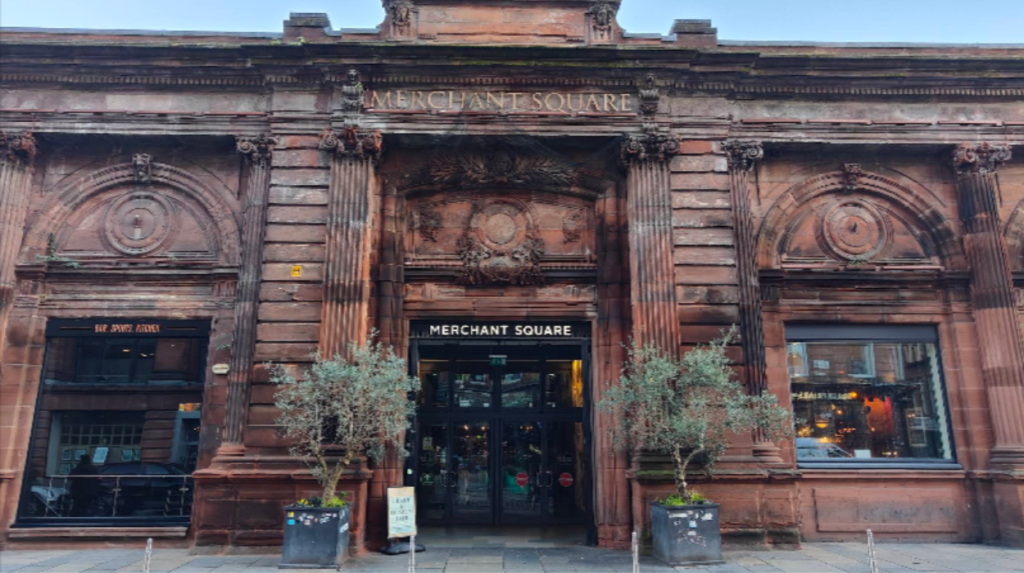
The 1980s renaissance transformed warehouses into apartments, offices, and cultural spaces, kickstarting gentrification. Merchant Square, once the Victorian Fruit Market, reopened in 1987 as a dining and events hub, its glass-roofed courtyard hosting everything from ceilidhs to craft markets. The Glasgow International Festival of Visual Art and Merchant City Festival amplified its profile, while adaptive reuse preserved authenticity—former tobacco stores now house boutique hotels like the Dakota. Today, over £500 million in investments have revived 300 listed buildings, blending heritage with hipster appeal.
Must-Visit Landmarks Today
Wander Trongate, the district’s spine, lined with independent shops and the Tron Theatre, Glasgow’s oldest playhouse since 1794. Royal Exchange Square dazzles with its Italianate piazza and the Duke of Wellington statue—famously adorned with a traffic cone—and connects to Exchange Place’s high-end jewelers. The Gallery of Modern Art occupies the former Royal Exchange, its provocative exhibits contrasting the classical shell.
Candleriggs Square pulses with street food stalls and pop-ups, overlooked by the Ramshorn Kirk, a Gothic Revival gem turned academic theater. Don’t miss the Italian Centre on John Street, a cluster of 1750s arcaded warehouses now fashion boutiques. For history buffs, the Glasgow Police Museum in the old HQ reveals gritty tales, while Merchant Square’s vaults offer subterranean tours of fruit market relics. These sites, interwoven with blue plaques, invite self-guided exploration via apps like the Glasgow Merchant City Trail.
A Culinary Powerhouse Reborn
Merchant City’s gastronomic scene rivals Edinburgh’s, with its past as a trading hub inspiring global flavors. Merchant Square anchors the action: its nine venues span Italian at Di Maggio’s, craft beer at UZOS, and live music at the Absent Ear. Nearby, Ingram Street’s fine dining includes Rogano, Glasgow’s seafood institution since 1876, its Art Deco interiors evoking ocean liners.
Street food thrives at Barras Market fringes, blending curries, pizzas, and Scotch eggs, while vegan spots like Mono’s record shop-cafe draw ethical eaters. Whisky bars like the Absent Ear pour rare malts amid exposed brick, and coffee roasters in converted vaults fuel brunch crowds. Seasonal events like the Christmas market amplify the buzz, making it a year-round foodie haven.
Shopping in Style Amid Heritage
Luxury meets indie in Merchant City’s retail landscape. The Italian Centre’s designer flagships—think Mulberry and Vivienne Westwood—rub shoulders with concept stores in restored arcades. Trongate’s Hutcheson’s City Arcade houses jewelers and tailors, evoking Victorian elegance.
Vintage hunters scour Beyond Retro on Virginia Street for retro finds, while contemporary crafts fill stockists like Transmission Gallery’s shop. Antiques row on Wilson Street offers silverware and maps from tobacco eras. This mix caters to discerning shoppers seeking unique Glaswegian flair without chain-store blandness.
Vibrant Nights and Cultural Pulse
As dusk falls, Merchant City ignites with bars, clubs, and theaters. The Old Fruit Market hosts raves under its canopy, while Sub Club on Jamaica Street—world-renowned for techno—pulses nearby. LGBTQ+ venues like Polo Lounge draw diverse crowds, fostering an inclusive vibe amid festivals like Pride.
Live music echoes from King Tut’s Wah Wah Hut (where Oasis was scouted) and the 02 ABC, while comedy at Blackfriars keeps laughs flowing. The district’s nightlife nods to its rebellious spirit, with speakeasies in cellars serving prohibition-era cocktails.
Festivals and Events Calendar
Merchant City thrives on celebration. The Merchant City Festival in July transforms streets into open-air theaters with music, dance, and markets. Hogmanay’s street party packs Merchant Square, fireworks bursting over spires. Glasgow International Festival brings biennial art invasions, while the Christmas Village twinkles with chalets. Year-round, the Barras Antiques Market and indoor Barras Market offer bargains every weekend, embedding the area in Glasgow’s festive rhythm.
Staying Over: Luxury in Historic Settings
Overnight options immerse guests in history. The Radisson Blu nods to the 1770s Townhouse with vaulted ceilings and clawfoot tubs. Dakota Glasgow occupies a tobacco lord pile, blending tartan luxury with city views. Boutique stays like the Merchant Lodge offer self-catering Georgian flats, perfect for extended sojourns amid the action.
Merchant City in Modern Glasgow
Today, Merchant City encapsulates Glasgow’s reinvention, a UNESCO City of Music and Film where heritage fuels creativity. Its proximity to George Square and the Style Mile makes it central, yet its preserved scale offers intimacy. Sustainability initiatives, like green roofs on restorations, align it with forward-thinking urbanism.
Challenges persist—balancing tourism with locals’ needs—but regeneration successes position it as a model for cities worldwide. For Glaswegians and global travelers, it remains a living archive, where every corner whispers of empire, resilience, and reinvention.