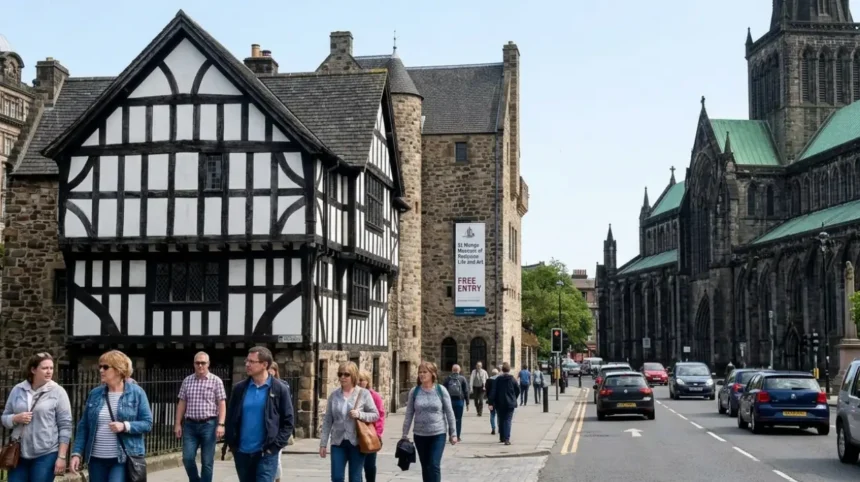
Provand’s Lordship is simple to reach from Glasgow city centre, and the cheapest option is usually to walk from nearby rail or subway stops. The house stands on Castle Street, opposite Glasgow Cathedral and beside the St Mungo Museum of Religious Life and Art, with free entry at the museum itself and free or low-cost access around the site.
- Where is Provand’s Lordship in Glasgow?
- What is the easiest way to get there?
- Which train station is nearest?
- Which bus routes stop nearby?
- How much does it cost to visit?
- When should you go?
- What route works best on foot?
- Is it easy to combine with other sights?
- Why does the location matter historically?
- What makes it affordable for visitors?
- What should you know before setting off?
- Why this remains a strong city visit
Where is Provand’s Lordship in Glasgow?
Provand’s Lordship is on Castle Street in the Cathedral precinct, in Glasgow city centre, with the postcode G4 0RB. It sits beside Glasgow Cathedral and opposite the St Mungo Museum of Religious Life and Art, making it easy to locate on a city map or walking route.
The building is one of Glasgow’s oldest surviving medieval structures. Glasgow Life says it was built in 1471 and is one of only four surviving medieval buildings in the city. That history makes the site useful not only as a destination, but also as a landmark for navigation in the north-eastern edge of the centre.
Castle Street runs through the historic cathedral area. This part of Glasgow has a dense cluster of heritage sites, so the route to Provand’s Lordship often works best when planned as part of a wider visit to Glasgow Cathedral and the surrounding precinct.

What is the easiest way to get there?
The easiest way to reach Provand’s Lordship is on foot from Glasgow High Street station or from the central streets around George Square and Buchanan Street. The walk is short, direct, and free, which makes it the most affordable route for most visitors.
From George Square, Glasgow Cathedral’s visitor information gives a clear walking route: head north along North Hanover Street, turn right onto Cathedral Street, then continue to Castle Street. The cathedral is also a useful marker because Provand’s Lordship stands nearby on the same historic axis.
If you are already in the city centre, walking avoids fare costs and traffic delays. This matters because street parking in central Glasgow is limited, and city-centre traffic often adds time without adding convenience.
Which train station is nearest?
Glasgow High Street is the nearest rail station to Provand’s Lordship. It is described as a short walk away, and Glasgow Cathedral is also listed as a 15-minute stroll from Glasgow Queen Street station.
High Street station is the better choice if your only goal is Provand’s Lordship or the cathedral area. That station places you close to the medieval quarter and reduces walking distance compared with larger central stations.
Queen Street station also works well if you are combining the visit with central shopping streets. National rail and visitor guidance place the cathedral area within easy walking distance of the main city-centre network, so rail travel remains one of the cheapest practical choices.
Which bus routes stop nearby?
Several First Bus services stop near the cathedral area, including routes 19, 19A, 38, 57, and 57A. These services place you close to Castle Street, Cathedral Street, or the wider cathedral precinct, which keeps the final walk short and inexpensive.
Bus travel works well if you are coming from outer Glasgow districts. First Bus service information shows that these routes serve the cathedral corridor and adjacent streets, including Castle Street, Baird Street, Kyle Street, North Hanover Street, and Cathedral Street on current diversions and normal routing.
For affordability, buses often suit visitors better than taxis or private cars. A bus plus a short walk gives direct access to the site without parking charges, while still keeping the journey simple.
How much does it cost to visit?
Provand’s Lordship has free entry according to Glasgow Life. That makes the visit one of the lowest-cost heritage outings in the city, with optional donations rather than mandatory ticket prices.
Glasgow Life lists the venue as free to enter, and other heritage sources repeat that the house is open without admission charge. That matters for families, students, and budget-conscious visitors who want a major historic site without paying museum-style admission.
There is a note of variation in secondary listings, including mention of guided tour fees in some sources. The safest planning approach is to treat the standard visit as free and to confirm any special tour charges before arrival.
When should you go?
Provand’s Lordship is open daily with standard daytime hours, and Glasgow Life lists Monday to Thursday and Saturday as 10:00 am to 5:00 pm, Friday and Sunday as 11:00 am to 5:00 pm. Visiting earlier in the day usually gives the easiest access and the quietest experience.
The venue’s published schedule is practical for day trips and short city-centre visits. Because the site sits in a compact heritage zone, it is easy to pair with Glasgow Cathedral and the St Mungo Museum during the same outing.
A daytime visit also helps with walking navigation. The area is more straightforward to read on foot in daylight, and the cathedral precinct becomes easier to orient around once you can see the relationship between Castle Street, Cathedral Street, and the museum buildings.
What route works best on foot?
The best walking route is from George Square or Glasgow Queen Street station via North Hanover Street and Cathedral Street to Castle Street. It is direct, signposted by major landmarks, and free, which makes it the most affordable route for most visitors.
A simple city-centre walk usually works better than trying to navigate by small side streets. Glasgow Cathedral’s visitor guidance gives a straightforward route from George Square, and that route leads naturally into the cathedral precinct where Provand’s Lordship stands.
If you are starting from Buchanan Street, you can still reach the area on foot through the city-centre grid and then continue toward High Street and Castle Street. The route remains short enough for most visitors, and it avoids the unpredictability of parking or taxi fares.
Is it easy to combine with other sights?
Yes. Provand’s Lordship sits beside Glasgow Cathedral and the St Mungo Museum of Religious Life and Art, so one trip covers three major historic attractions in a single small area. This is efficient for time, transport, and money.
This cluster is one reason the site is such a useful anchor point for visitors. Glasgow Cathedral has its own visitor hours and free admission, while Provand’s Lordship is also free to enter, so the area works well as a low-cost heritage circuit.
For people who want to maximise value, this is the best structure: arrive by train or bus, walk to Castle Street, visit Provand’s Lordship, then move across to the cathedral and museum area. That sequence keeps transport simple and reduces backtracking.
Why does the location matter historically?
Provand’s Lordship is historically important because it is Glasgow’s oldest house, built in 1471 as part of the cathedral hospital complex. Its placement beside the cathedral reflects the city’s medieval religious centre, not a random modern tourist address.
History matters here because the building’s location explains why it survives. The house formed part of St Nicholas’s Hospital, later linked with cathedral canons and the ecclesiastical life of medieval Glasgow. That context makes Castle Street more than a navigation point; it is a preserved fragment of the old city.
The site also shows how Glasgow has changed. A former medieval residence later became a shop and a sweet factory before restoration returned it to museum use. That long transformation gives the address its present-day significance as both a landmark and a heritage site.
What makes it affordable for visitors?
Provand’s Lordship is affordable because it sits in a free-entry heritage zone, is reachable by public transport, and requires no expensive travel from the city centre. Walking from nearby stations is the cheapest option, followed by standard bus travel.
Cost control starts with location. Visitors arriving by rail can often walk the rest of the way, avoiding taxis and parking fees. Visitors already in central Glasgow can reach Castle Street from George Square or Buchanan Street without paying anything extra.
The site’s free entry is a major saving. With no required admission charge, the main cost becomes transport, and even that stays low if you use rail or bus instead of private car travel.
What should you know before setting off?
Before you go, check opening hours, allow extra time for nearby attractions, and use the postcode G4 0RB for maps or route apps. The site is compact, central, and easy to reach, but the best route depends on whether you arrive by train, bus, or on foot.
Map searches work best when you use the exact site name and postcode. Provand’s Lordship is clearly identified by Glasgow Life as being on Castle Street, Glasgow, G4 0RB. That detail reduces the chance of arriving at the wrong end of the cathedral quarter.
A small amount of planning improves the visit. If you arrive by train, High Street station is the most efficient stop; if you arrive by bus, choose a service that serves the cathedral area; if you are already in the centre, walk. That simple decision tree keeps the trip easy and affordable.

Why this remains a strong city visit
Provand’s Lordship remains one of Glasgow’s best low-cost heritage visits because it combines historical depth, a central location, free entry, and straightforward transport links. It delivers strong value for locals, day-trippers, and visitors exploring the cathedral quarter.
The attraction works because it is both specific and accessible. Few historic buildings in Glasgow are as old, and few are as easy to reach without spending much money. That combination keeps it relevant for anyone planning a practical city-centre outing.
For Glasgow audiences, the site offers a clear model of efficient sightseeing. Use High Street station, Glasgow Cathedral, Castle Street, and the postcode G4 0RB as your main reference points, and the journey stays simple from start to finish.
What is Provand’s Lordship in Glasgow?
Provand’s Lordship is Glasgow’s oldest surviving house, built in 1471 beside Glasgow Cathedral in the city’s medieval quarter.