

Key Points
- Project Sentinel is targeting upstream drug dealers linked to Glasgow city-centre problems.
- The operation involves Police Scotland, Glasgow City Council and the Crown Office and Procurator Fiscal Service.
- Dispersal powers were used 2,677 times between their introduction and 30 September.
- Chief Superintendent Emma Croft said people had been charged with violence, drugs, weapons, theft and sexual offences.
- The dispersal zone was due to run until 20 December, with a possible extension under consideration.
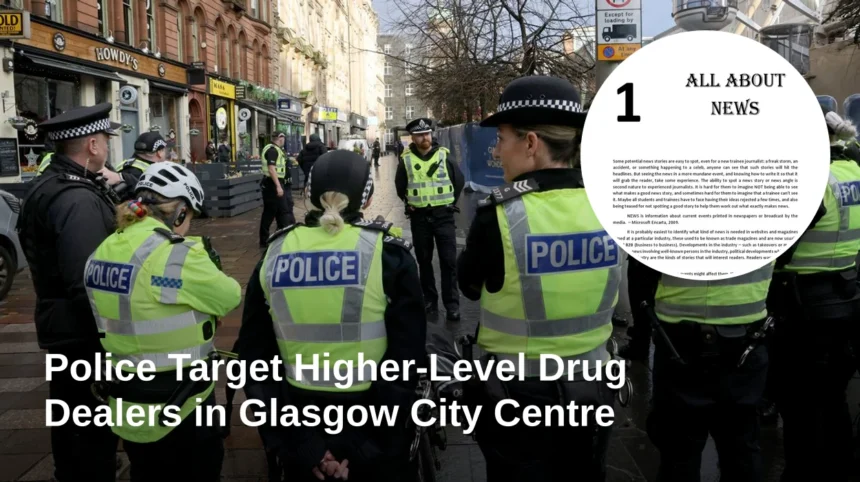
Glasgow city centre (Glasgow Express) November 28, 2026 – Police Scotland is using intelligence from Project Sentinel to identify higher-level drug dealers as part of a multi-agency operation addressing crime and anti-social behaviour in Glasgow city centre. The operation, launched in August, is focused on tackling the causes of persistent problems and preparing targeted days of action. Chief Superintendent Emma Croft said a significant number of people had been charged with offences including violence, drugs, weapons possession, theft and sexual assault.
How is Project Sentinel targeting drug networks?
As reported by Glasgow Live in a report by its newsroom, Project Sentinel has generated intelligence supporting the identification of “upstream drug dealers”. Police Scotland’s Serious and Organised Crime Teams, Proactive Unit and Disruptions Teams are supporting the operation.
The police report presented to the Safe Glasgow Partnership said plans were in place to enhance policing in Glasgow city centre. Project Sentinel brings together Police Scotland, Glasgow City Council and the Crown Office and Procurator Fiscal Service.
The report said the operation remained focused on the city centre, while targeted days of action were planned. The stated aim is to address root causes rather than only respond to individual incidents at street level.
How many times have dispersal powers been used?
Chief Superintendent Emma Croft said dispersal powers had been enforced “a few thousand times”. The reported total was 2,677 uses between the introduction of the city-centre dispersal zone and 30 September.
The powers allow officers to direct groups of two or more people to leave an area when their behaviour is affecting public safety. The zone was scheduled to remain in place until 20 December, although Chief Superintendent Croft said a further extension could be considered.
A separate report by Glasgow Times said police had acknowledged concerns about people being displaced from the city centre towards areas south of the River Clyde. Inspector Graeme Hogg said additional city-centre officers would support policing around Carlton Place, Bridge Street and Carlton Court, with uniformed and plain-clothes officers also deployed locally.
What offences and police responses have been recorded?
At the Safe Glasgow Partnership meeting, Chief Superintendent Croft said a significant number of people had been charged with violence, drug offences, possession of weapons, theft and sexual assault. She said officers were working with partners to identify and address the causes of recurring city-centre issues.
Glasgow Times also reported that drug and substance-misuse incidents had more than doubled since 2024 and that a new team was being used to target anti-social behaviour. Inspector Hogg described the dispersal zone as a temporary measure rather than a permanent arrangement.
What is the background to the operation?
Project Sentinel was launched in August after complaints from residents about anti-social behaviour and related problems in Glasgow city centre. Its multi-agency structure allows police, the council and prosecutors to share responsibility for enforcement and follow-up action.
The operation complements the dispersal zone, which gives officers additional powers to move people from locations where public safety is affected. Police Scotland has linked the wider response to intelligence-led work against serious and organised crime.
The Scottish Police Authority has separately reported convictions and prison sentences in Operation Arachnoid, an investigation into serious organised criminality and illicit drug supply across Greater Glasgow.
How could the operation affect city-centre policing?
The intelligence-led approach is likely to direct more police resources towards identifying people higher in drug-supply networks, while specialist teams continue supporting enforcement activity in the city centre.
For people involved in drug dealing or associated violence, targeted days of action could increase the likelihood of investigations, arrests and prosecutions. For members of the public, the visible presence of additional officers may support responses to anti-social behaviour and other offences.
Police and partner agencies will also need to monitor possible displacement into nearby areas, including locations south of the River Clyde, as dispersal and enforcement activity continues.