Key Points
- Paisley’s second fire engine was unavailable for 22.3% of the previous financial year because of insufficient crew numbers, according to a Freedom of Information response.
- Paisley Southwest councillor Anne Hannigan said the figure showed the alarming consequences of fire crew shortages.
- The Scottish Fire and Rescue Service said appliances may be unavailable because of training, unplanned absences or shortages of staff with required skills.
- The service said it maintains a national network, dynamically deploying the nearest suitable available resource.
- The Scottish Fire and Rescue Service reported a whole-time appliance availability rate of at least 90% over the past three years.
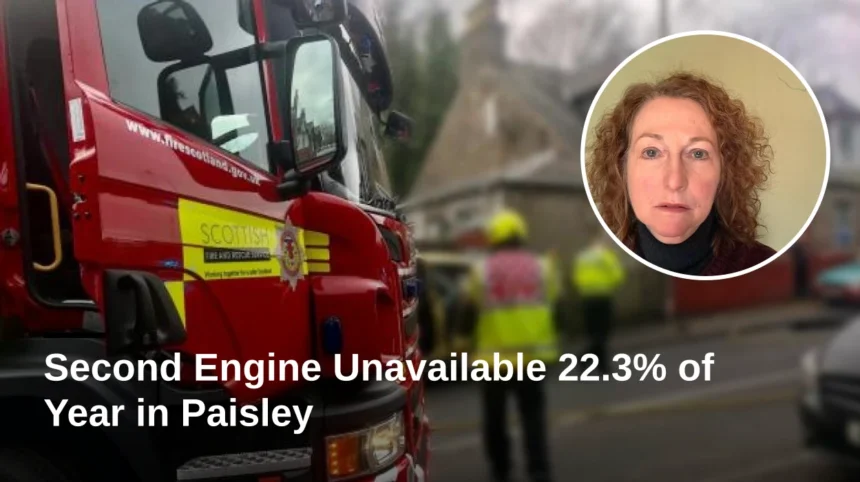
Paisley (Glasgow Express) November 18, 2026 – Paisley’s second fire engine was unavailable for 22.3% of the previous financial year because there were insufficient crew numbers, according to information obtained by Paisley Southwest councillor Anne Hannigan through a Freedom of Information request. Hannigan said larger stations should have two engines ready to respond, while the Scottish Fire and Rescue Service said it would continue to deploy the nearest appropriate available resource to emergencies.
Why has Paisley’s second fire engine been unavailable?
As reported by The Gazette in its report “Councillor sounds alarm over Paisley fire engine availability”, Anne Hannigan said the Renfrewshire station could not use its second engine for nearly a quarter of the previous financial year because of insufficient crew numbers.
Hannigan said staffing shortages could prevent a station from dispatching a crew or vehicle to an emergency call. She said the figures illustrated the “alarming consequences” of fire crew shortages in Paisley and warned that a simultaneous incident could leave only one nearby engine available.
“For almost a quarter of last year, a second fire engine could not be deployed to incidents because there was not enough crew to man it,” Hannigan said.
She called for fire service leaders and ministers to provide greater support for firefighters.
How has the Scottish Fire and Rescue Service responded?
David Farries, assistant chief officer at the Scottish Fire and Rescue Service, said the organisation had more than 600 operational appliances across Scotland and that many stations had more than one vehicle.
Farries said the service operated as a national network and could strategically place resources where they were needed. Operations control staff consider an appliance’s real-time location, availability and operational status rather than relying on fixed station response areas.
He said the service would attend every emergency and had maintained a whole-time appliance availability rate of 90% or higher over the previous three years. He added that appliances could be unavailable because of staff training, unplanned absences or a lack of personnel with the required skill sets.
What wider changes are being considered?
Farries said the Scottish Fire and Rescue Service had completed the first round of public consultation for its Service Delivery Review. The review is intended to identify operational changes that place resources in locations matching community risk and demand.
According to Farries, the review could improve appliance availability while allowing staff to support other areas, including prevention. He said firefighters continued to work in communities to reduce the likelihood of emergencies before a 999 call was made.
What is the background to the Paisley fire engine dispute?
The dispute centres on the availability of Paisley station’s second engine during the previous financial year. Anne Hannigan’s Freedom of Information request linked the 22.3% unavailability figure to insufficient crew numbers. Hannigan argues that a larger station should retain two immediately deployable engines. The Scottish Fire and Rescue Service says availability can be affected by several operational factors and that national deployment arrangements are designed to maintain emergency cover.
How could the staffing issue affect Paisley residents?
If a second Paisley engine is unavailable, the Scottish Fire and Rescue Service may need to send another suitable appliance from elsewhere, depending on its location and operational status. That could affect the distribution of resources during multiple incidents, although the service says its control room dynamically deploys the nearest appropriate available appliance. The Service Delivery Review may lead to operational changes intended to improve availability. For residents, the immediate issue remains whether sufficient trained crews and appliances are available when more than one emergency occurs at the same time.