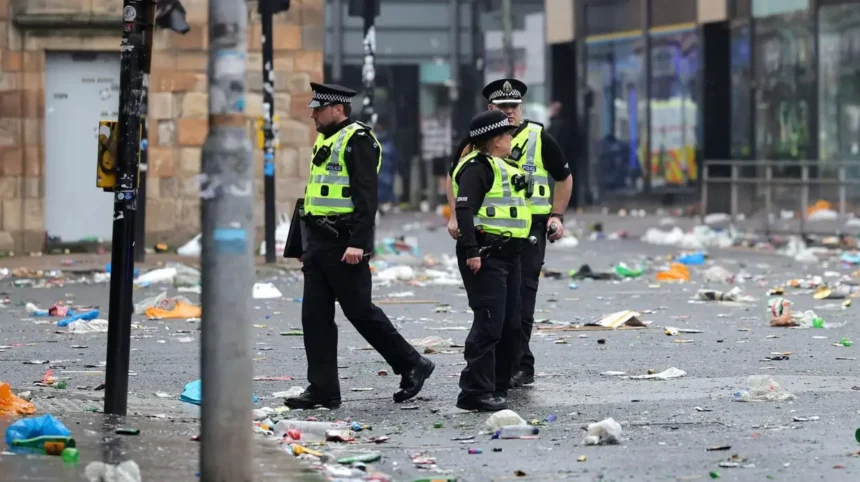
- Incident: Two Police Scotland officers were assaulted with glass bottles during a large-scale disturbance involving a group of men in Glasgow city centre on Wednesday night.
- Location & Closures: The incident prompted a substantial emergency response, leading to the temporary closure of both Douglas Street and Pitt Street.
- Police Response: Chief Superintendent David Robertson condemned the violence as “unacceptable,” stating that being assaulted is “not part of the job” for frontline personnel.
- Status of Investigation: Police Scotland have launched a formal enquiry into the disorder, with active investigations ongoing to identify all individuals involved.
Glasgow (Glasgow Express) November 5, 2026 – Two police officers have sustained injuries after being targeted with glass bottles during a wave of public disorder involving a large group of men in Glasgow city centre on Wednesday evening.
Emergency services were dispatched to the scene following reports of a significant disturbance, which prompted police to establish a heavy presence in the surrounding area. To manage the ongoing risk and facilitate emergency operations, officers cordoned off Douglas Street and Pitt Street, halting both vehicular and pedestrian traffic throughout the duration of the incident.
According to statements released by Police Scotland, the two officers were attacked whilst responding to reports of anti-social behavior and unrest involving the group. Both officers received treatment for their injuries following the assault.
Addressing the incident, Chief Superintendent David Robertson expressed firm condemnation of the violence directed towards his team. Chief Superintendent Robertson designated the acts of aggression against the responding personnel as entirely “unacceptable,” emphasizing that officers routinely put themselves in harm’s way but that being physical assaulted remains an unacceptable risk that is “not part of the job.”
Police Scotland confirmed that comprehensive enquiries remain underway to establish the full sequence of events and locate the individuals responsible for the assault and wider disorder in the city centre.
What Happened During the Glasgow City Centre Disorder?
The disturbance broke out in the late evening on Wednesday, drawing a prompt and visible deployment of law enforcement units to the core of the city. Members of the public reported seeing a substantial number of police vehicles and uniformed personnel converging on the streets adjacent to Douglas Street and Pitt Street.
Witness accounts and official confirmations indicate that the disruption was caused by a large group of men acting in a disorderly manner. As officers arrived to restore order and disperse the crowd, the situation escalated, culminating in direct attacks on the emergency responders. Glass bottles were launched at the officers, resulting in injuries to two members of the force.
To bring the situation under control and preserve the area for forensic examination, police quickly established perimeters. Douglas Street and Pitt Street were shut down completely to ensure public safety while extra units worked to clear the thoroughfares and secure the location.
What Has Police Scotland Said About the Assault on Officers?
Following the containment of the disorder, senior leadership within Police Scotland released official commentary regarding the physical harm inflicted upon their staff during the call-out.
Chief Superintendent David Robertson made a clear declaration regarding the standards expected for officer safety and public order. Chief Superintendent Robertson remarked that the level of aggression displayed towards the emergency service personnel was wholly “unacceptable.” He further underscored the fundamental principle that while police officers accept inherent duties to safeguard the public, being targeted and assaulted with missiles such as glass bottles is “not part of the job.”
The force leadership reiterated that support is being provided to the two injured officers as the investigation proceeds. Police Scotland have urged anyone who witnessed the disorder or who holds mobile phone footage, dashcam recordings, or private security footage from the vicinity of Douglas Street and Pitt Street to come forward to assist the active enquiries.
Background of the Particular Development
The incident in Glasgow city centre reflects ongoing challenges faced by emergency services regarding public order management and violence directed against first responders across Scotland.
Statutory protections for emergency workers in Scotland fall under specific legislation designed to penalize assaults or obstructions directed at police, paramedics, and fire services personnel. The Emergency Workers (Scotland) Act 2005 was introduced specifically to provide legal mechanisms to prosecute individuals who target emergency staff while they are performing their duties.
Over recent years, Police Scotland and police staff associations have repeatedly highlighted concerns over the frequency of verbal and physical abuse encountered by officers during night-time economy patrols and large-scale public disturbances. Urban centers such as Glasgow regularly see high concentrations of police resources deployed during peak hours to manage night-life areas, transport hubs, and high-density commercial zones.
The temporary closure of primary thoroughfares like Douglas Street and Pitt Street—both key connectors within Glasgow’s commercial core—highlights the operational operational disruption caused when spontaneous disorder escalates to violence requiring full street containment and investigative preservation.
Prediction: How Will This Development Affect Glasgow Residents and Emergency Personnel?
This latest incident of disorder and assault on law enforcement is expected to have direct consequences for several key groups within the local area, including city residents, night-time patrons, businesses, and operational police officers.
For the local community and business operators around Douglas Street and Pitt Street, the immediate effect involves potential concerns regarding public safety and localized movement disruptions during police operations. Future responses to similar public order reports in the city centre may see heightened police presence, stricter street management tactics, and increased use of temporary cordons to prevent crowd gatherings from escalating into violent confrontations.
For Police Scotland officers and emergency service workers, the incident is likely to reinforce calls from police representative bodies for stricter enforcement under the Emergency Workers Act and enhanced protective measures for frontline personnel. In response to attacks involving weapons such as glass bottles, management may review tactical deployments in high-density urban areas, potentially increasing the availability of specialized public order assets or additional protective gear during late-night urban patrols.
Furthermore, the ongoing police enquiries will likely result in an intensified investigative push, including expanded Closed-Circuit Television (CCTV) reviews across Glasgow city centre. This may lead to an increased police visible presence in the coming days as officers conduct appeals, seek witnesses, and execute targeted patrols to deter further anti-social behavior and maintain public confidence.