Key Points
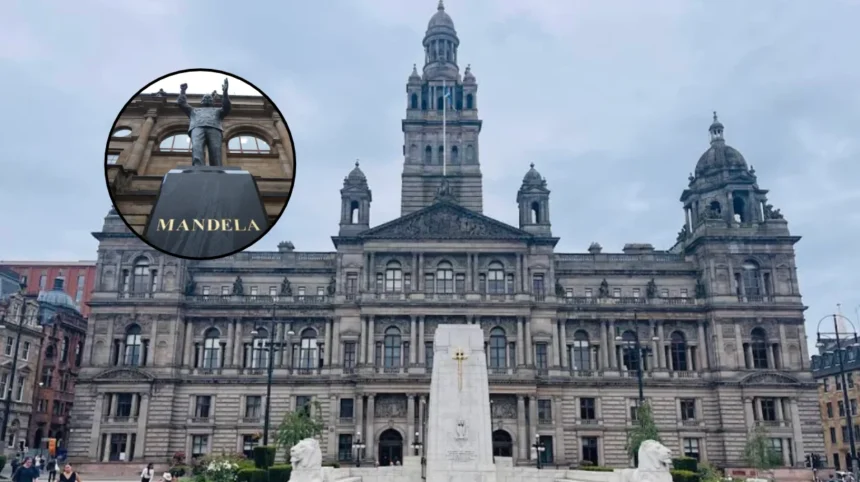
- Glasgow City Council Response: Local authority leaders have firmly condemned an anti-immigration stunt aimed at the newly erected Nelson Mandela statue in Nelson Mandela Place.
- Far-Right Involvement: A placard promoting the “remigration” ideology—demanding the forced removal of foreign nationals—was attached directly to the monument by a group operating under the name Dissidents Scotland.
- Timing of Incident: The incident occurred merely weeks following the official unveiling of the landmark bronze memorial in October 2026.
- Community Reaction: Civic leaders and campaigners, including representatives from the Nelson Mandela Scottish Memorial Foundation, expressed outrage, reaffirming that the statue serves as a symbol of unity, anti-racism, and social justice.
- Law Enforcement Engagement: Police Scotland was formally notified regarding the incident after social media posts displaying the banner began circulating online.
Glasgow (Glasgow Express) October 30, 2026 – Glasgow City Council has issued a stern condemnation following an “unacceptable” far-right action in which an anti-immigration banner was attached to the city’s newly erected Nelson Mandela statue.
The local authority voiced outrage after photographic material circulated across social networks revealing a placard advocating the “remigration” movement attached to the bronze monument, located in Nelson Mandela Place. The public monument had been officially uncovered only weeks earlier following a long-running public campaign to honour the anti-apartheid leader and former South African President.
Images published online show the political placard affixed to the base of the statue. In accompanying digital messages, the far-right faction Dissidents Scotland posted:
“The City of Glasgow council recently erected a Nelson Mandela statue. They support mass immigration. We support remigration. Choose your side!”
The term “remigration” is used by far-right political factions to advocate the forced deportation of ethnic minorities and foreign nationals.
In response to the demonstration, a spokesperson for Glasgow City Council denounced the act as completely inconsistent with the values of the municipality. The local authority emphasised that the statue represents a proud historical stance against oppression and racial discrimination, reiterating that divisive political actions targeting civic monuments will not be tolerated.
As reported by Marco Suttie of The National, representatives from the Nelson Mandela Scottish Memorial Foundation highlighted the underlying educational mission of the newly installed monument. Brian Filling, Chair of the Nelson Mandela Scottish Memorial Foundation, indicated that the memorial was intentionally established to offer “a focus for ongoing education around the continuing struggle against racism and for justice and equality.”
Police Scotland was alerted after images depicting the banner posted on the statue were published on social media platform X. Officers were contacted to review the circumstances surrounding the unauthorized placement of political materials on public property.
The installation of the statue marks the culmination of years of fundraising and advocacy led by local campaigners to commemorate Glasgow’s historic opposition to the South African apartheid regime. In 1981, Glasgow became the first municipality in the world to grant Nelson Mandela the Freedom of the City while he was still incarcerated on Robben Island. The surrounding square, formerly known as St George’s Place, was subsequently renamed Nelson Mandela Place in 1986 as a direct statement of solidarity against apartheid policies.
What Is the Background to the Nelson Mandela Memorial Development in Glasgow?
The unveiling of the Nelson Mandela statue in October 2026 represents the completion of a multi-year civic initiative organised by the Nelson Mandela Scottish Memorial Foundation. The campaign was established to create a permanent physical monument celebrating the long-standing relationship between the city of Glasgow and the anti-apartheid movement.
Glasgow played a prominent role in international opposition to South African racial segregation policies throughout the late 20th century. Beyond awarding Mandela the Freedom of the City in 1981, municipal leaders renamed the street housing the South African Consulate-General to Nelson Mandela Place, forcing diplomatic personnel to use the activist’s name on all official correspondence.
Following Mandela’s release from prison in 1990, he visited Glasgow in 1993 to personally collect his Freedom of the City award alongside honours from eight other UK local authorities. The newly commissioned bronze statue was funded through public donations, trade union contributions, and educational grants, designed to serve as an enduring symbol of human rights education and anti-racist advocacy for future generations.
How Will This Development Affect Local Communities and Anti-Racism Initiatives?
The targeting of the monument by far-right activists highlights an escalating cultural tension within local governance and community relations across the region.
Impact on Local Residents and Minority Communities
For local residents and ethnic minority communities, the placement of anti-immigration slogans on a landmark anti-apartheid statue creates concerns regarding safety and community cohesion. Anti-racism advocacy groups warn that the public promotion of “remigration” rhetoric seeks to intimidate migrant populations and undermine municipal inclusion strategies.
Impact on Local Governance and Security Measures
Glasgow City Council and Police Scotland face increasing demands to safeguard public monuments and civic spaces against unauthorised political demonstrations. The incident may prompt municipal authorities to evaluate enhanced security protocols, such as increased CCTV surveillance and frequent policing around historic and political landmarks, to deter future acts of vandalism or unauthorised postings.
Impact on Educational and Civic Campaigning
Despite the disruption caused by the stunt, community leaders and civil rights organisations contend that such incidents reinforce the necessity of public anti-racism education. Civic organisations plan to proceed with outreach initiatives centred on the Nelson Mandela statue, using the monument as an active platform to promote racial equality, civil rights history, and social integration across Scotland.