Key Points
- Radical public service reform proposals under consideration by the Scottish Government could lead to the abolition of Glasgow City Council, replacing the current 32 local authorities with six to 10 larger regional authorities and 120 to 160 community-based bodies.
- Scottish Green councillors have issued an explicit warning that structural overhauls must not be driven primarily by cost-cutting, highlighting that these proposals were omitted from previous election manifestos.
- Concerns have been raised regarding democratic accountability, massive potential job losses, service reductions, and the operational risks associated with splitting Scotland’s largest city into smaller administrative divisions.
- Trade unions, including Unison, have strongly criticized the wider reform model as “nonsense,” estimating that up to 20,000 public sector jobs could be placed at risk if structural reorganization is prioritized over direct funding.
- Public sector ministers, including Public Finance Minister Ivan McKee, maintain that structural reform is required to ensure long-term public service sustainability, whilst opposition members argue the focus must shift to replacing council tax and securing sustainable funding.
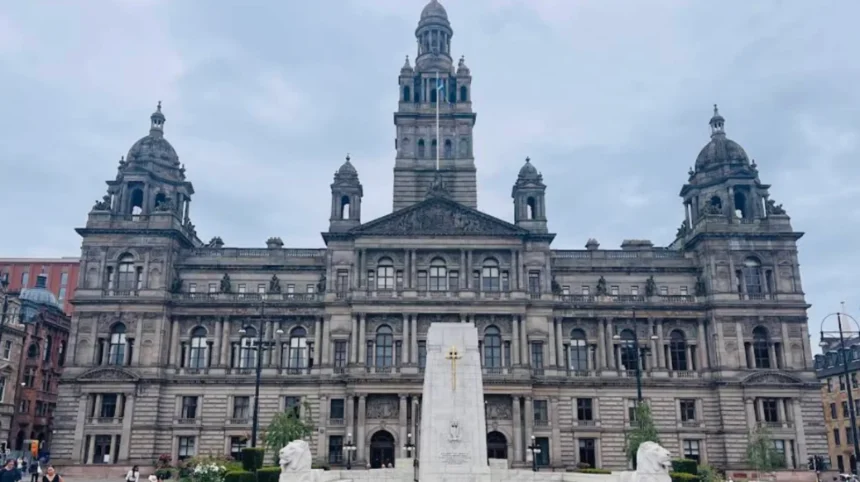
Glasgow (Glasgow Express) October 26, 2026 — Proposals currently under discussion within the Scottish Government could fundamentally alter the landscape of Scottish local governance by abolishing all 32 existing unitary local authorities, including Glasgow City Council. In their place, initial discussions contemplate the creation of between six and 10 large regional authorities alongside a secondary tier comprising 120 to 160 community-based authorities.
- Key Points
- Why Are Scottish Green Councillors Warning Against Cost-Driven Reorganisation?
- What Impact Could the Proposals Have on Local Services and Employment?
- How Has the Scottish Government Justified the Public Sector Reform Agenda?
- Background of the Particular Development
- Prediction: How This Development Can Affect Glasgow Residents and Council Staff
Glasgow City Council represents the single largest local authority in Scotland when measured by annual operating budget, total elected members, and municipal workforce. Under the proposed blueprint, municipal duties across the country would be reallocated into broader regional jurisdictions, effectively ending the governance structure established under the Local Government etc. (Scotland) Act 1994.
The administrative realignment forms part of a broader public service reform framework championed by SNP ministers aiming to streamline service delivery across local government, health services, and public agencies. However, key elements of the proposal have drawn immediate resistance from local representatives and trade union leadership across the country.
Why Are Scottish Green Councillors Warning Against Cost-Driven Reorganisation?
As reported by Stacey Mullen of the Glasgow Times, local councillors have raised major concerns regarding both the timing and motivation behind the proposed structural changes. Members of the Scottish Greens have noted that plans to dismantle local authorities were not presented to voters prior to the last election, prompting questions regarding democratic mandates and public consultation.
The Green group on Glasgow City Council warned that structural restructuring must not serve as a front for budget reductions or staff contraction. As reported by Stacey Mullen of the Glasgow Times, Green councillors stated that:
“There is a strong case to not split Glasgow into smaller administrative units.”
Extending this argument, municipal representatives referenced administrative models across Europe to highlight potential risks to urban governance. As reported by Stacey Mullen of the Glasgow Times, a spokesperson for the local Greens noted:
“In Nordic countries, which have two-tier systems similar to the approach the Scottish Government is proposing, the main cities are largely kept as extant wholes.”
The local authority group emphasized that fragmenting Scotland’s economic core could weaken municipal coordination, dilute local democracy, and lead to reduced public services.
What Impact Could the Proposals Have on Local Services and Employment?
The prospect of replacing 32 unitary councils with consolidated regional authorities has generated significant concern amongst municipal employees and trade union representatives regarding workforce retention, service provision, and institutional accountability.
As reported by Martin Williams of The Herald, Lilian Macer, the Scottish Secretary of trade union Unison, stated that:
“For any public sector reforms, you cannot fix or try and fix health without looking at social care. It cannot be separated.”
Addressing the broader structural plan to consolidate local authorities into six to 10 regional bodies, Lilian Macer of Unison, as reported by Martin Williams of The Herald, characterized the proposals in their current format as:
“Just nonsense.”
Unison officials have estimated that up to 20,000 public sector jobs across Scotland could potentially be impacted or eliminated should consolidation plans proceed without explicit safeguards against compulsory redundancies and service cuts. Trade union leaders maintain that structural realignment fails to address the underlying financial pressures facing frontline municipal services.
How Has the Scottish Government Justified the Public Sector Reform Agenda?
The Scottish Government has defended its exploration of structural options as a necessary effort to ensure public sector sustainability amidst severe financial constraints and growing demographic demands on local infrastructure.
As reported by Martin Williams of The Herald, Minister for Public Finance Ivan McKee stated that:
“Reforms will fail without social care.”
Ivan McKee has continuously asserted that public services require systemic integration across health, social care, and local administration to eliminate duplicated bureaucracy and optimize operational expenditure. SNP ministers contend that exploring alternative regional governance models is essential to protecting core delivery frameworks over the long term, denying that the proposals represent arbitrary cuts to local democracy.
Conversely, opposition parties and political partners have called for immediate funding reform rather than structural reorganisation. Scottish Green Co-Leader Ross Greer highlighted that structural shifts cannot succeed without addressing local revenue mechanisms. As reported by staff writers at Green News, Ross Greer stated:
“Our schools are desperately short of staff and our social care system is on its knees. That is the result of a completely broken funding model. If the First Minister wants Green support for his plans, he needs to work with us to scrap and replace the Council Tax for good.”
Background of the Particular Development
The current structure of Scottish local government was established following the implementation of the Local Government etc. (Scotland) Act 1994, which dismantled the former two-tier system of regional and district councils on April 1, 1996. This legislative change created 32 single-tier unitary authorities responsible for all municipal services, ranging from education and social work to roads, waste management, and local planning.
Glasgow City Council emerged as the premier local authority in Scotland, serving a population of over 630,000 residents and managing an annual operating budget exceeding £1.8 billion. Over recent decades, Scottish municipal finance has been heavily constrained by freeze mechanisms on council tax, real-terms reductions in central block grants, and increasing statutory demands in adult social care and early years education.
The Scottish Government launched its formal public service reform initiative to identify long-term efficiencies across state-funded bodies. Previous reform attempts, such as the national consolidation of police and fire services into Police Scotland and the Scottish Fire and Rescue Service in 2013, demonstrated both the financial advantages and the centralisation critiques associated with large-scale administrative mergers. The current discussion regarding council consolidation represents the most significant proposed overhaul of Scottish local administration in thirty years.
Prediction: How This Development Can Affect Glasgow Residents and Council Staff
If the Scottish Government proceeds with the proposed abolition of Glasgow City Council in favour of a wider regional authority structure, the primary impact will fall directly upon the city’s residents, municipal employees, and local business communities.
Impact on Glasgow Residents and Taxpayers
- Dilution of Local Accountability: Merging Glasgow into a larger regional authority spanning surrounding council areas could reduce direct electoral representation per capita. Residents may find local ward issues subordinate to broader regional priorities.
- Risk of Service Fragmentation: Splitting Glasgow into smaller administrative or community units risks disrupting centralized city-wide services such as social housing management, urban transport infrastructure, and public cleansing.
- Taxation Realignment: Any structural shift accompanied by property tax reform could result in significant re-evaluations of household local tax liabilities across different urban sectors.
Impact on Municipal Workforce and Trade Unions
- Employment Insecurity: With trade unions projecting substantial workforce impacts nationwide, Glasgow’s non-teaching and administrative staff could face structural redundancies, departmental relocations, or contract restructuring.
- Operational Disruption: Merging municipal IT systems, pension funds, and administrative protocols across new regional entities typically leads to transitional delays and operational friction in service delivery.
Impact on Regional Economic Governance
- Strategic Planning Disruption: Dismantling Scotland’s largest economic authority could temporarily slow major urban regeneration projects, infrastructure investments, and municipal economic development strategies across the Greater Glasgow region.