Key Points
- Traffic wardens in Glasgow have expressed outrage after being instructed by council managers to observe and report criminal activities, including drug dealing and violent behaviour, while on patrol.
- Enforcement officers have been tasked with monitoring illicit activities around the “Four Corners” intersection, an area in Glasgow city centre long recognised as a high-crime hotspot (Beat 12).
- Staff are required to log and submit details of criminal offences to senior bosses at the conclusion of their daily shifts, though officers claim management has not clarified how this gathered intelligence will be utilised.
- Trade union representatives and frontline wardens argue that the directive places a “target on their backs,” putting lone workers at severe personal risk without proper protection or adequate risk assessments.
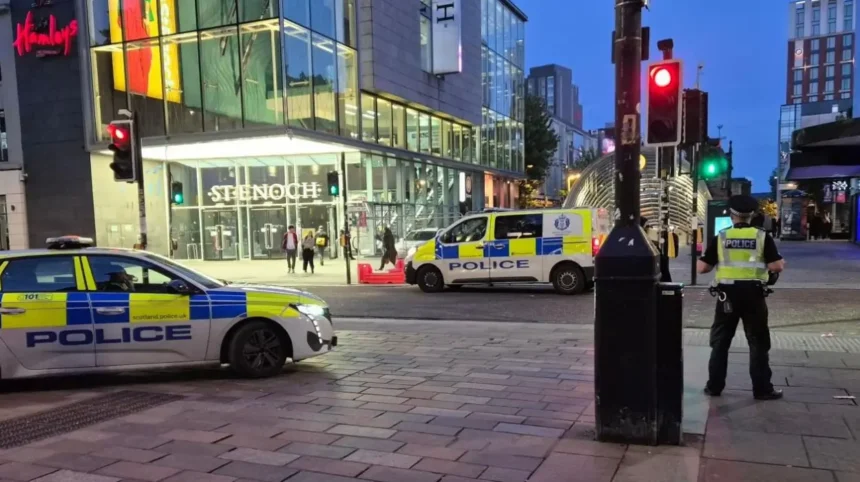
- Frontline workers highlight a stark contrast between their vulnerable position as uniformed council employees and police officers, who routinely deploy in multi-person tactical units equipped with personal protective gear when attending the same area.
- The Scottish Police Federation has noted that ongoing police staffing deficits hinder the delivery of consistent, proactive, and visible street patrols required in high-crime zones.
- Glasgow City Council has maintained that employee safety remains a primary priority and asserted that appropriate support mechanisms and reporting protocols are maintained to safeguard council staff.
Glasgow (Glasgow Express) October 22, 2026 — Traffic wardens patrolling the streets of Glasgow have voiced intense anger after being ordered by senior management to gather intelligence on drug dealers and violent offenders within one of the city’s most notorious crime hotspots. Frontline parking enforcement personnel report that council bosses issued directives requiring them to monitor illicit activities and submit end-of-shift reports detailing criminal wrongdoings observed while servicing Beat 12, an area encompassing the central intersection commonly known as the Four Corners. Staff members state they were provided no explanation regarding how the submitted intelligence would be handled, raising grave concerns over personal safety and operational scope.
- Key Points
- Why Are Traffic Wardens Being Asked to Report Serious Crime in Glasgow?
- What Risks Do Frontline Enforcement Officers Face on Beat 12?
- How Have Trade Unions and Police Representatives Responded?
- Background of the Four Corners Security and Staff Safety Controversy
- Prediction: How This Development Can Affect Frontline Council Workers and Public Safety
Why Are Traffic Wardens Being Asked to Report Serious Crime in Glasgow?
As reported by Sally Hind of the Daily Record, traffic wardens have raised alarms after receiving requests from Glasgow City Council bosses directing them to observe and log criminal conduct while executing their standard parking enforcement duties. The directive specifically targets Beat 12, a street sector notorious for persistent anti-social behavior, public disorder, and open drug trafficking.
According to statements gathered by Sally Hind of the Daily Record, enforcement officers revealed that senior management requested logs of any wrongdoing spotted during patrols to be handed in at the end of each shift. Staff members noted that no formal guidance was provided regarding how the sensitive information would subsequently be processed or shared with law enforcement authorities.
Frontline staff contend that the instruction forces unequipped council employees into role conflict, expecting them to act as covert observers against dangerous criminal elements while visible in official council attire.
What Risks Do Frontline Enforcement Officers Face on Beat 12?
As reported by Sally Hind of the Daily Record, traffic wardens describe an increasingly hostile working environment where physical assault and verbal abuse are daily occurrences. One warden stated to Hind:
“I’ve been spat on, shoved, and called every name under the sun. It is horrendous and now I’m meant to be reporting crime too? It’s just another target on our back.”
The same warden highlighted the disparity between police interventions and warden patrols, explaining to the Daily Record:
“Police arrive in 12 Beat in twos, fours and sixes. They pour out of minivans in all the gear while we are out there on our own, on constant alert with our eyes on swivels. The job is hard enough without being asked to look out for criminals. That is not our job and even the suggestion that it might be will only bring us more abuse.”
As further reported by Sally Hind of the Daily Record, another long-serving parking attendant remarked on the worsening atmosphere across the city centre, stating:
“It’s no secret. Anyone going into the city sees things have got worse. It can be an angry, angry place. People see our uniform and think it’s acceptable to shout and bawl at us. And it’s not just drivers, just random folk in the street think we’re fair game.”
The long-serving officer added:
“I walked past some guy this week and he just started calling me the most disgusting names. You try to ignore it but it gets to you because it’s so relentless. You swallow the stress of it, all day, every day, then go home feeling like your head is going to explode.”
How Have Trade Unions and Police Representatives Responded?
As reported by Sally Hind of the Daily Record, David Hume, GMB trade union organiser for Glasgow City Council, forcefully criticised the council’s directive, emphasizing that parking attendants are being exposed to unnecessary danger.
David Hume told the Daily Record:
“Parking attendants already face horrific abuse and aggression every day on the streets of Glasgow. They need the full support of management, greater protection and rigorous risk assessments.”
Hume expanded on the operational reality for staff members, declaring to the publication:
“Our members are not ad hoc crime fighters. They are lone workers — often women — in uniform, being asked to patrol streets that have become synonymous with trouble and disorder.”
Addressing broader enforcement issues, David Kennedy of the Scottish Police Federation pointed to systemic resource constraints within law enforcement. As reported by Sally Hind of the Daily Record, David Kennedy stated:
“We do not have enough police officers to provide the visible, proactive policing that our communities deserve. Areas such as Glasgow’s Four Corners require a consistent and visible police presence.”
In response to the growing criticism, a spokesman for Glasgow City Council issued a statement defending staff welfare policies. As reported by Sally Hind of the Daily Record, the council spokesman stated:
“Staff safety and well-being is always an absolute priority. Any abuse directed towards our staff is completely unacceptable and we always seek to ensure the correct procedures needed to support staff appropriately are in place.”
Background of the Four Corners Security and Staff Safety Controversy
The controversy surrounding parking enforcement officers in Glasgow arises against a backdrop of prolonged public safety concerns at the Four Corners—the junction linking Argyle Street, Union Street, and Jamaica Street. Historically identified as one of Glasgow’s central transit hubs, the area has experienced elevated levels of street-level drug dealing, anti-social behaviour, and violent crime over recent years.
Glasgow City Council parking attendants operate as lone workers responsible for monitoring parking restrictions, bus lanes, and pedestrian zones. Unlike Police Scotland officers, traffic wardens possess no statutory powers of arrest, carry no defensive equipment (such as protective vests or pepper spray), and undergo no formal tactical training for handling violent offenders or organized crime groups.
Rising civil friction and budget pressures across Scottish local authorities have heightened strain on public sector staff. Trade unions, including the GMB, have repeatedly challenged council management over lone-working protocols, citing escalating physical assaults, verbal threats, and mental health strain among municipal workers operating in high-risk beats.
Prediction: How This Development Can Affect Frontline Council Workers and Public Safety
The decision to instruct traffic wardens to collect crime intelligence in high-risk beats is likely to trigger significant repercussions for municipal staff, local trade unions, and city centre governance.
- Escalation of Workplace Violence and Abuse: Tasking uniformed council workers with monitoring criminal activities significantly increases the likelihood of confrontation. Drug dealers and violent offenders operating around the Four Corners may perceive traffic wardens as police informants, increasing targeted intimidation, physical assaults, and harassment against lone parking attendants.
- Heightened Industrial Action and Union Disputes: Continued enforcement of the directive without comprehensive risk assessments or protective measures is likely to prompt formal industrial disputes. The GMB and allied trade unions may initiate ballot proceedings for refusal of unsafe work or demand immediate alterations to lone-working policies in designated high-risk beats.
- Increased Staff Absenteeism and Turnover: Heightened operational anxiety, physical risks, and mental stress will likely lead to increased sick leave, burnout, and higher resignation rates among parking enforcement staff, exacerbating existing local authority staffing shortages.
- Policy Reversal or Operational Refinement: Under joint pressure from trade unions, public criticism, and staff safety evaluations, Glasgow City Council will likely be forced to clarify or withdraw the reporting instruction, shifting intelligence gathering responsibilities strictly back to Police Scotland.