Key Points
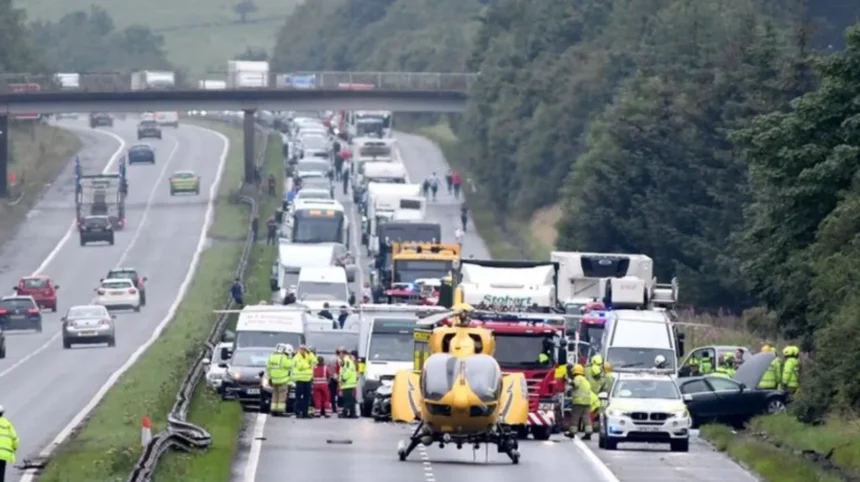
- Incident Overview: A serious collision occurred on the westbound carriageway of the M8 motorway near Glasgow, triggering major morning rush-hour disruptions.
- Location and Timing: The crash took place between Junction 7A (Shawhead) and Junction 8 (Baillieston) at approximately 5:20 AM on Wednesday, September 23, 2026.
- Casualties: A man in his 50s was rushed by the Scottish Ambulance Service to Wishaw General Hospital for treatment.
- Travel Impact: The westbound section was closed for several hours, causing tailbacks reaching up to 25 minutes and severe congestion on the nearby A725.
- Resolution: Police Scotland confirmed that the road has since been fully reopened to traffic following emergency response operations.
Glasgow (Glasgow Express) September 23, 2026 – Commuters across central Scotland faced extensive travel delays and heavy congestion on Wednesday morning following a serious road traffic collision on one of the country’s busiest arterial routes.
As reported by Glasgow Live, the incident unfolded when a vehicle collision occurred on the westbound carriageway of the M8 motorway between Junction 7A at Shawhead and Junction 8 at Baillieston. Emergency services rushed to the location shortly after the initial reports came in at approximately 5:20 AM.
Detailing the emergency response, a spokesperson for Police Scotland stated that
“Emergency services are in attendance following a road crash on the M8 westbound near to Shawhead which was reported at 5.30am this morning. Junction 7A is closed. Please follow diversions or take an alternative route.”
The scale of the incident required a closure of the westbound lanes for several hours, trapping early motorists and creating substantial tailbacks. According to updates provided by Traffic Scotland and highlighted by the Glasgow Times, initial travel delays hovering around 10 minutes quickly escalated to 25-minute tailbacks as peak commuting hours commenced. Secondary routes, notably the A725, experienced severe gridlock in both directions as drivers sought alternative paths around the motorway block.
Who Was Injured in the M8 Motorway Collision?
Glasgow, STV News – September 23, 2026 – Medical professionals confirmed that one individual sustained injuries requiring immediate hospital treatment following the early morning impact.
As detailed by STV News, the Scottish Ambulance Service deployed resources to the scene after receiving an urgent call. A spokesperson for the Scottish Ambulance Service stated:
“We received a call at 6.12am today to attend a road traffic collision on the M8. We dispatched one ambulance to the scene and transported one male patient in his 50s to Wishaw General Hospital.”
While emergency crews worked meticulously to clear debris and secure the wreckage, the identity of the man has not been publicly released, and his precise medical condition remains unconfirmed by hospital representatives.
When Did the M8 Westbound Lanes Reopen to Drivers?
Glasgow, The Herald – September 23, 2026 – Normal traffic conditions began to restore later in the morning after police and highway authorities finalized safety checks at the site of the crash.
Providing a resolution to the morning’s gridlock, a spokesperson for Police Scotland announced:
“Junction 7A of the M8 west bound near Shawhead is now reopened following an earlier crash. Drivers are thanked for their co-operation.”
While residual delays took time to clear, traffic monitoring systems verified that all restrictions between Junction 7A and Junction 8 had been lifted, allowing vehicles to pass through freely once again.
Background of the Particular Development
The M8 motorway serves as the economic backbone of Scotland’s central belt, connecting the country’s two largest cities, Glasgow and Edinburgh, alongside heavily populated industrial and residential suburbs like North Lanarkshire. Because millions of commuters, freight operators, and commercial vehicles rely on this corridor daily, any unexpected obstruction or lane closure during peak early-morning hours creates an immediate domino effect across the regional transport network. Sections like the stretch between Shawhead (Junction 7A) and Baillieston (Junction 8) handle high volumes of converging traffic from connecting routes such as the A725, making them critical pinch points. Historical infrastructure data shows that incidents occurring before 6:00 AM consistently generate rapid gridlock because recovery vehicles and emergency responders must navigate heavily congested tailbacks just to reach the scene, amplifying delays for thousands of motorists.
Prediction on How This Development Can Affect Commuters
For daily commuters, logistics operators, and local drivers traveling through the central belt, incidents of this magnitude highlight the extreme fragility of regional road networks during peak travel windows. Although the M8 westbound has officially reopened following the swift intervention of Police Scotland and the Scottish Ambulance Service, recurring disruptions of this nature directly translate to lost productivity, missed appointments, and heightened commuter stress. In the immediate aftermath, drivers utilizing the Shawhead-to-Baillieston corridor can expect residual psychological hesitance and heightened caution during morning hours, potentially encouraging more motorists to seek out local bypasses. Consequently, local authorities may face mounting pressure from regional business groups to fast-track intelligent traffic management systems and dynamic diversion protocols, ensuring that future emergency responses minimize prolonged gridlocks on Scotland’s principal highway artery.