Key Points
- A Georgian man, identified as Giorgi Chirgatze, was intercepted at Glasgow Airport after airport security flagged him for looking unkempt and nervous.
- The 36-year-old traveller presented a fraudulent red Latvian passport bearing the alias Arturs Tumasevics to security officers.
- Suspicion arose because Chirgatze could not speak English, was travelling alone, had no return flight booked, and carried next to no luggage.
- Border Force and immigration officers confirmed through forensic examination that the document was a forgery, featuring irregular background prints, incorrect optically variable devices, and trapped debris under the laminate.
- Defence agent Gemma Elder explained in court that her client fled his hometown due to severe political terror and local victimisation affecting both him and his two dogs.
- Sheriff Janis Scott imposed a six-month custodial sentence, which was backdated to his date of remand on May 18, resulting in his effective release.
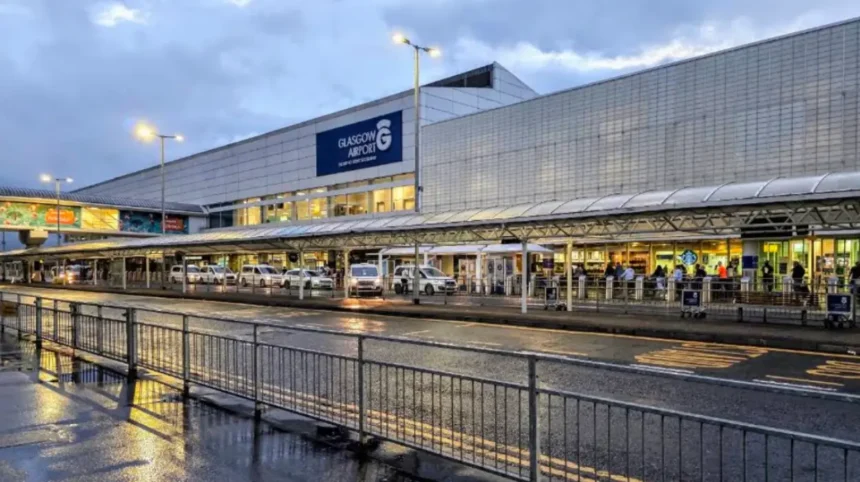
Paisley (Glasgow Express) September 23, 2026 — A Georgian man who fled his hometown due to “terror” was found with a fake passport at Glasgow Airport.
As reported by Emylie Howie, Court Reporter for The Gazette, Giorgi Chirgatze was snared at the Paisley travel hub on May 26 after appearing unkempt and nervous.
How Did Glasgow Airport Security Detect the Forged Document?
As reported by procurator fiscal depute Michael Cunningham of Paisley Sheriff Court, witnesses Menzies and Skelton were working in their capacity as airport security officers at 9 am on May 16. They were assisting with the check-in of passengers for a WestJet flight to Toronto at desk 19. Their primary role was to approach queuing passengers prior to standard check-in to verify that everyone possessed the correct documentation.
During this routine process, the officers observed Chirgatze approaching the check-in desk. As stated by Menzies, the accused looked unkempt and nervous. When Menzies engaged with him, several immediate flags were noted: Chirgatze could not speak English, was travelling alone, had no return flight booked, and carried next to no luggage.
Menzies reviewed the traveller’s passport, which turned out to be a red Latvian document bearing the name Arturs Tumasevics. It was quickly established that the accused possessed no further supporting documentation or items bearing that specific alias. Because of these accumulated circumstances and the defendant’s suspicious demeanour, the witnesses decided to report the incident, suspecting a false passport. The individual was then asked to step aside for further enquiry.
What Did Police and Immigration Officers Discover During the Investigation?
As reported by Emylie Howie of The Gazette, police officers who subsequently spoke with Chirgatze discovered he could or would not speak English. Officers attempted to use Google Translate to communicate with him, though with limited success. It was soon established that the accused held no identification of any sort.
Following this initial interaction, an immigration officer examined the passport inside the Paisley travel hub. Procurator fiscal depute Michael Cunningham explained the technical findings to the court:
“The seized passport was reviewed and compared to a genuine specimen held locally. It was noted that the background print on the front of the polycarbonate biographical details page, the page which displays the holder’s details and image, had been printed using a process resulting in randomly positioned coloured dots. This was not the process used in documents of this type.”
Furthermore, the forensic analysis revealed additional flaws. Cunningham noted that the optically variable device on the right-hand side of the biographical details page failed to shift between the image and date of birth as expected, lacked transparency, and presented an incorrect colourway. Additionally, the spine of the biographical details page and the perforated numbers along the side appeared irregularly cut, while debris was visibly trapped underneath the laminate. Page 11 of the passport also contained an Egyptian visa vignette number printed with randomly coloured dots, which deviated from standard manufacturing processes. In summary, investigators concluded that the document was an outright forgery and could not be relied upon as valid evidence of nationality or identity.
What Were the Motives and Legal Consequences Presented in Court?
As reported by Emylie Howie of The Gazette, defence agent Gemma Elder informed the court that her client found himself in this desperate position because he was essentially fleeing from being terrorised in his local community. Elder explained:
“Due to an affiliation with the opposition political party in his home town, this resulted in both physical and verbal harm towards him but also harm to his two pets, his two dogs. These difficulties first arose in 2021. In essence, he’s been terrorised in his local community.”
Despite the mitigation regarding political persecution, Sheriff Janis Scott emphasised the legal limitations of the judiciary. Sheriff Scott stated:
“I think you understand my options are limited; I have no alternative but to impose a custodial sentence.”
Consequently, the court imposed a six-month sentence, which was backdated to Chirgatze’s initial date of remand on May 18, meaning he would effectively be released from custody.
Background of the Particular Development
The detection of fraudulent travel documents at regional transport hubs like Glasgow Airport highlights the ongoing challenges faced by frontline border security and aviation staff. Across the United Kingdom, airport security personnel and Border Force agents maintain rigorous screening protocols to intercept undocumented or illicit travellers. With sophisticated forgery methods frequently utilised by criminal networks, airports rely heavily on both behavioural analysis—such as identifying nervous passengers travelling without luggage or return itineraries—and advanced forensic document examination. Incidents involving political asylum seekers turning to falsified papers underscore the dangerous intersection between global political oppression and illegal immigration pathways.
Prediction and Impact on the Particular Audience
This judicial outcome directly impacts frequent international travellers, regional airport staff, and immigration advocacy groups operating within Scotland. For airport personnel and security teams, the case reinforces the critical importance of behavioural profiling and meticulous document checks during check-in procedures, potentially leading to tighter preliminary screening protocols at terminals like those in Paisley. For legal and refugee support communities, cases involving individuals fleeing political violence with forged documents highlight the complex tension between strict border enforcement and the humanitarian realities driving desperate migration attempts. Consequently, regional authorities are likely to maintain heightened vigilance, increasing scrutiny on passengers arriving from politically volatile regions while courts continue to enforce strict custodial penalties for identity fraud.