Key Points
- Surging Numbers on Victoria Road: Cycling Scotland traffic surveys recorded 5,637 bikes on Victoria Road over a 48-hour period in May 2026, marking a 38% increase compared to May 2025.
- Record Modal Share: Cycling accounted for 16.6% of all travel methods counted on Victoria Road, establishing a new record modal share for an urban street in Scotland.
- Rush Hour Trends: More bikes than cars were recorded at all rush hour travel peaks on Victoria Road, continuing a trend first observed in September 2025.
- Milestones Across Multiple Corridors: Clyde Street and Garscube Road recorded their highest ever numbers of cycle journeys, with 3,489 and 2,146 bikes respectively.
- West End Uptake: Byres Road recorded 1,955 people cycling, representing 7.9% of all travel methods on that section.
- East City Way Growth: Cycle traffic on London Road’s East City Way counter more than doubled from an average of 300 journeys a day in May 2024 to nearly 700 a day in May 2026.
- Primary Growth Driver: Analysis shows long-term increases in cycling modal share are primarily due to more people choosing to cycle rather than any decrease in vehicle traffic.
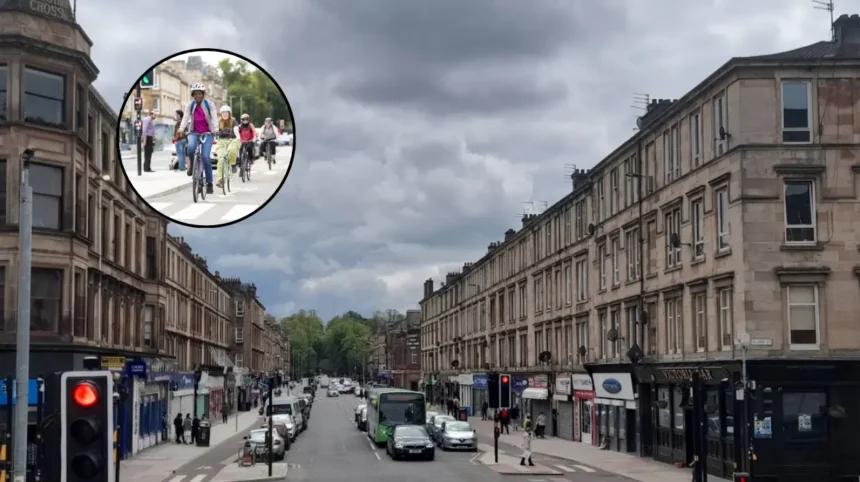
Glasgow (Glasgow Express) September 22, 2026 — New traffic data analysed by Scotland’s national cycling charity has demonstrated the continuing success of cycle lanes across Glasgow, revealing record levels of cycling on key routes throughout the urban area. Over a 48-hour period in May 2026, Cycling Scotland traffic surveys recorded 5,637 bikes on Victoria Road. This figure represents 38% more bike journeys than those recorded in May 2025, underscoring the continued impact of the landmark protected cycling route connecting the Southside to the city centre.
- Key Points
- Which Other Routes Are Experiencing Surge in Bike Journeys?
- What Do the Rush Hour Patterns Reveal About Commuter Behaviour?
- What Are Officials and Local Stakeholders Saying About the Findings?
- Background of the Particular Development
- Prediction on How This Development Can Affect Glaswegians and Local Commuters
Overall, cycling accounted for 16.6% of all travel methods counted on Victoria Road, marking a new record modal share for the location and for any urban street in Scotland. Furthermore, more bikes than cars were recorded at all rush hour travel peaks on Victoria Road, consolidating a trend that was first established during the previous traffic survey in September 2025.
Which Other Routes Are Experiencing Surge in Bike Journeys?
Beyond Victoria Road, several other streets featuring recently installed protected cycle lanes also recorded their highest ever numbers of cycle journeys during the Cycling Scotland traffic surveys. On Garscube Road, where a 1km protected bi-directional cycle lane connects Maryhill to the city centre, 2,146 bikes were recorded over the two-day survey period. Similarly, Clyde Street—where multiple cycle routes converge at the edge of the city centre—registered 3,489 bikes.
Records were also broken for cycling modal share, which reflects the percentage of journeys made by bike. Garscube Road saw its share rise to 6.2% of journeys, up from 5% in May 2025, while Clyde Street climbed to 13.6%, up from 12.5%. Additionally, 1,955 people were logged cycling on Byres Road in the city’s West End, where cycle lanes have been completed between Dumbarton Road and University Avenue. On this specific section of Byres Road, cycling represented 7.9% of all methods of travel.
What Do the Rush Hour Patterns Reveal About Commuter Behaviour?
At all of these surveyed locations, strong peaks in cycling were observed during the morning and evening rush hours. This distribution indicates that the new infrastructure is actively assisting more people to travel by bike for everyday journeys, such as commuting to and from work.
Analysis of general traffic levels demonstrates that long-term increases in cycling modal share at these locations are primarily driven by more people choosing to cycle, rather than any corresponding decrease in vehicle traffic. Alongside these snapshot traffic surveys, data gathered from the fixed cycle counter network further highlights the long-term impact of municipal investment in high-quality cycle lanes.
Specifically, the East City Way cycle route counter on London Road showed that cycle traffic more than doubled, rising from an average of 300 cycle journeys a day in May 2024 to nearly 700 journeys a day in May 2026. This growth follows significant improvements to the 8km route connecting communities in the East End to the city centre, which included physical protection for the cycle lanes and the completion of a Dutch-style cycle priority junction at the corner of London Road and the Clyde Gateway road.
What Are Officials and Local Stakeholders Saying About the Findings?
As reported by staff journalists at The Herald, Councillor Angus Millar, Glasgow City Council Convener for Transport and Climate, stated that
“Cycling Scotland’s latest figures are really encouraging and show the clear impact of investing in safe, high-quality cycle routes across Glasgow.”
Councillor Angus Millar further noted:
“The increase in cycling on routes such as Victoria Road, Clyde Street, Garscube Road, Byres Road and London Road shows that more people are choosing to travel by bike for everyday journeys. These routes are helping to make cycling a more practical and accessible option for more Glaswegians, while supporting our wider work to create safer streets, improve air quality and give people more choice in how they travel around the city.”
Commenting on the broader regional data, Keith Irving, Chief Executive of Cycling Scotland, stated:
“What we see clearly from the data is where local authorities are investing in protected cycle lanes and improved networks of cycling routes, far more people are travelling by bike.”
Keith Irving added:
“Due to the ambition of Glasgow Council, we’re also seeing signs of a strong network effect, as routes begin to join together and make many more journeys possible. Altogether, more people cycling is a net benefit for everyone, for our health, for reducing harmful pollution and reducing congestion on our streets.”
Weighing in on the practical experiences of utilizing the upgraded infrastructure, NHS health visitor Kirsty Milton-Moir stated:
“I’ve found that cycling is much quicker than driving, so that’s cut a massive proportion of time from my visits. Seeing all the people cycling on the cycle lane is amazing. I feel so much safer on the cycle lane where I know that that area is for people on bikes, and there are no cars.”
Background of the Particular Development
The surge in Glasgow’s cycling metrics follows years of strategic municipal planning aimed at overhauling the city’s active travel infrastructure. Glasgow City Council has pursued an ambitious target to establish 54km of active travel routes across the city by the year 2032. Historically, urban transport networks across Scotland heavily favoured private motor vehicles, leading to chronic congestion points and environmental concerns regarding inner-city air quality.
To counteract these trends, local authorities partnered with national bodies like Cycling Scotland to secure funding and implement physically protected cycle lanes. Interventions such as the Southside-to-centre connection on Victoria Road and the East City Way on London Road represent foundational phases of this multi-year urban redesign strategy. By introducing physical barriers, junction upgrades modeled after European standards, and dedicated modal filters, the council sought to eliminate the psychological and physical barriers that previously discouraged everyday cyclists from sharing road space with heavy traffic.
Prediction on How This Development Can Affect Glaswegians and Local Commuters
The continuous expansion and data-proven success of Glasgow’s protected cycle network are poised to fundamentally reshape daily commuting habits for local residents, workers, and students across the city. As individual corridors interconnect to form a cohesive grid—creating what experts term the “network effect”—more commuters living in residential hubs like Maryhill, the Southside, and the East End will likely view cycling as a reliable, time-efficient alternative to automobiles and public transit during peak rush hours.
For everyday Glaswegians, this transition can translate into more predictable travel times, lower personal transportation costs, and improved public health outcomes through increased physical activity. Simultaneously, as modal share shifts progressively away from motor vehicles on key arterial roads, local neighborhoods may experience reduced tailpipe emissions, lower noise pollution, and enhanced street safety. However, this rapid growth will also place pressure on urban planners to maintain infrastructure integrity and safely manage mixed-modal interactions at remaining unsegregated junctions as cycling volumes scale higher in the coming years.