Key Points
- A further five men, aged 41, 39, 27, 23 and 22, have been arrested and charged in connection with far-right disorder in Glasgow.
- The charges relate to offences including assault and the possession of offensive weapons.
- The investigation stems from widespread violence, intimidation, and hate-motivated incidents following planned demonstrations at Glasgow Green on July 25.
- Police Scotland confirmed that the suspects will be reported to the Procurator Fiscal and are expected to appear at Glasgow Sheriff Court at a later date.
- Authorities have emphasized that extensive enquiries remain ongoing under Operation Cornstarch.
- Police continue to appeal for public assistance, encouraging witnesses to come forward via 101, Crimestoppers, or a dedicated Major Incident Public Portal (MIPP).
Glasgow (Glasgow Express) September 18, 2026 — A further five men have been arrested as part of an ongoing police investigation into far-right disorder that erupted in Glasgow over the summer.
Who Was Arrested and What Charges Do They Face?
As reported by staff writers at The National, the five men—aged 41, 39, 27, 23 and 22—were charged in connection with a range of offences following a comprehensive police inquiry. According to law enforcement details, the specific charges brought against the individuals include assault and the possession of offensive weapons.
The suspects will all be formally reported to the Procurator Fiscal and are anticipated to make appearances at Glasgow Sheriff Court on subsequent dates. Police Scotland confirmed that extensive enquiries remain very much active as detectives continue to parse through evidence gathered from the summer demonstrations.
What Was the Context of the Glasgow Green Disorder?
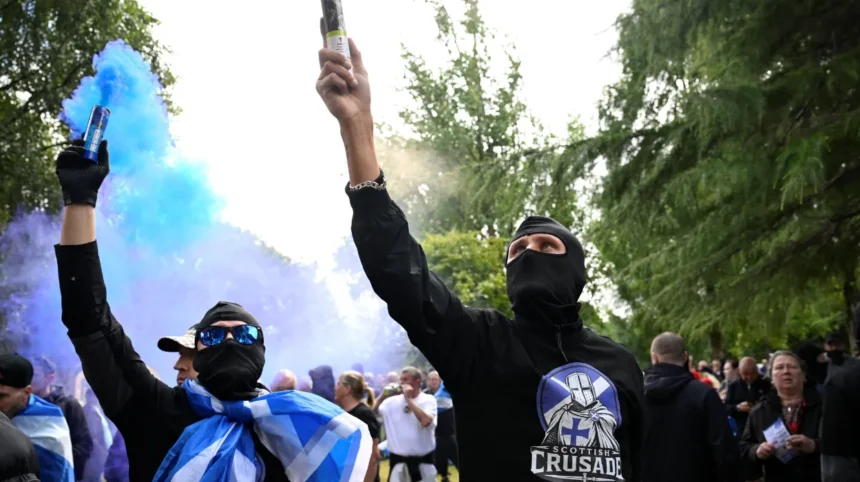
The arrests form part of a wider, intensive investigation into significant disorder, violence, intimidation, and hate-motivated offences that broke out around the city centre. The unrest followed planned protest activity originating at Glasgow Green on Saturday, July 25, which drew a crowd of approximately 1,700 people.
During the events, clashes occurred as disparate groups engaged in confrontational behavior. Incidents included a large group of roughly 100 people moving into the city centre, prompting officers to seal off areas such as Oswald Street as opposing factions confronted one another.
How Have Police Authorities Responded to the Violence?
In previous statements addressing the unrest, Chief Superintendent Stevie Dolan made it clear that authorities maintain a policy of “no tolerance” for individuals who mask aggressive intentions under the guise of peaceful protest.
As previously stated by Chief Superintendent Stevie Dolan:
“People have a right to peaceful protest. We perform various functions at protests but our main role is to prevent crime and disorder, whether that criminality is from people who are part of a protest group, counter protesters or passers-by disrupting a protest.”
Mr Dolan added:
“The disorder at this protest had a significant impact on communities, businesses and police officers and it will not be tolerated and anyone involved should expect to be identified and arrested. Any violence or disorder will get a strong response.”
How Can the Public Assist With the Ongoing Investigation?
Police Scotland are continuing to appeal to the wider public for information, footage, or photographs that can aid the identification of additional individuals involved in the criminality.
Members of the public who possess relevant information are urged to contact authorities by calling 101, referencing Operation Cornstarch, or by contacting Crimestoppers anonymously on 0800 555 111. Additionally, a Major Incident Public Portal (MIPP) has been established to allow citizens to upload digital media, photographs, and video footage directly to investigating officers via the official police online portal.
Background of the Particular Development
The events of July 25 in Glasgow represent a flashpoint in tensions surrounding localized demonstrations and counter-demonstrations that have affected various urban centres across the United Kingdom. The rally at Glasgow Green—involving groups such as Unite the Clans and speakers associated with far-right networks—drew immediate opposition from counter-protesters, including Stand Up To Racism. The subsequent breakdown in public order, characterized by skirmishes, projectiles being thrown, and disruption across core commercial districts, prompted widespread condemnation from civic leaders and triggered a major, resource-heavy police response. Operation Cornstarch was subsequently established to systematically identify, track down, and prosecute individuals captured engaging in violent acts or carrying offensive weapons, leading to successive waves of arrests over the following weeks and months.
Prediction
This ongoing police enforcement action and the systematic prosecution of individuals involved in the Glasgow Green disorder will likely serve as a strong deterrent for future large-scale confrontations involving extremist and opposing activist factions. For the local community, small business owners, and residents of Glasgow, the steady progression of arrests offers reassurance that public disturbances and hate-motivated violence are met with sustained judicial accountability rather than short-lived responses. However, it may also heighten underlying ideological sensitivities, prompting law enforcement agencies to maintain heightened readiness and tighter security frameworks for future public demonstrations held within the city centre.