Key Points
- Community Bid Launched: Local campaigners and Southside residents have established the First Hampden Community Interest Company (CIC) to secure the historical site of the original Hampden Park into community ownership.
- Historic Importance: Opened in 1873, the location served as the world’s first purpose-built international football stadium and the original home of Queen’s Park Football Club and the Scotland national team.
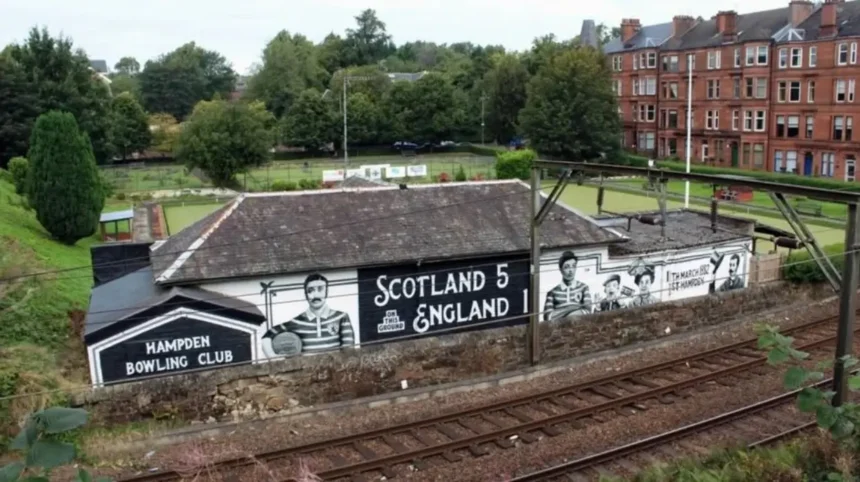
- Closure of Bowling Club: The land operated as Hampden Bowling Club for more than 120 years; following the club’s closure, the site’s future came under immediate risk of commercial development.
- Threat of Commercial Sale: The land is owned by Glasgow City Council through its arms-length property entity, City Property Glasgow, which campaigners report intends to market the plot for commercial development rather than community use.
- Official Protected Status: Historic Environment Scotland (HES) officially designated the buried remains of the First Hampden pavilion as a nationally significant scheduled monument following extensive archaeological findings.
- Public Campaign Demands: Local campaigners argue that “Glasgow deserves a say” and are urging public sector intervention to convert the grounds into a mixed-use community hub, sporting asset, and heritage centre.
Glasgow (Glasgow Express) September 14, 2026 – Is the world’s oldest purpose-built international football arena about to be lost to private real estate, or can local residents successfully save the birthplace of modern football for public use? A coalition of Southside community leaders, sports preservationists, and local residents have united under the banner of the First Hampden Community Interest Company (CIC) to launch a high-profile bid to acquire the historic site on Kingsley Avenue, asserting that the people of Glasgow must be granted a decisive voice in deciding its long-term future.
As reported by Calum Loudon of STV News, the historic grounds on Kingsley Avenue in the southside of Glasgow originally opened in 1873 and served as the initial home of Queen’s Park FC and the Scottish national football team until 1884. The ground was globally groundbreaking, establishing the architectural and operational blueprint for modern sports arenas by introducing spectator turnstiles, dedicated grandstands, and fixed refreshment facilities. From the early 1900s until its recent closure, the site functioned quietly as the home of Hampden Bowling Club. However, following the dissolution of the bowling organization, ownership of the land reverted into the portfolio managed by City Property Glasgow, an arms-length property company wholly owned by Glasgow City Council.
According to statements released by representatives of First Hampden CIC, municipal authorities are currently preparing to market the historic plot for commercial development or private sale, raising widespread anxiety across the Southside community that a foundational piece of global sporting heritage could be demolished or paved over for residential units. Campaign organisers confirmed that City Property Glasgow has so far declined opportunities to enter formal discussions with community delegates regarding an direct, mutually beneficial transfer into local community hands.
As detailed in campaign documentation issued by First Hampden CIC, the grassroots campaign group stated that “public spaces in Glasgow are disappearing” and insisted that “First Hampden’s future should be shaped by its heritage and its community, not by commercial value alone.” The organization’s stated vision involves acquiring the site under community ownership laws to transform the grounds into an accessible, non-profit community hub, featuring affordable local event spaces, outdoor recreational facilities, and curated heritage installations celebrating the global origins of association football.
As noted by Dara Parsons, head of designations at Historic Environment Scotland, the cultural and structural importance of the location cannot be understated. Parsons stated that “football is Scotland’s national sport, and a key part of the identity of communities all over Scotland,” adding that
“the remains of the pavilion at the First Hampden are a link to the earliest days of football in Scotland, and its importance to and impact on communities. It is a monument to our national game and to the origins of the modern football stadium.”
Following a comprehensive public consultation that yielded overwhelming public backing, Historic Environment Scotland officially declared the sub-surface remains of the original 1878 pavilion a Scheduled Monument of national importance.
As highlighted by Graeme Brown, engagement director at Football’s Square Mile and key historical researcher, the preservation of the location relies upon acknowledging the vital stewardship of the local bowling members who preserved the ground’s legacy for over a century. Brown stated that “the footballing world owes a debt of gratitude to the Hampden Bowling Club’s ‘boolers’ who passed down their story, explaining they were on the site of the First Hampden Park.” Brown further emphasized that heritage advocates view the location “not as a lost stadium site, but as a living and breathing asset within Scotland’s global footballing heritage.”
As reported by Philip Long, Chief Executive of the National Trust for Scotland, major cultural entities across the nation have added their weight to the community’s cause. Long stated that
“the site is intrinsic to the development of the game of football as we know it, so it makes a vital contribution to Scotland’s culture and modern identity. A place of such significance needs to be protected and respected,”
while urging Historic Environment Scotland, Glasgow City Council, and the Scottish Government to collaborate on a viable strategy to rescue the location from speculative building projects.
What Is The Background Of The First Hampden Development?
The historical plot located at Kingsley Avenue in the Mount Florida and Crosshill districts of Glasgow represents one of the most culturally significant sites in the global history of sport. Constructed in 1873 by Queen’s Park Football Club—Scotland’s oldest football club—the original Hampden Park was built specifically to host high-capacity athletic fixtures. Prior to its construction, early football matches took place on open public parks or adapted cricket pitches lacking formal spectator infrastructure. First Hampden introduced defined boundary fencing, ticketed turnstiles, a wooden spectator pavilion, and terraced embankments, effectively creating the world’s very first purpose-built international football stadium.
Between 1873 and 1884, the venue hosted historic domestic and international fixtures, including the initial Scottish Cup finals and Scotland’s famous 5-1 victory over England in 1882. During this decade, players at First Hampden pioneered the tactical “combination game”—a rapid, short-passing style of play that replaced traditional individual dribbling tactics and subsequently spread across the world to define modern association football.
In 1883, Queen’s Park FC was forced to vacate the grounds when the Cathcart District Railway line was constructed directly through the territory, slicing off a portion of the pitch area. The club subsequently relocated a short distance away to establish “Second Hampden” (later renamed Cathkin Park), before eventually building the current, third Hampden Park in Mount Florida in 1903.
In 1905, the original, abandoned site was taken over by Polmadie Bowling Club (later renamed Hampden Bowling Club), which erected a bowling green and repurposed the surviving pavilion structures. For over a century, members of the bowling club maintained oral traditions claiming their green occupied the exact ground of the legendary first national stadium. While academic historians initially dismissed these claims, groundbreaking historical research conducted in 2017 located 19th-century railway maps confirming the exact boundary alignments. Subsequent archaeological digs led by Archaeology Scotland in 2021 uncovered physical evidence beneath the bowling greens, including brick wall foundations of the original 1878 clubhouse pavilion, original drainage systems, and 19th-century spectator artifacts such as clay pipes, glass bottles, and stadium turnstile remnants.
When Hampden Bowling Club formally wound up its operations, control of the site reverted to Glasgow City Council and its property development arm, City Property Glasgow. Because the parcel sits in a desirable residential zone in Glasgow’s Southside, local concerns immediately mounted that the land would be disposed of to commercial real estate developers, leading directly to the formation of the First Hampden Community Interest Company and its public campaign.
Explore More Local Glasgow News
Heartfelt Tributes Paid to Uddingston Mechanic Vincent Callaghan 2026
Golden Wonder Pop-Up Comes to Glasgow 2026
How Will This Development Affect Local Residents And Football Supporters?
The outcome of the battle for the First Hampden site carries significant, direct consequences for multiple distinct stakeholder groups across Glasgow and the broader sporting community:
- Local Southside Residents and Families: If the community bid succeeds, residents of Crosshill and Mount Florida will gain an inclusive, non-commercial public asset featuring green space, affordable venue hire, and multi-generational recreational programs. Conversely, if City Property Glasgow sells the site for private commercial development, local residents face the permanent loss of accessible open space, alongside increased urban density, construction disturbance, and heightened pressure on local parking and public services.
- Scottish Football Supporters and Heritage Advocates: For football fans, securing the site under community stewardship guarantees that the physical birthplace of the modern passing game and international stadium design is preserved as a living historical destination. Private redevelopment would result in the irreversible destruction or concrete coverage of key historical ground, reducing a site of international sports history to a mere plaque on a residential wall.
- Glasgow City Council and Taxpayers: For municipal leaders, balancing commercial land value against cultural heritage presents a direct political test. Choosing a commercial sale yields short-term capital receipts for council budgets; however, facilitating a community transfer preserves civic trust, enhances local health outcomes, and aligns with national legislative mandates under the Community Empowerment (Scotland) Act 2015.
- International Sports Tourism and Local Economy: Establishing a dedicated heritage site within “Football’s Square Mile” creates a permanent destination for international football tourists, sports historians, and visiting supporters. Long-term community control could drive economic footfall to local independent businesses, cafes, and transport links across Glasgow’s Southside, positioning the city as a global capital of sporting heritage.