

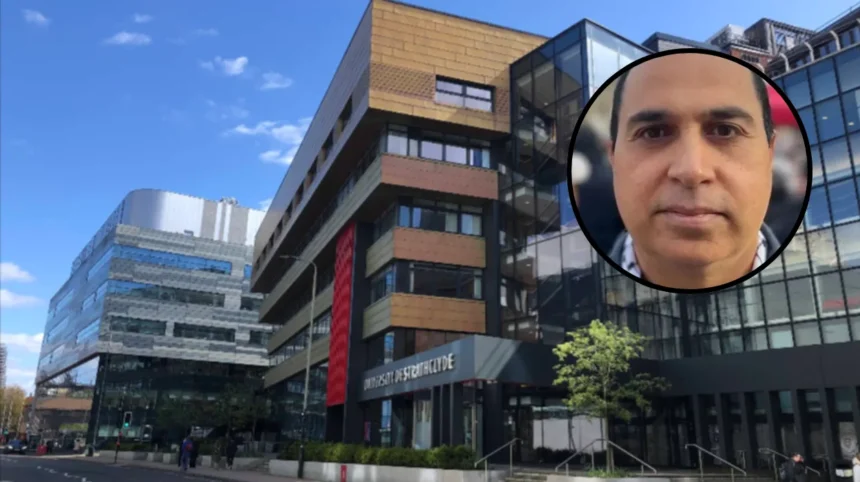
Key Points
- Professor Ibrahim Khadra of pharmaceutical sciences at the University of Strathclyde has been fired after an internal investigation regarding accusations of sexual harassment.
- According to allegations from students, the professor made sexual requests, harassed and threatened them through text messaging and phone calls as reported first by Glasgow Live.
- Inquiries from Police Scotland were confirmed to be continuing after receiving a report of inappropriate communication.
- The university has stated that it immediately suspended the employee on discovering the allegations, highlighting the safety and wellbeing of students above all else and providing continued support.
- Khadra was part of the academic community of Strathclyde for more than two decades starting as a PhD student in 2002 up to the point when he became a professor in December 2024.
Glasgow (Glasgow Express) September 11, 2026 – The University of Strathclyde confirmed the dismissal of Dr Ibrahim Khadra from his post as Professor in Pharmaceutical Sciences following the conclusion of a formal internal investigation. The disciplinary action was initiated after students came forward with accusations of sexual harassment. According to reporting by Glasgow Live, the complaints detailed instances where Khadra requested intimate images and engaged in harassment through phone calls and text messages.
A spokesperson for the University of Strathclyde addressed the institution’s handling of the disciplinary process, stating that the university treated the accusations with the utmost seriousness. The university representative stated that
“the university suspended the staff member as soon as we became aware of the allegations and, following a full investigation, the individual was dismissed.”
The institution further highlighted its commitment to student welfare, noting that support services have been extended to those impacted by the conduct. The university spokesperson added:
“The university has provided ongoing support to those affected and will continue to do so. We recognise the courage it takes for anyone to come forward, and where they do they will be heard and supported.”
What Are The Details Of The Police Scotland Investigation?
Beyond internal disciplinary measures, law enforcement authorities have opened an inquiry into the matter. Police Scotland received formal reports concerning the nature of the communications involved in the allegations.
A spokesperson for Police Scotland issued a statement regarding the ongoing legal proceedings, confirming that “we have received a report relating to inappropriate communication. Inquiries are ongoing.” Law enforcement officials have not yet released further details regarding potential criminal charges as the investigation proceeds.
What Is Dr Ibrahim Khadra’s Academic Background At Strathclyde?
Dr Ibrahim Khadra’s professional association with the University of Strathclyde spans more than twenty years, encompassing multiple academic and advisory roles. His tenure at the institution began when he undertook doctoral studies, serving as a PhD student at the university between 2002 and 2006.
Following the completion of his doctorate, Khadra returned to the university in 2010 to work as a research associate. His career progressed steadily through the academic ranks over the subsequent decade. In 2016, he secured a position as a lecturer, before advancing to the role of associate professor in 2020. Most recently, he achieved the rank of professor in December 2024.
Alongside his research and teaching duties within the pharmaceutical sciences department, Khadra undertook institutional leadership responsibilities. He served as the university’s official advisor on engagement with the Middle East and North Africa.
Previous Public Prominence And Activism
Prior to the disciplinary proceedings, Khadra had gained public visibility through various advocacy and community platforms. In 2023, he participated in a large-scale pro-Palestinian demonstration in Glasgow city centre, where thousands of protesters gathered to call for an end to military action in Gaza. During public addresses at the time, he stated that over forty members of his extended family had been killed in Gaza as a result of regional conflict.
Subsequent campus developments involving Khadra occurred in 2025. Reports published by the university’s student newspaper indicated that he was among a collective of students and staff members who lobbied university leadership to alter institutional ties, specifically calling for the institution to sever connections with various arms manufacturers in connection with geopolitical events.
Explore More Glasgow Crime News
Glasgow Directors Banned Over £15m Vape Tax Fraud 2026
Cyclist Dies Following Car Collision on A8 Dual Carriageway Port Glasgow 2026
Background
The dismissal of a senior academic for misconduct highlights the evolving mechanisms within higher education institutions regarding internal accountability, safeguarding, and the handling of student grievances. Universities across the United Kingdom face increasing regulatory and public scrutiny regarding how they manage allegations of harassment and staff-student boundaries. Institutions have increasingly adopted zero-tolerance policies and streamlined reporting frameworks designed to protect students and encourage whistleblowing or the disclosure of professional misconduct without fear of institutional reprisal. This case reflects broader institutional pressures within the tertiary education sector to balance thorough due process with rapid preventative suspension measures when safeguarding concerns are raised by the student body.
This high-profile dismissal is expected to have a significant operational and cultural impact on the University of Strathclyde community, particularly regarding student trust and institutional oversight. For current and prospective students, the swift disciplinary action demonstrates that formal reporting channels can lead to the removal of senior academic staff, potentially encouraging greater confidence in reporting inappropriate behavior. Conversely, the case may prompt heightened scrutiny from student unions and advocacy groups regarding how departments monitor professional boundaries between faculty members and students. For the academic staff and administration within the Faculty of Science, the departure of a senior professor in pharmaceutical sciences will necessitate immediate departmental restructuring to manage teaching and research commitments, while reinforcing the necessity of strict adherence to professional codes of conduct across all academic tiers.


