Key Points
- Single bus fares across Glasgow and the west of Scotland will be capped at £2 starting Monday, September 7, 2026.
- The announcement was confirmed by First Minister John Swinney during his Programme for Government speech at Holyrood.
- The fare capping scheme covers Glasgow, Ayrshire, Dunbartonshire, Renfrewshire, Lanarkshire, and Inverclyde.
- The initiative follows a successful regional pilot previously introduced across the Highlands and Islands.
- The move expands on the SNP election manifesto pledge to implement a national rollout of £2 fares across the country.
- Opposition politicians, including the Scottish Greens, have welcomed the savings for the West of Scotland but criticized the timeline for rolling the scheme out nationally.
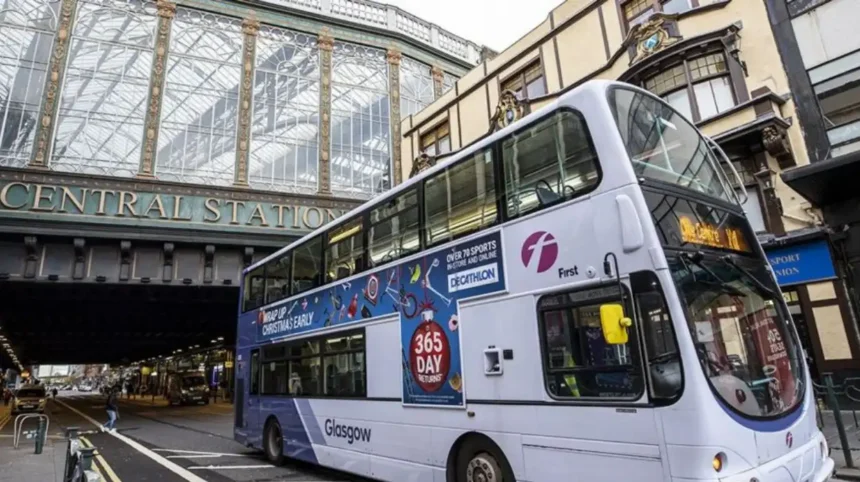
Glasgow (Glasgow Express) September 1, 2026 – Single bus journeys across Glasgow and the west of Scotland will be capped at £2 starting from Monday, September 7, 2026, First Minister John Swinney has confirmed. Delivering his annual Programme for Government statement to the Scottish Parliament, the leader of the Scottish National Party (SNP) announced that the regional price cap will take effect early next week, bringing financial relief to commuters across major central belt regions. The updated fare capping structure will apply to services operating within Glasgow, Ayrshire, Dunbartonshire, Renfrewshire, Lanarkshire, and Inverclyde.
The policy initiative follows an earlier regional rollout across the Highlands and Islands, marking the second phase of a wider national policy. As reported by Chris McCall, Deputy Political Editor of the Daily Record, the move expands the Scottish Government’s wider cost-of-living support package aimed at easing household expenses during ongoing economic pressures.
What did John Swinney say in Parliament?
Addressing Members of the Scottish Parliament (MSPs) at Holyrood during the presentation of his legislative agenda, the First Minister set out the government’s timeline for extending affordable fare measures to urban regions.
As reported by political correspondents at The Independent, John Swinney stated:
“It is our ambition and intention to put more money in families’ pockets, building on what is already the most generous cost-of-living support package anywhere in the United Kingdom. The national rollout of our £2 bus cap has already begun. It is in place right now, already, in the Highlands and Islands.”
Elaborating further on the timetable for regional transport integration, Swinney added:
“We promised to extend it first to Glasgow and to the west of Scotland – we will keep that promise. I can confirm today that bus fares in the west of Scotland – be that Glasgow, Renfrewshire, Ayrshire, Dunbartonshire, Lanarkshire, or Inverclyde – will be capped at £2, and the £2 bus fare will start this coming Monday morning.”
How have political parties and industry stakeholders responded?
The policy update has drawn a varied set of reactions from across the political spectrum, with praise for local savings countered by frustration regarding the pace of the wider nationwide expansion.
As reported by journalists at The National, Scottish Green co-leader Ross Greer noted that his party had actively campaigned for the initial measures. Greer stated:
“The current £2 bus fare cap across the Highlands and Islands was secured by the Scottish Greens. Much like our free bus passes for young people, it has been a huge success. We pushed for its expansion across the rest of the country as soon as possible and we are glad bus users across the West of Scotland will start saving money from next week.”
However, Greer raised concerns over the duration required to cover the rest of Scotland, adding:
“Delaying the rollout to the rest of the country by up to five years is completely unacceptable though. Bus passengers in every corner of Scotland should enjoy the savings from a £2 fare cap by the end of this year, not wait until 2031.”
Prior to the formal announcement in Parliament, regional transport operators had highlighted the operational requirements needed to support public transport schemes. As reported by Chris McCall of the Daily Record, Ralph Roberts, chairman of McGill’s Group, previously expressed the industry’s stance on rapid policy rollouts, stating:
“We have been warning for some time that a policy of this scale could not simply be announced in a manifesto and delivered without detailed planning, proper consultation with operators and clarity on long-term funding.”
Roberts further emphasized the necessity of structural support for private network providers, commenting:
“If this policy is to succeed, it must be properly funded and designed in partnership with the operators expected to deliver it. The worst outcome would be a short-term political announcement that ultimately proves unsustainable and leaves passengers and communities worse off.”
Background of the Development
The implementation of the £2 flat fare cap across Glasgow and the west of Scotland forms part of a longer-term policy commitment by the Scottish National Party. During the 2026 Holyrood election campaign, the SNP pledged to reduce the cost of bus travel to a maximum of £2 per single journey nationwide over the course of the parliamentary term.
Public transport pricing strategies in Scotland have faced heightened scrutiny in comparison to other jurisdictions within the United Kingdom. Single-journey caps set at £2 have been operating in English city-regions such as Greater Manchester and Liverpool, while London bus fares remain fixed at £1.75 under Transport for London.
In Scotland, the government initially piloted its £2 regional cap in rural and island communities across the Highlands and Islands to gauge patronage response and financial viability.
Following calls from local politicians and transport advocacy groups to address the cost of living across urban populations, pressure mounted on Ministers to accelerate the expansion to Scotland’s most populous transport district, Greater Glasgow and the wider Strathclyde region.
Prediction: How This Development Can Affect Bus Passengers and Local Communities
The introduction of a £2 single bus fare cap across Glasgow, Ayrshire, Dunbartonshire, Renfrewshire, Lanarkshire, and Inverclyde is expected to have immediate direct impacts on daily commuters, lower-income households, and local transport networks.
For commuters and regular public transport users across the West of Scotland, the price ceiling represents a significant reduction in day-to-day travel expenses, particularly for passengers making longer suburban cross-boundary journeys where single fares previously exceeded £2. This direct saving may increase disposable household income for individuals who rely on buses as their primary mode of transport.
From a transport network perspective, lowering single fares is anticipated to stimulate passenger numbers, encouraging a modal shift away from private private-car use toward public transit. Increased bus usage could contribute to reduced road congestion across Greater Glasgow’s arterial routes and support regional carbon reduction targets.
However, the long-term effectiveness of the scheme for passengers will depend on bus network capacity and funding stability. If passenger volumes rise substantially without corresponding funding adjustments or service expansions by bus operators, commuters could face overcrowding on peak-time services. Furthermore, as passengers in regions outside the West of Scotland remain subject to standard commercial fares, geographic disparities in public transport affordability across Scotland will persist until the national rollout progresses further.