Key Points
- Council Rejection: Glasgow City Council’s licensing committee has refused a resident-led application to revoke the 24/7 taxi rank on Queen Margaret Drive in the city’s West End.
- Safety Concerns: The applicant argued the rank is overcrowded, unfit for purpose, and causes hazardous road conditions, including double parking and dangerous U-turns across four lanes of traffic.
- Trade Opposition: The attempt to remove the rank met fierce resistance, drawing more than 30 official objections from taxi trade representatives, individual drivers, and trade unions.
- 70-Year Heritage: Councillors were informed that the rank is an essential piece of transport infrastructure that has operated at the site for over seven decades.
- Enforcement Argument: Representatives for the trade asserted that alleged road traffic offences should be handled by Police Scotland rather than through the cancellation of a vital civic license.
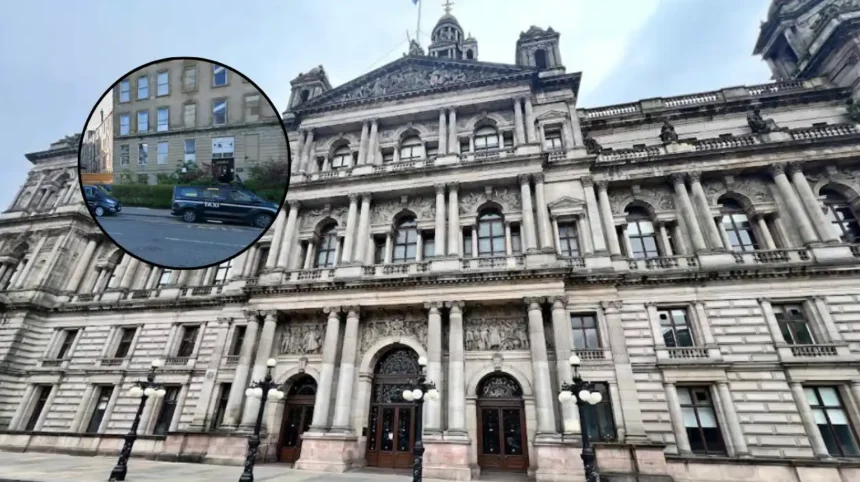
Glasgow Council (Glasgow Express) August 17, 2026 — A long-standing taxi rank situated in Glasgow’s West End will remain operational after local authority licensing members rejected a legal bid by a local resident to have the facility permanently revoked.
As reported by Drew Sandelands, Local Democracy Reporter for The Herald, Glasgow City Council’s licensing committee refused the revocation request following widespread opposition from the local taxi industry. The application targeted the prominent 24/7 rank located on Queen Margaret Drive, positioned between Ruskin Lane and Great Western Road adjacent to the Botanic Gardens.
Why Did a West End Resident Request the Revocation of the Queen Margaret Drive Taxi Rank?
The formal process to abolish the rank was initiated by a nearby resident who submitted an application to the local authority, alleging that the facility was no longer suitable for the urban space it occupies.
As reported by Sandelands, a representative speaking on behalf of the applicant informed members of Glasgow City Council’s licensing committee that taxis routinely double park on Queen Margaret Drive. The representative stated before the committee that this practice is
“not only illegal but can be hazardous for other road users, pedestrians and residents.”
Elaborating on the physical limitations of the location, the representative noted:
“Today’s taxis are so long that the rank cannot accommodate four taxis in the space provided.”
The applicant further maintained that the rank is situated in a “purely residential” section of the street, flanked by domestic properties at both street and basement levels.
Concerns were raised regarding anti-social behavior, with the representative explaining that “often anti-social behaviour issues” occur “given people are drawn there in the early hours.” Summarising the resident’s position, the representative warned the panel that
“in summary it is only a matter of time before a serious accident happens due to the position of the rank.”
While the applicant did not formally petition for an alternative site, the representative suggested that a more appropriate location for a stand would be further along Great Western Road, positioned between the Oran Mor venue and Kitty O’Shea’s bar.
How Did the Local Taxi Trade and Union Representatives Respond to the Application?
The petition to revoke the rank triggered an immediate and robust reaction from Glasgow’s taxi sector, yielding more than 30 formal objections submitted to the licensing panel.
As reported by Sandelands of The Herald, Dougie McPherson of Glasgow Taxis defended the strategic necessity of the facility during the committee hearing.
McPherson stated that the rank is situated in “an area of high footfall” at a “major intersection” in close proximity to major cultural attractions and nightlife destinations.
Addressing the committee on the broader value of the stand, McPherson remarked: “Other than the city’s rail stations and bus station, I cannot think of a single location that requires or justifies a rank more than Queen Margaret Drive.” He added:
“From a trade perspective, public hire taxis operate in challenging times and they are a key part of the city’s culture infrastructure.”
McPherson pointed out that black cabs are “designed to be easily identifiable” and “unmistakable to the public” at designated hubs.
Addressing the allegations of traffic infractions, fellow objector Robert Finlayson argued that potential moving violations should not dictate licensing infrastructure decisions. As reported by Sandelands, Finlayson stated:
“The taxis are serving that part of the city, they are serving the nightlife. It is a vital part of the infrastructure. Whilst there may be objections to drivers committing road traffic offences, I don’t believe that is an issue that should be up to the licensing committee. That is something that should be taken to Police Scotland.”
Adding union representation to the defence, Michael Meehan from Unite the Union highlighted the historical continuity of the installation. As reported by Sandelands, Meehan informed councillors:
“This is a historic rank, it has been there for many years. It is a major junction, if you remove the taxi that’s not going to remove the commuters, the passengers that are going to be around there.”
Following the submissions from both sides, committee members determined that the rank should remain open, refusing the resident’s application.
Explore More Glasgow Council News
Glasgow Council Addresses Backlash Over Covered Murals in Glasgow 2026
Glasgow Council Urged To Relight Herries Lane: Pollokshields 2026
Background to the Development
The controversy over the Queen Margaret Drive taxi rank unfolds against a broader backdrop of evolving transport infrastructure and urban management decisions across Glasgow.
Operating on a 24-hour basis, the rank has served the West End for over 70 years, acting as a key transport feeder for visitors to the Botanic Gardens, local retail corridors, and the bustling nightlife circuit centered around Byres Road and Great Western Road.
In recent years, Glasgow City Council has actively reassessed roadside allocations, bus lanes, cycleways, and public hire ranks across the municipality to balance the needs of pedestrians, cyclists, motorists, and public transport operators.
These infrastructure adjustments have frequently led to friction between local residents concerned with traffic volume and noise, and commercial transport providers defending access points.
The dispute at Queen Margaret Drive reflects wider debates occurring throughout Glasgow’s urban landscape. Transport unions, including Unite, and trade bodies such as Glasgow Taxis have repeatedly advocated for the preservation of established public hire ranks, arguing that reducing available cab stands risks destabilising nighttime transport options, impeding mobility for vulnerable passengers, and squeezing the livelihoods of licensed taxi operators amidst ongoing economic pressures and changing road layouts.
Prediction: How Will This Decision Affect Key Groups?
The decision by the licensing committee to maintain the Queen Margaret Drive rank carries specific consequences for several key stakeholder groups across the West End:
- For West End Residents and Local Businesses: Residents living in the immediate vicinity of Ruskin Lane and Queen Margaret Drive will continue to experience high traffic density and late-night activity associated with the 24/7 stand. However, local hospitality venues, bars, and restaurants along Great Western Road and Byres Road will benefit from the continued presence of an organized transport hub that helps clear crowds efficiently during peak evening hours, mitigating potential street-level loitering.
- For Taxi Drivers and Union Members: Hackney carriage operators secure a critical, high-demand operational hub in the West End. The decision prevents a precedent wherein individual residential complaints could lead to the removal of established infrastructure. It also reinforces the principle that traffic enforcement duties remain under the authority of Police Scotland rather than the licensing panel, providing greater operational certainty for drivers navigating complex urban streets.
- For Passengers and Nighttime Commuters: Members of the public, late-night workers, and tourists retain a recognized, safe, and regulated point to secure hailed transport in a high-density area. Maintaining the rank ensures that individuals leaving surrounding venues late at night have immediate access to licensed vehicles, aiding public safety and reducing reliance on unregulated transport options.