Key Points
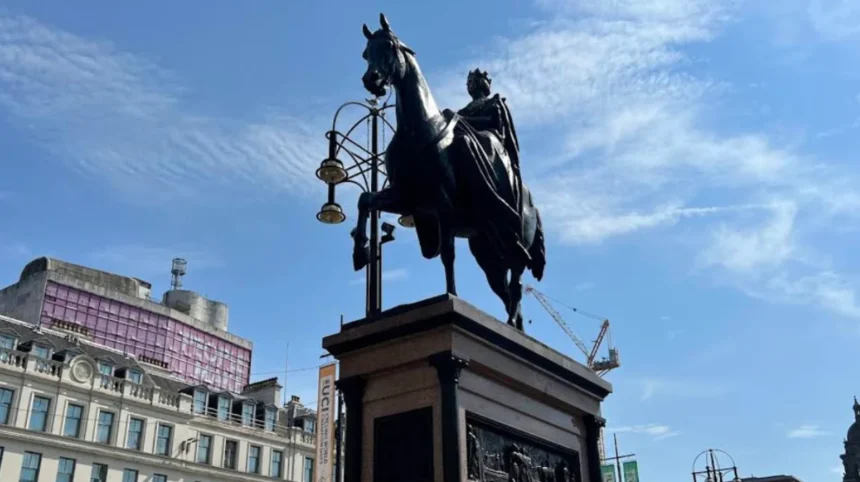
- Statue Reinstatement in George Square: A 160-year-old bronze statue of Prince Albert has been re-erected in George Square as part of an ongoing £20 million redevelopment project in Glasgow.
- Council Support for Renovation: Glasgow City Council Leader Susan Aitken described the restoration as an unprecedented event, highlighting that the restored monuments justify the disruption and delays experienced during the project.
- Disparity in Disaster Recovery Funds: A political dispute has emerged over the Scottish Government’s distribution of recovery funds following major fires in both cities. Glasgow received £10 million for the Union Street fire in March, alongside government underwriting for site clearance, whereas Edinburgh received £5 million for the Princes Street fire.
- Accusations of Political Favoritism: City of Edinburgh Council Leader Jane Meagher expressed disappointment over the disparity, suggesting that Glasgow is held in higher esteem by Holyrood and questioning whether the allocation was politically motivated due to SNP electoral support in Glasgow.
- Government Justification: Deputy First Minister Jenny Gilruth defended the funding allocation, explaining that the £10 million allocated to Glasgow was due to local businesses being forced to close, whereas Edinburgh businesses were not subject to mandatory closures.
- Calls for Greater Local Autonomy: The funding debate has renewed calls from local authorities for increased fiscal devolution and independent powers to prevent reliance on Scottish Government emergency allocations.
Glasgow (Glasgow Express) August 8, 2026 – The reinstatement of historical monuments in Glasgow’s George Square has coincided with a growing political dispute between Scotland’s two largest cities over the allocation of Scottish Government emergency funding. As reported by Mark Smith of The Herald, Glasgow City Council Leader Susan Aitken joined project team members in George Square to oversee the return of a renovated 160-year-old bronze statue of Prince Albert to its granite plinth. The event marks a key milestone in the broader £20 million transformation of the civic space, following the removal and restoration of several historic statues that were taken off-site last year.
- What Has Caused the Political Dispute Between Edinburgh and Glasgow Council Leaders?
- How Has the Scottish Government Responded to Accusations of Regional Bias?
- What is the Background to the Funding Allocation Controversy?
- How Will This Funding Disparity and Ongoing Policy Debate Affect Local Councils and Taxpayers?
As reported by Mark Smith of The Herald, Susan Aitken stated that “no one alive has seen anything like this,” emphasizing that the pristine condition of the restored statues demonstrates the long-term benefit of the multi-million-pound investment despite the delays and disruption caused by the construction works.
However, the positive milestone in Glasgow stands in contrast to an escalating disagreement over emergency financial support granted following recent fire disasters in Glasgow and Edinburgh. As reported by Mark Smith of The Herald, Susan Aitken previously addressed the public following a devastating fire on Glasgow’s Union Street in March, declaring that
“this is not a good morning for Glasgow”
and noting that
“this has to be a national effort.”
Following the incident, the Scottish Government pledged to underwrite the costs of site clearance and established a £10 million relief fund to assist affected businesses.
What Has Caused the Political Dispute Between Edinburgh and Glasgow Council Leaders?
The allocation of emergency funding by Holyrood has drawn criticism from civic leaders in Edinburgh, who point to a significant gap in the financial assistance provided to each city. Following a separate major fire on Princes Street in Edinburgh, the Scottish Government allocated £5 million to support local recovery efforts.
As reported by Mark Smith of The Herald, City of Edinburgh Council Leader Jane Meagher stated that while she was grateful for the financial support received by her city, she felt disappointed that Glasgow
“seems to be more highly valued, in a sense, than we are.”
Jane Meagher further remarked that it was
“a disappointing signifier of the esteem, or the importance, that Glasgow has over Edinburgh,”
adding that it was “hard not to think that it might be political,” specifically pointing toward the geographic concentration of electoral support for the Scottish National Party (SNP).
As reported by Mark Smith of The Herald, electoral data indicates that while the SNP’s vote share in Glasgow has declined from the 53% recorded during the 2014 independence referendum, the party retained 41% of the vote in the most recent election, remaining the largest political force in the city. This distribution has fueled ongoing claims from political opposition regarding regional funding priorities.
How Has the Scottish Government Responded to Accusations of Regional Bias?
Ministers within the Scottish Government have rejected assertions that political bias influenced the distribution of disaster relief funds between the two cities.
As reported by Mark Smith of The Herald, Deputy First Minister Jenny Gilruth explained that the decision to grant £10 million to Glasgow compared to £5 million for Edinburgh was based strictly on the operational impact of the respective fires.
Jenny Gilruth noted that businesses adjacent to the Union Street fire in Glasgow were subjected to mandatory closures, whereas commercial properties near the Princes Street fire in Edinburgh were able to remain open or resume trade without forced shut-downs.
Former Minister for Local Government Shona Robison had similarly noted that emergency funding was calculated according to the direct economic impact assessed as soon as the damage became clear.
Despite these assurances, debate continues regarding whether central government intervention mechanisms create perceived inequities between local authorities during unexpected crises.
Explore More Local Glasgow News
Popular Glasgow West End Brunch Café Put Up for Sale Glasgow West End 2026
Mitie Begins Windyhill Battery Site Construction in Bearsden 2026
What is the Background to the Funding Allocation Controversy?
The debate over emergency fire funding forms part of a longer-standing structural tension between Scottish local authorities and central government at Holyrood regarding municipal finance and autonomy.
Over recent years, both Glasgow City Council and the City of Edinburgh Council have frequently raised concerns regarding budget constraints and the reliance on ring-fenced central funding allocations.
In response to municipal budget pressures, local authority leaders have consistently advocated for greater fiscal powers, arguing that councils require independent financial mechanisms to manage major infrastructure initiatives and local emergencies without relying on ad-hoc central government grants.
Susan Aitken has previously advocated for expanded municipal authority, asserting that local governments are best positioned to tailor financial decisions to their specific geographical and economic requirements.
In their recent manifesto commitments, major political parties, including the SNP, pledged to explore legislative steps toward establishing new urban development structures, such as an Urban Development Company for Glasgow, intended to serve as a strategic driver of regional economic growth.
However, until structural reforms to local government finance are formally enacted, local authorities remain dependent on discretionary Holyrood funding allocations during major emergencies.
How Will This Funding Disparity and Ongoing Policy Debate Affect Local Councils and Taxpayers?
The outcome of this funding dispute and the ongoing debate surrounding central grant distribution are likely to have direct implications for municipal governance, local business recovery, and public perceptions of regional fairness across Scotland.
For local businesses and commercial tenants affected by major urban incidents, the size and speed of government grant support dictate how quickly properties can be cleared, repaired, and reopened.
The £10 million allocation to Glasgow and the £5 million fund for Edinburgh will directly determine the level of financial compensation and operational assistance available to property owners and independent traders attempting to recover from severe trade disruptions.
For local taxpayers and municipal councils, the friction between Holyrood and local authorities underscores potential risks in emergency planning.
If future relief allocations are perceived as inconsistent or subject to political dispute, local councils may face increased pressure to build larger independent contingency reserves within their own municipal budgets. This could lead to tighter local spending constraints or shifts in how local council tax revenue is prioritized to cushion against future unbudgeted disasters.
Furthermore, the heightened scrutiny over emergency relief distribution may accelerate demands from Scottish local authorities for formalized, objective criteria governing disaster response funds, ensuring that future financial assistance is calculated through standardized economic impact models rather than discretionary ministerial decisions.