

Key Points
- Suspect Named: A warrant has been issued for the arrest of a man accused of threatening police officers with weapons and boiling water at his home in Summerston, Glasgow.
- Alleged Escalation: The suspect allegedly armed himself with weapons and threatened to douse officers with boiling water when police attended the property.
- Court Action: The matter was brought before the Glasgow Sheriff Court, where a warrant was formally granted after the accused failed to appear or respond to charges.
- Charges Faced: The charges involve culpably and recklessly threatening violence with hazardous liquids and brandishing weapons at law enforcement personnel.
- Current Status: Law enforcement authorities are actively seeking the individual to execute the court warrant.
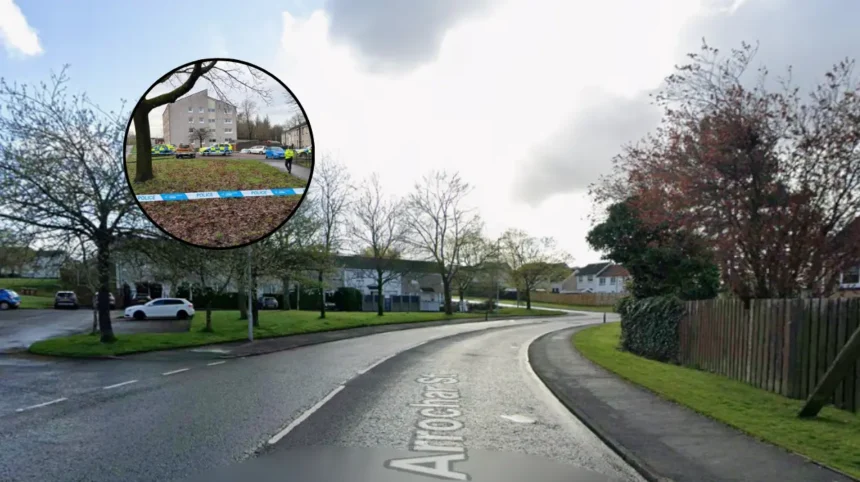
Glasgow (Glasgow Express) August 1, 2026 – A warrant for arrest has been granted by Glasgow Sheriff Court for a man who allegedly threatened to pour boiling water over police officers and brandished weapons at his home in the Summerston area of North Glasgow.
- Key Points
- What Happened During the Summerston Police Incident?
- Why Was an Arrest Warrant Issued at Glasgow Sheriff Court?
- How Are Threats of Scalding Water Treated Under Scottish Criminal Law?
- Background of the Particular Development
- Prediction: How This Development Can Affect Local Residents and Emergency Personnel
As reported by court journalists at Glasgow Sheriff Court, the incident unfolded when police officers attended the residential property in Summerston to deal with an ongoing disturbance.
Upon their arrival, the male suspect allegedly refused to comply with police instructions and proceeded to barricade or fortify his position within the flat.
According to official court details provided during the proceedings, the situation escalated rapidly when the occupant allegedly armed himself with weapons and threatened to throw boiling water directly onto the responding officers if they attempted to enter the residence or detain him.
The threat of using scalding water as a improvised weapon presents severe risks of significant bodily harm, including severe second- and third-degree burn injuries.
In response to the high-risk environment created inside the Summerston property, officers managed the standoff while ensuring public safety in the surrounding residential block.
Following the initial disturbance, formal charges were lodged at Glasgow Sheriff Court detailing the alleged possession of weapons and the specific threat of physical violence using boiling liquids against police officers acting in the line of duty.
However, after the accused failed to comply with court proceedings, a sheriff granted an outstanding arrest warrant.
Local law enforcement officers are now executing measures to locate and apprehend the individual so he can face formal prosecution.
What Happened During the Summerston Police Incident?
The incident occurred at a residential flat within the Summerston neighborhood of North Glasgow. Police officers were dispatched to the address following reports requiring official intervention.
Upon entering the common area or reaching the doorway of the flat, officers were met with immediate hostility.
Reports presented to the court indicate that the occupant threatened to douse officers with boiling water—a practice often treated by Scottish courts as a serious assault or culpable and reckless conduct due to the permanent disfigurement scalding water can cause.
Alongside the threats involving hot liquids, the suspect allegedly brandished unspecified weapons to intimidate the attending police personnel, preventing them from carrying out their duties safely.
Why Was an Arrest Warrant Issued at Glasgow Sheriff Court?
An arrest warrant is a formal judicial order issued when an accused individual fails to appear for a scheduled court hearing, breaks bail conditions, or when immediate custody is deemed necessary by the judiciary following non-compliance.
During the proceedings at Glasgow Sheriff Court, prosecutors presented the charges against the Summerston resident. Due to the suspect’s absence or failure to adhere to the legal process, the presiding Sheriff signed off on the warrant.
This authorises Police Scotland to actively trace, arrest, and remand the suspect in custody until he can be formally brought before the bench.
How Are Threats of Scalding Water Treated Under Scottish Criminal Law?
Under Scots Law, threatening or attempting to use scalding liquids against any person—and particularly against emergency service workers—is treated as a grave criminal offence.
Emergency services personnel are protected under specific legislation, including the Emergency Workers (Scotland) Act 2005, which makes it a specific offence to assault, obstruct, or hinder emergency workers acting in a capacity as such.
Using or threatening to use boiling water as a weapon elevates the severity of an offence, moving it from breach of the peace or minor breach of conduct to serious assault or culpable and reckless conduct endangering life.
Background of the Particular Development
The Summerston area, located in the north of Glasgow, consists largely of residential housing estates developed primarily from the 1970s onwards.
Like many suburban residential hubs, community safety depends heavily on localized police responses to domestic and residential callouts.
In recent years, Police Scotland and representative bodies such as the Scottish Police Federation have highlighted a rising trend in violent threats and assaults directed at frontline officers during domestic callouts.
Threats involving hazardous household items—such as hot liquids, kitchen knives, and improvised weapons—present distinct tactical challenges for officers who often enter enclosed residential spaces without advanced protective gear.
This specific case at Glasgow Sheriff Court reflects the broader procedural timeline followed in the Scottish summary justice system:
initial response by frontline officers, submission of a standard prosecution report to the Crown Office and Procurators Fiscal Service (COPFS), initial court appearances, and the issuance of apprehension warrants when an accused individual fails to engage with the judicial process.
Explore More Glasgow Police News
Police Appeal After Glasgow Pedestrian Hit by Car; Scarrel Drive, 2026
Police Raid Glasgow Businesses Over Immigration Crime – Glasgow 2026
Prediction: How This Development Can Affect Local Residents and Emergency Personnel
This legal development and the ongoing search for the suspect have several direct implications for both the local Summerston community and wider emergency service operations:
- For the Summerston Community: Local residents in North Glasgow can expect a heightened police presence as officers execute search enquiries to serve the arrest warrant. Neighborhood safety measures may temporarily increase, and residents living within the immediate vicinity of the flat may notice increased patrols until the individual is safely in custody.
- For Police Scotland Officers: The case serves as a stark reminder of the unpredictable operational hazards frontline officers face during routine residential callouts. It reinforces the necessity for continuous tactical training regarding high-risk entries and weapon containment, specifically when dealing with non-conventional hazards like boiling liquids.
- For the Judicial Process: Once the warrant is executed, the suspect will be held in police custody prior to appearing directly before Glasgow Sheriff Court. Given that a warrant was required due to non-appearance or the nature of the alleged violence, prosecutors are more likely to oppose bail to ensure public safety and guarantee attendance at future trial dates.